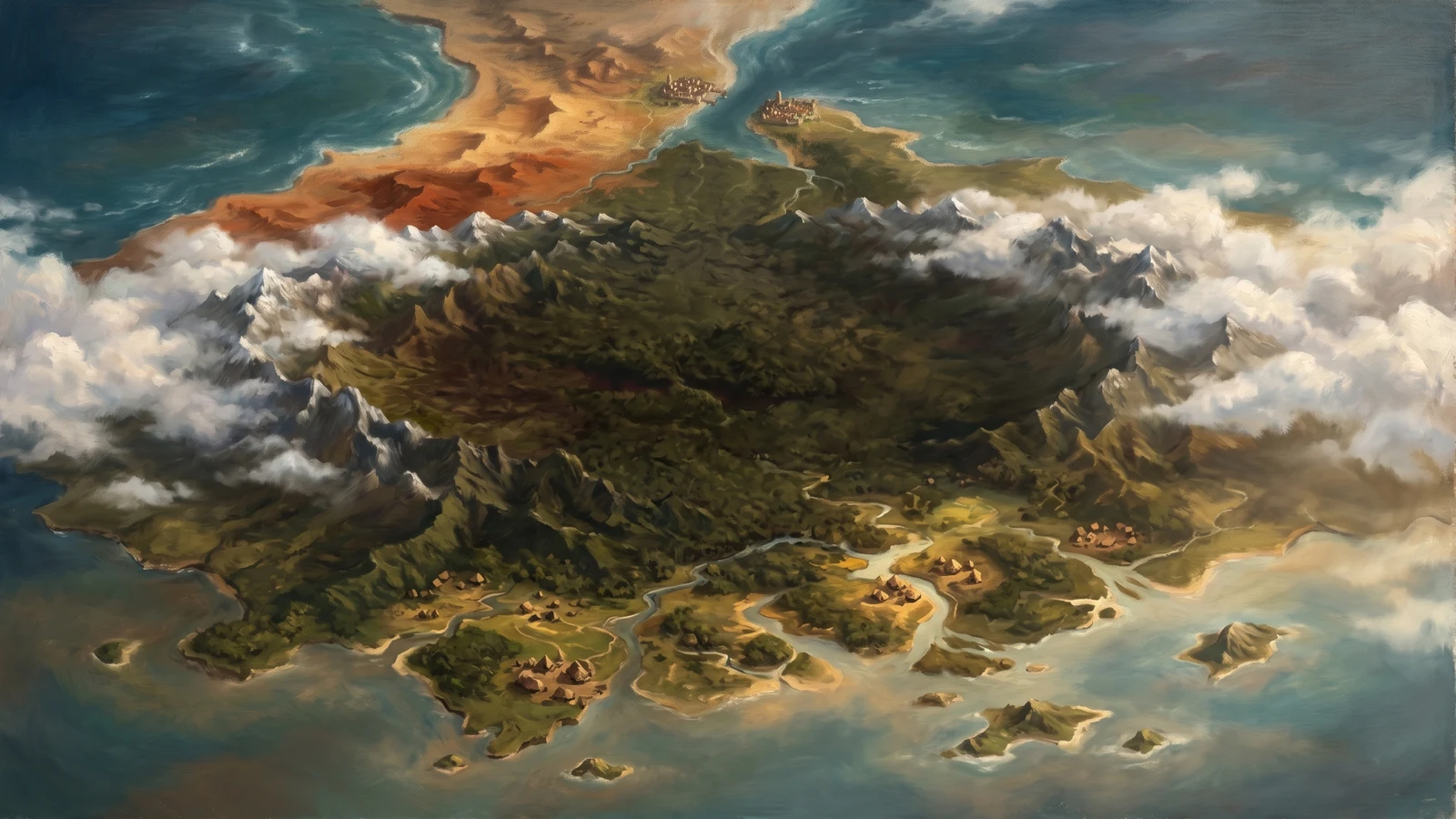
Rimihuica is the middle continent of Alaria, one of the three that sit close enough together that the seas between them read as crossings rather than barriers. Its character is vertical. Walk its length from top to bottom and the land changes under you completely: desert badlands in the north, then a waist of lethal jungle and cloud-wrapped mountains, then the lawless Shacklands at its southern foot, where slave markets and pirate captains answer to no crown. The only sea route between the western oceans and Clueanda's Middle Sea pinches shut at the continent's northern tip, and the Tarkhon Empire holds that strait and taxes everything through it. To the southwest the Agreben Sea opens toward the Greenwater Isles and Upoceax beyond. To the south the South Sea separates Rimihuica from Aboyinzu.
Geography
Read Rimihuica north to south and it falls into four zones, each fenced off from the next by mountains.
The top of the continent is the strait. Here the land narrows to a thin temperate neck that the Tarkhon Empire shares with Clueanda across the water, and the Eronia Range walls this imperial north off from everything below it. Two centuries ago a commander remembered as Klor the Blood Lord emptied the range of its inhabitants by force. The dwarven city-states that survive in its high valleys now keep to themselves.
South of the Eronia opens Westrim, the dry quarter. Its center is the Dunes of Kunagi, a kidney-shaped desert wide enough to swallow a kingdom, and its only dependable water, Benshu's Promise, sits behind a sphinx and a riddle. The Ishnit Jungles ring the desert's southern rim and count among the deadliest country on Alaria. The Morsuye, Pino, and Royon rivers thread the region's wetter margins.
The interior is the Innerrim, a single enormous jungle basin the locals call the Godahi, lowland forest ringed on every side by high ground. The Cloud Mountains close it to the south. The Seawatch and Tambrielle ranges wall its eastern edge against the coast, and the Myjornis Mountains rise in the southwest. This is the green heart of the continent, dark and dense, and most of it has never been mapped.
The bottom of Rimihuica is the eastern seaboard and the southern interior below the Cloud Mountains. The Emerald Coast runs the basin's eastern flank, its Vortek River draining toward the Gulf of Tears. Past the southern mountains lie the Shacklands, broken across the mainland and the offshore islands of the Sea of Selegos, where the Myublin River marks the edge of a jungle nobody holds.
Major regions
The Tarkhon Empire occupies the strait at the continent's northern tip and straddles both Rimihuica and Clueanda. Founded by the Neferati roughly six centuries ago, it exists to control the one sea lane between the western oceans and the Middle Sea, and it taxes every hull that passes. Its capital, Tarkhetan, sits on the headland called the Needle, and three leylines run beneath its territory. Detail belongs to the empire's own entry.
Westrim is the arid northwest, dominated by the Dunes of Kunagi and the Ishnit Jungles that ring them. It has no single ruler. Scorpion-riders, merchant-kings, a four-city confederation, and an ancient dragon-bonded monarchy divide the desert and its margins between them. The member entry carries the particulars.
Innerrim is the jungle basin at the continent's heart, divided among competing states that contest the Godahi floor. Its defining feature is buried in its center: Old Tolaria, a fallen mage-civilization whose capital Elderran is locked inside a temporal catastrophe that has never quite finished. See the Innerrim entry for the basin's powers and for Elderran itself.
The Emerald Coast is the stateless jungle coastline along Innerrim's eastern seaboard, running south from Ofrenia toward the Phirexes peninsula. It is governed by no overarching authority, only scattered harbor settlements and a slow disaster building beneath its waters. It belongs administratively to the Innerrim basin rather than standing as a region in its own right.
The Shacklands are the southern territories, and they are defined by an economy instead of a border. A polity belongs to the Shacklands because it trades in slaves. The military republic of Gorath anchors the arrangement; the Drasnian dwarves are its chief commodity. The member entry lays out the trade and the resistance to it.
Peoples and powers
Everything about the north turns on one fact: the Tarkhon Empire holds the only sea route between the western oceans and the Middle Sea, and it has spent six hundred years making sure no one finds a second. The empire is bound by profit rather than loyalty. Each subject state stays in because the toll revenue outweighs the cost of independence, and that arithmetic is the only thing holding the structure together. This makes the empire wealthy and badly frightened. A canal, a mountain pass, a working portal, any route that let trade skip the strait would unmake it overnight, so Tarkhon treats every rumor of an alternative as a threat to be killed early. The Fire leyline under Nektuna and Tarkhetan gives it firemages. The Time leyline at Besnoumeru lets its merchants read a market before the news of it arrives. Its oldest problem is a person: King Ulyas of Kerwin has outlived every emperor for five centuries, remembers the bargains the current dynasty would rather bury, and has cooperated this whole time only because cooperation has suited him.
Cargo, origin, duty owed. If your name's not in the book, you didn't sail the strait, and if you didn't sail the strait, where did the salt come from? Pay the column or turn the ship around. — a toll-clerk's standing reply, Tarkhetan customs house
Westrim is held by no one and contested by everyone. The Husakas ride scorpions across the Dunes of Kunagi under a curse that eats their memory; the Naruaghin live in the Ishnit Jungles that ring the sand. On the coast the merchant-kings of Mueras run an oligarchy from a broken shoreline, and they have never settled the matter of Kaspion, their old capital, which a dying king cursed a hundred and eighteen years ago and which no one has dared reoccupy since. Inland, the four city-states of Atriik wrap constant maneuvering in elaborate courtesy. Their people are the Kor and the Sharabha, and the Sharabha carry the Lion lineage of Shara Bolasi. South of Atriik the old Dwelyn monarchy of Enapay keeps its throne bonded to the emerald dragon Surrey Mahaila, one of the three sacred dragon lines.
The Innerrim basin is split among jungle states fighting over its floor. In the west the wolf-people called the Ulvsjael hold Qet Yemani, and with them Rimihuica completes its set of all three sacred bloodlines: Wolf here, Lion in Westrim, Dragon in Enapay. The Ix'Tyrann lizardfolk hold Da Trang in the north. The colonial state of New Chimea, the overseas arm of the halfling empire of Chimea on the far continent of Ve, has pushed east over the mountain divide onto the coast, where it is the strongest naval power on the water. Beneath all of them lies the basin's deepest wound. Old Tolaria undid itself in a single instant, and its capital Elderran is still inside that instant: an Apparatus running with no one to switch it off, a dragon frozen halfway through being unmade above the central spire, a stretch of forest that erupted into the Faewoods the moment the machine woke. The Apparatus has never stopped, which makes the catastrophe ongoing rather than finished.
The Emerald Coast looks empty and is not. No state governs the harbor towns strung along it, New Chimea dominates the shipping lanes offshore, and at the southeastern end a gorgon queen rules the town of Phirexes by keeping its Dengar population addicted to a fog. The real story is underground. The Crystal Caverns beneath the Chimeyan coastal waters sit where the Force and Earth leylines cross, and centuries of crystal mining have loosened something down there. Earthquakes are up by nearly half over the past hundred years and the coastline is sinking. The Kendor have started sabotaging the extraction works because no one in Chimea will hear the warning, and if the caverns finish collapsing, the shock will travel the whole Golus leyline network and reach far beyond this coast.
The Shacklands are the continent's grimmest ground, and the cruelty is structural rather than the work of any single villain. Gorath is a six-hundred-mile jungle military republic that has expanded for three centuries and elects its emperors from among its own generals, so the appetite for conquest is built into the office. It works its slaves on the Slaver's Coast of Pesalolo, an island across the Sea of Selegos, and its principal commodity is Drasnian dwarves, who have been held in bondage for three hundred years. The legions are paid and the slaves are sold in the southern coin, weighed silver rather than minted money, and the wars themselves run on advances the Azantir banking house of Belmonte writes against conquests not yet made. The Drasnians have never stopped resisting. Their way out is the Moon Wilds on Gorath's western edge, a jungle the empire has never been able to hold because the Vexlings live in it, spider-goblin things with a hypnotic gaze and corrosive silver blood that have lately begun moving with something like a plan. The Vexlings do not chase runaways, and Gorath will not follow anyone into their territory, so the deadliest ground on the continent doubles as the only reliable road off it. Two pressures sit on the whole system. Emperor Veramus is sixty-three with no clean line of succession, which means a contested election is coming. Beyond the region, the Trømgar dwarves have never accepted what was done to their Drasnian kin, and they are watching for the opening.
The Wilds will eat you. Gorath only owns you. Walk toward the thing that hasn't decided yet. — a saying among Drasnian runaways