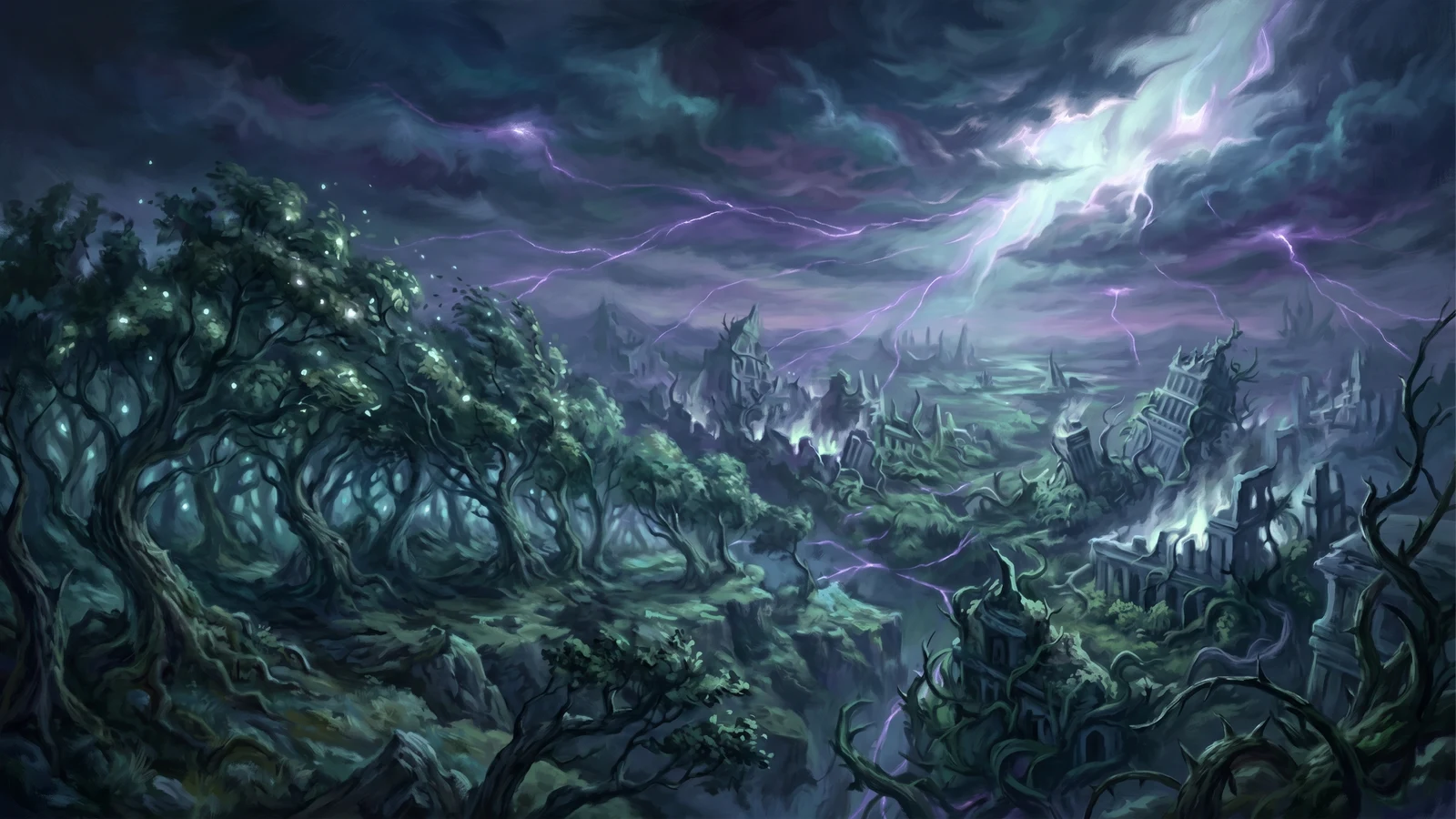
Old Tolaria was the magical heart of Alaria, an empire whose people studied every tradition that existed and whose capital, Elderran, held the deepest practitioners of all of them. It is a haunted wilderness now. The Faesong bleeds through the land unchecked, the dead empire's leylines still pulse beneath ground that no longer keeps a fixed shape, and almost nothing here is what it appears to be. The whole of it came apart in a single catastrophe, and the centuries since have not begun to heal it.
The catastrophe had a cause, and it was no accident of fate. The Tolarian mage-kings built the Apparatus of Severance beneath Elderran, a machine meant to pull the world's tangled magics apart into pure, separately governable forms. When they switched it on, it half succeeded, which proved worse than failing outright. What it did to the capital is told in Elderran's own account. What concerns the region is what spilled past the capital's walls and never stopped.
Four failures shaped the land that remains. The elemental planes, partly severed from the world, left rifts where fire burns without fuel and water runs uphill. Divine channels crossed and tangled, so that clerics within a long ride of Elderran find their prayers answered by something almost, but not quite, their god. Time fractured, and pockets of the region now keep their own hour. And the Faesong, which the Apparatus had tried to compress and lock away, tore loose instead.
That last failure is the one a traveler feels first. The Faesong is Melera's music, the emotion woven through all of Ezz, and under Tolarian magic it had always run as a half-heard undertone. Caging it turned the undertone into something near a voice. Where it pools thickest the effects are plain enough to touch: trees wake and think, animals take on a cunning they were never meant to carry, and fae step out of the resonance as though they had been standing there the whole time.
The Glass Forest
The western edge of the region, where the first wave of loosed Faesong washed over living forest, is the Glass Forest. It is the most accessible part of Old Tolaria and the part most travelers ever see: trees that gleam wrong and glow at night with trapped starlight, fae thick in the depths, and the oldest trees awake enough to pull up their roots and walk. The Eloweir of Eloesi keep watch stations along its near edge for whatever comes out, usually a confused fae or an awakened animal and occasionally far worse. The forest carries its own account. What matters at the regional scale is that it is the one door into Old Tolaria a careful person can use and come back from.
The interior ruins
Past the Glass Forest, the ruins of Old Tolaria proper spread across a landscape that no longer obeys ordinary geography. Cities stand where no city should. Some are intact and empty. Some are half-swallowed by growth that appears nowhere else. Some are frozen in the instant of their destruction, eternally burning or collapsing or coming apart.
No reliable map of the interior exists, because the land shifts. Not constantly. A path can hold for years. But no one can say when a road that ran east yesterday will run somewhere else tomorrow, and expeditions that go in with careful surveys come back, if they come back, with charts that contradict one another.
The magic here is not only Faesong. It is everything the Apparatus broke. The leylines that once fed Tolarian spellwork still pulse, but they run corrupted and wild and pay no attention to whoever stands over them. Elemental rifts discharge without warning. In some stretches time runs slow or fast or sideways. The Psywinds carry thoughts through the ruins that were never human and never will be.
The Tolarian vaults
Before the fall, Elderran and the cities around it held the center of magical learning in Alaria. Every tradition was kept and taught here, Kethic elementalism and Deoric binding and the harmonics of the Faesong itself. The greatest libraries and the most dangerous artifacts were gathered into Tolarian vaults.
Those vaults are still down there, somewhere under the shifting ground. Treasure hunters and scholars have hunted them for centuries. A handful have come out with fragments: a spellbook, an enchanted relic, the record of a ritual no one should attempt twice. Most come out with nothing, or do not come out, or come out changed.
As for the mage-kings and their people, the ones they were are gone. Travelers in the interior occasionally meet things that speak of the old empire with the ease of memory. Some of these are genuinely the wizards themselves, remade past recognition by the catastrophe and still carrying scraps of who they were. Others are fae wearing borrowed recollection, picked clean from the dead. Both kinds exist, and guessing wrong about which one you are talking to has killed people.
The approach to Elderran
Everything in Old Tolaria worsens toward its center, because the center is Elderran, where the Apparatus of Severance still runs. The machine was built to sustain itself, and it has never stopped. Century by century it goes on completing the severance it began, and the closer a traveler comes to the capital the less the ordinary rules hold. Gravity loses track of down. Objects remember being other things and slip between shapes. Thought begins to print itself on the world. Time thickens until a single step costs an hour, and Melera's music, only a voice elsewhere in the region, rises here toward something like her actual song. What waits at the heart of it belongs to Elderran's account, not this one. The few who reach the Apparatus and return do not return whole, and no two of them agree on what they saw.
What lives here now
The fae of Old Tolaria cannot be counted. Creatures of every kind have come out of the loosed Faesong: sprites, dryads, things with no name in any tongue. Some match the old folklore. Others are wholly new, born from the particular mix of energies that made this place.
The awakened trees are their own kind. They run from barely aware, responding to a presence without truly thinking, to fully sapient, able to hold a conversation and a grudge. The oldest have been awake since the catastrophe and keep their own purposes.
Other things live here that are neither fae nor awakened, only changed. Animals that ate magic-soaked forage and became something else. Plants that learned to hunt. Stones that watch. And through the elemental rifts come things that belong to other planes entirely, drawn to the broken places the way moths come to a lamp. Those who meet them describe them in contradictory ways, because the rifts do not open onto any single elsewhere.
The leak and the cordon
The dead zone does not spread. That is the one mercy of Old Tolaria, and the people who live around it have learned to trust it. The border the catastrophe drew has held roughly where it fell, and a farmer in the Innerrim lowlands can work land within sight of the Glass Forest's glow and expect to die of old age. What the border does not do is hold things in. The region leaks, it has always leaked, and it leaks at a rate that never lets the surrounding states forget it is there.
What comes out is everything that lives inside, scattered and at large. Animals warped by the time-pockets wander out aged wrong: a wolf with a gray muzzle on a yearling's body, a hind whose antlers carry more winters than the rest of her. Things from the elemental rifts follow the broken ground outward, salamander-bright and burning no fuel, until they reach a village well and cool it to slag. Faesong-touched creatures drift with the resonance, including the worst kind, an awakened thing wearing the borrowed manners of a scholar it ate, a courtesy that knocks before it kills. And loose objects work their way to the surface and get carried off: a Tolarian focus-stone, a ledger that writes in itself, a small clock that runs backward and takes the room with it.
To catch all this the Innerrim states maintain a cordon. It is a thin line of watch-forts and paid trackers strung along the region's habitable margin, thickest at the western edge where the Glass Forest funnels most of what escapes. The cordon is not a wall and was never built to be one. Its work is to meet what comes out before it reaches a town, name it, and decide what to do with it. The deciding is where the trouble lives.
Three answers pull against each other and none has won. The states that pay for the cordon are the border holds, who bear the cost while the interior reaps the safety and contributes little, and they increasingly want a kill-line: destroy whatever crosses, burn the relics rather than catalogue them, and have done with the fiction that the place can be studied at all. The scholars want the opposite. They argue for a controlled intake, every creature and artifact logged and held, on the grounds that the only thing worse than Tolarian magic loose in the world is Tolarian magic no one has bothered to understand. The smugglers want the gaps kept open, because a captured rift-beast or an intact focus-stone is worth a working lifetime's wages to the right buyer, and the right buyer always exists.
Everything that comes out of Tolaria is one of three things. It is hungry, or it is valuable, or it is pretending to be a man. The fourth kind we do not talk about, because the fourth kind we never caught. — attributed to a watch-captain of the western cordon
The fourth kind has a name. Not everything that left Old Tolaria was a beast or a trinket. Vesimar, called the Unsevered, was one of the Tolarian mage-kings, a master of the Apparatus of Severance who walked out of Elderran before the machine was thrown and so was never caught in the severance that took the rest of his dynasty. He is still abroad centuries later, carrying stolen time in his own threads, still chasing the purified magic the Apparatus was built to make. The cordon was raised to stop loose creatures and looted relics. It has never once stopped a mage-king, because the first one was already gone before anyone thought to build it.
Approaching Old Tolaria
The borders are half-open. The Glass Forest can be entered, carefully, and people do: herbalists after rare plants, scholars after fragments of the lost kingdom. The trick is knowing the hour to leave and having the will to actually go.
The interior is another matter. Every generation throws up adventurers certain they can navigate the chaos, recover the vaults, perhaps even shut the Apparatus down. They go in prepared, armed, warded against every danger they thought to name.
Most do not come back. The ones who do are often changed, sometimes plainly and sometimes in ways that only surface later, and their accounts never quite line up even when they walked in side by side.
Old Tolaria is not a finished disaster. The Apparatus is still running, and the country is still coming apart by degrees.