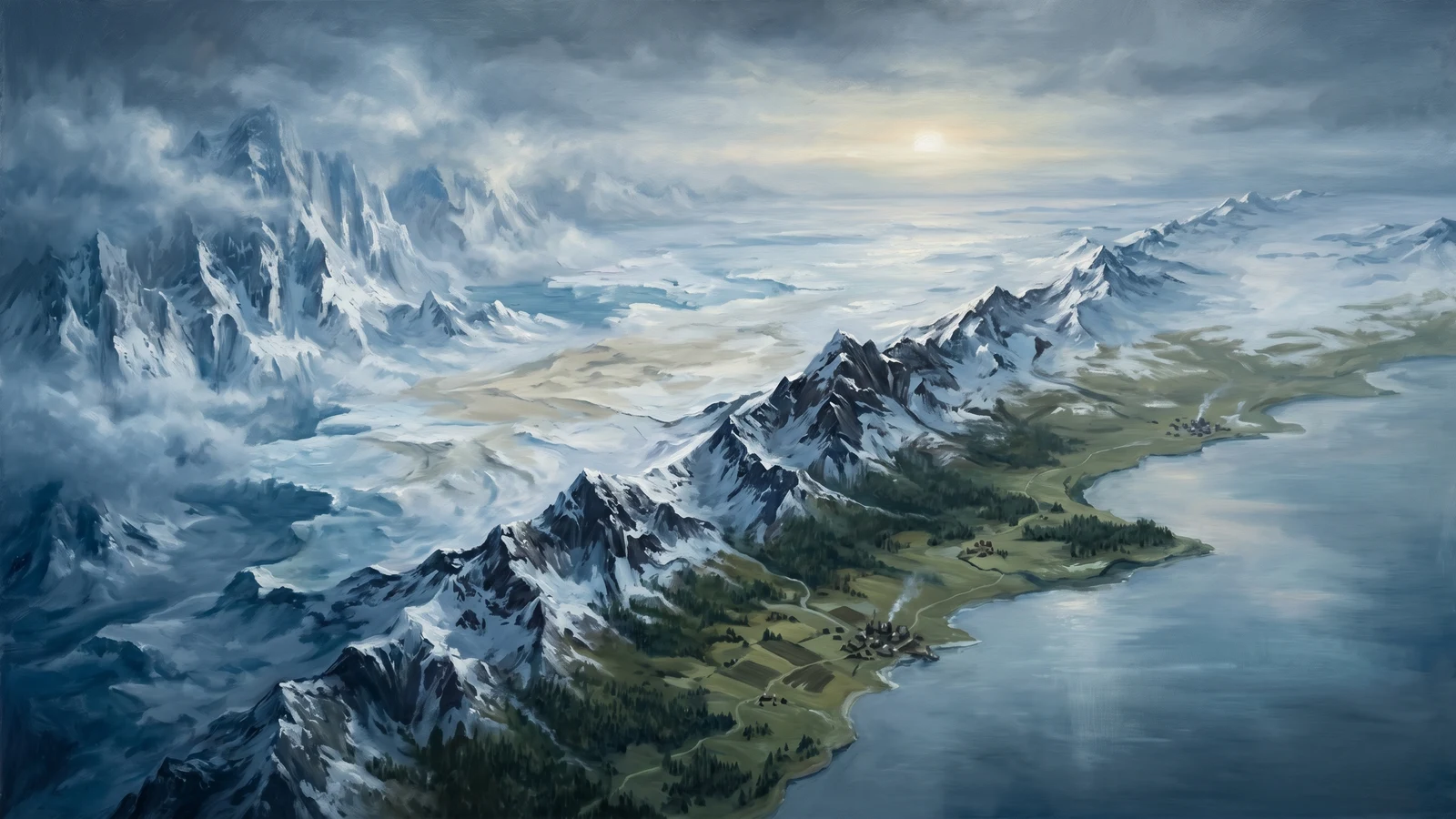
Clueanda is the frozen crown of northwestern Alaria, a great landmass that sits too far from the sun's warm band to be counted among the central continents. Two mountain systems give it its shape. The Nysanna Range walls off the western pole, the tallest peaks in the world and never free of blizzard. The Kharvorn Mountains run a long diagonal down the continent's spine, and that diagonal is a climate line: perpetual winter to its north, a temperate farming belt to its south. The warm belt drains into the Middle Sea, an inland trade water ringed by city-states, and a ship reaches that sea from the western oceans only through the Tarkhon Strait, which the Tarkhon Empire holds and taxes. East of all this the land thins into the Frostmarch Peninsula and breaks apart into the Northern Isles, scattered across the Ocean of Azeros.
Geography
The logic of Clueanda is latitude, and latitude here does not mean what it means elsewhere. Bryn, the sun, goes where congregations sing it, and no coalition has held its warm trail this far north for any length of time. So the cold is not weather. It is the standing condition of the upper continent, and everything people do here is arranged around the one band where the sun's path still reaches.
Three zones stack from the pole down. The northern zone is true arctic: the Nysanna Range along the western polar edge, the tundra of the Northlands below it, and the wind-scoured steppe of the Celedrim Plains to the east. Glacial melt off the Nysanna feeds what few rivers run unfrozen, the Beathamuir chief among them. The middle zone is the Kharvorn Mountains, a diagonal wall of sub-ranges running from the center-north down toward the southeast. The Kharvorn is the divide. North of it, nothing ripens. South of it the land falls into the temperate belt that holds nearly everyone who matters to trade: the lowlands of the Middle Sea Lands, the inland Middle Sea itself, and the dry scrub of the Westwilds in the southwestern corner. East of the main body the Frostmarch Peninsula juts into the Ocean of Azeros and shatters into the Northern Isles.
The Middle Sea has one mouth to the open ocean. It is a western narrows past the city of Kazul that opens into the Tarkhon Strait, and the Westwilds coast looks down on that strait's northern approach. Everything that reaches the warm belt by water comes through there, which is why a continent this large is organized, in the end, around a single gap.
Major regions
The Northlands are the western half of the polar interior, flat tundra running south from the Nysanna Range. The Nysanna itself is the roof of the world, a polar wall whose higher peaks hold air too thin to breathe and whose valleys are packed with glacier ice that never melts. Two white dragons keep separate territories in the range and have not fought in living memory, an arrangement nobody mistakes for friendship. The ice occasionally gives up what it has held. Somewhere beneath the Nysanna glaciers lies a city that stood under open sun once, in an age when the warm trail ran this far north, and froze in place when the trail moved on, grain still sealed in its storehouses. Below the range the tundra is broken by isolated peaks that are not mountains at all but the fossil skeletons of titanwurms, large enough to read as geography. The Beathamuir cuts the northern plains. The Wydling, a people of ice goblins, hold the high country; the Neth keep the plains below them.
Two great whites sleep up there, and they have agreed not to wake each other. Pray you are not the thing that wakes them. — a Wydling elder
East of the Northlands the Celedrim Plains run as frozen steppe, flatter and emptier than the tundra, scoured by wind off the Ocean of Azeros. Frost-pixies called the Ikriel swarm the open ground in numbers that make a season's travel a gamble. At the plains' northwest corner sits the Dreamplains, a field of old impact craters where the wall between the Material and Celestia has worn thin enough that the dead are visible and the living lose their way among the Hills of the Lost. That thinness is its own phenomenon and has nothing to do with what sleeps under the Nysanna ice. Nomads cross the steppe on the backs of dire wolves.
The Kharvorn Mountains are the continent's backbone and its thermostat. The range is not one ridge but a chain of named sub-ranges marching from the northwest down to the Middle Sea coast, and every pass through it is reputed to belong to the Ikriel. Half-giant dwarves called the Mnurvlyon hold the Grey Mountains near the chain's center, and the Güli giants keep the heights of Ngül above the southern basins. The collapsed fortress of a dead mage still stands in the southern Kharvorn, its stone guardians still walking their rounds. What the range does for everyone south of it is plainer than any of that. It stops the cold, and the land below it can farm.
South of the Kharvorn the ground softens into the Middle Sea Lands, the warm coastal belt that is the civilized core of Clueanda. A dozen trade city-states ring the inner sea, from Adron in the east where the mountains end to Kazul in the west near the Tarkhon border, with Camaran, Ubrik, Ta Minn and the rest strung between them. No crown unites them. Where the lowlands rise into the mountain foothills, giants hold the Breidlheiss Basin, close enough to the trade towns to matter to them.
The Middle Sea is the water all those city-states are built around, a temperate inland sea shaped like an inverted arch. Its northern shore is the Clueandan city arc. Its southern shore belongs to Ofrenia, a large island off Rimihuica divided among three siblings who have warred with one another long enough that the war has become the island's government. East of the sea a permanent fog called the Oblivion hides Nagayeshi, the volcanic island where a dragon line returns to hatch its young. The sea's only way out to the open ocean is that western narrows past Kazul, which feeds the Tarkhon Strait.
The Westwilds occupy the dry southwestern corner, arid scrub caught between the frozen interior and the southern coast, and they look nothing like the rest of the continent. Six orc states divide the open country between them. In the northeast a band of dense forest stands where no forest should, fed by an Earth leyline, and the Twaan who hold it, bitter relatives of the skaag, keep all comers out. The Westwilds coast faces the northern approach to the Tarkhon Strait, and the empire that holds that strait presses on the region's southern border.
The Frostmarch Peninsula reaches east off the Celedrim Plains toward the Northern Isles, and for an arctic latitude it is oddly varied: old forests, open tundra, a stretch of woodland dark enough to be called the Twilight Forest, and in the far south a pocket of true jungle that has no business being warm. Its politics are a patchwork of small states. A minotaur kingdom and an orc confederation on the east coast have fought each other so long that neither remembers beginning it. A dragon sleeps under the Twilight Forest, and a people of quill-elves keep the tunnels beneath it.
The Northern Isles scatter across the Ocean of Azeros off the peninsula's end, a broad wreckage of islands locked in shifting pack ice. The largest, far to the east, is effectively lawless. The real authority over the archipelago is a lich named Bzulakar, who rules from a tower of ice two miles high. Among the lesser islands are frozen canyons where fire leylines burn in the rock and a waste where time has pooled and runs wrong.
Peoples and powers
No single power holds Clueanda, and the cold does much of the governing for everyone. Four pressures are worth a table's attention.
The first is the Tarkhon Strait. Every cargo moving between the western oceans and the Middle Sea pays the Tarkhon Empire for the passage, and the Middle Sea city-states resent the toll without being able to do a thing about it. The strait's northern flank holds only because the Uline dwarves of Vogenfeld garrison the passes against the Westwilds orcs, and those dwarves have gone unpaid. If they walk off the wall, the orc state of Hedroscobb has a clear road south, and the strait would be threatened from the Clueandan side for the first time.
They have raised the strait toll three times since my father sailed it and lowered it not once. You do not argue with Tarkhon. You raise your own prices and pass the cost to the next fool down the line. — a Kazul shipping factor
The second is the Middle Sea itself. The dozen city-states compete and never combine, which keeps the northern shore loose and easy to play against itself. The southern shore is worse off. Ofrenia's three ruling siblings have made the island a standing civil war that spills out into the shipping lanes whenever one of them gains an edge.
The third is the oldest and the largest. The warm belt that feeds everyone south of the Kharvorn exists only because the Solar Accord's congregations hold Bryn's trail where it presently runs. The ruins beneath the northern ice are the proof of what that arrangement is worth. Some coalition once held the trail far enough north to raise cities in what is now permafrost, and when its hold failed those cities froze where they stood. The live question is who holds the trail over Clueanda now, and what becomes of the warm belt if that grip ever slips. A frozen Middle Sea would end the trade the whole south lives on. It would also be a prize worth any risk to someone in the cold north with the will to drag the sun back.
The fourth is the far east, where the Northern Isles answer to no one but Bzulakar. The lich has not moved against the mainland. Nothing holds him still either, and neither the Frostmarch nor the Celedrim has much that could stop him if he chose to come south.