Geography
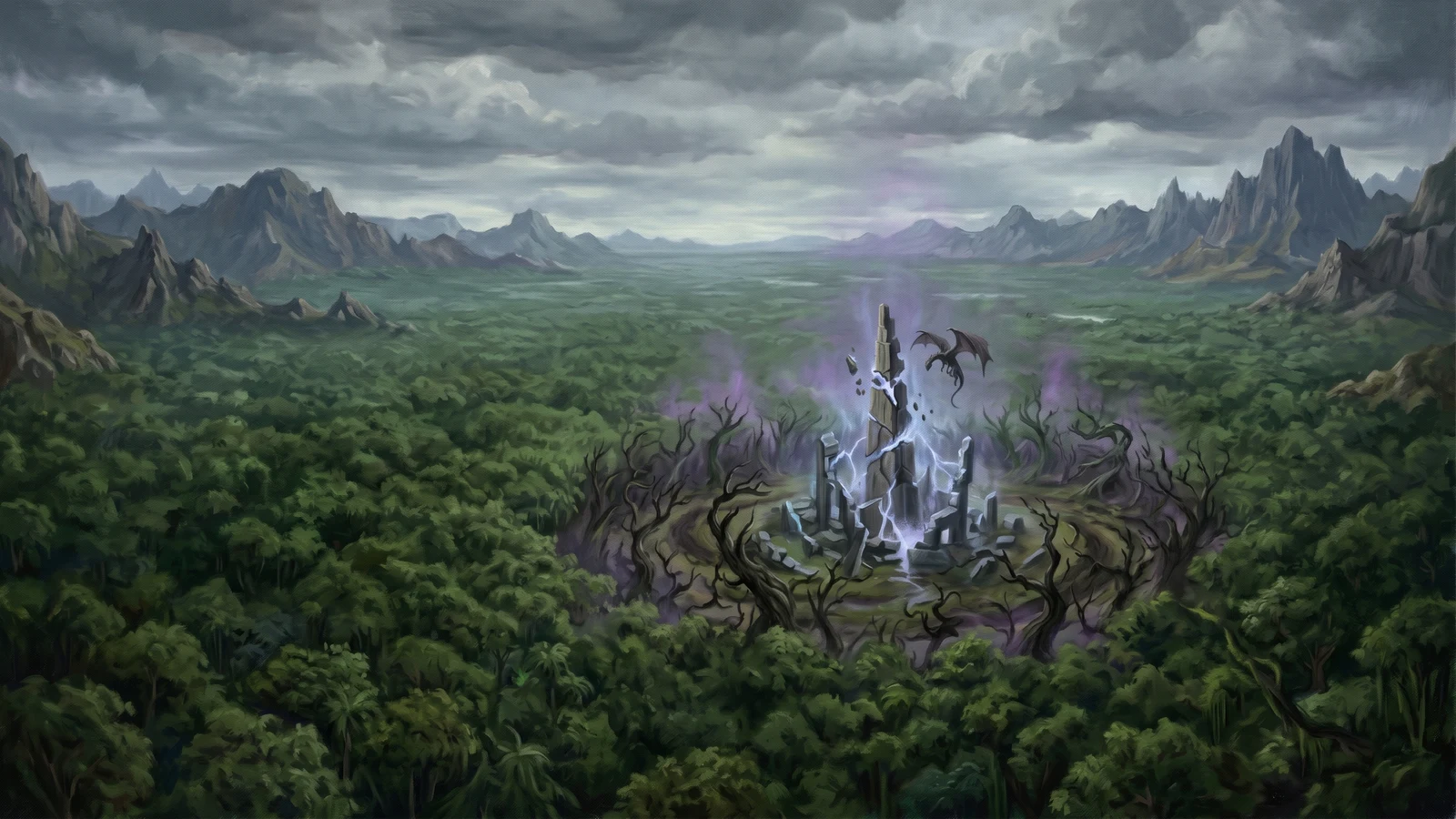
The Innerrim is the vast jungle basin at the heart of Rimihuica—a dark green sea of dense forest filling the continental interior. This is the "Godahi basin," a lowland region surrounded by mountains on multiple sides, where competing states carve out territory amid the endless canopy.
Boundaries and Position
- North: Bordered by the Middle Sea region and Ofrenia; Swampdeep (a saltwater swamp/bayou) lies to the northeast
- East: The Green Mountains, Seawatch Mountains, and Tambrielle Mountains form an east-west barrier separating Innerrim from the Emerald Coast
- South: The Cloud Mountains run from southeast to northwest, separating the basin from the Shacklands (particularly Gorath)
- West: Transitions into Westrim; the Ishnit Jungles and Thunder Plains mark the western and southwestern edges
The Thunder Plains
A significant geographic feature—the open plains that form the gap between the Ishnit Jungles to the west and the main Innerrim jungle mass. South of the Thunder Plains lies the Sea of Selegos.
States of the Innerrim (Clockwise from West)
The basin is divided among several competing powers:
- Qet Yemani (West): Home to the Ulvsjael, wolf-people who have adapted to the jungle depths
- Da Trang (North): Territory of the Ix'Tyrann, ferocious lizard-people and deadly killers
- New Chimea (East): A colonial state extending from the old empire of Chimea. Unusually, it spans across the eastern mountain range, holding territory in both the Innerrim jungles and on the Emerald Coast
- Vystrilik (Southeast): Another state that crosses the mountain divide, with lands in both the jungle basin and coastal regions
- Eoga (South): The southernmost Innerrim state, bordering the Cloud Mountains
Surrounding Seas
- Sea of Selegos: South of the Thunder Plains, separating mainland Rimihuica from Pesalolo island (Tamadrez)
Political Climate
TODO
What Makes It Interesting
TODO
What Will Go Wrong
TODO
Koilos Mountains
TODO
Emyrron the Vile
A dragon in the Mighty Mountains.
TODO
Old Tolaria
The ruins of what was once one of the most magically advanced civilizations in Alaria. Old Tolaria fell in a single catastrophic moment when its mage-kings attempted to unweave the fundamental nature of magic itself. What remains is a blighted landscape of magical instability, haunted forests, and the slowly-decaying remnants of a once-great nation.
The Fall
Old Tolaria's mage-kings pursued magical knowledge without restraint. They believed magic was too entangled—elemental, arcane, divine, and fae energies all bleeding into each other, impossible to isolate or perfect. They built the Apparatus of Severance in their capital of Elderran to separate these magical traditions into pure, controllable forms.
The activation of the Apparatus ended Old Tolaria as a functioning nation. The backlash created the Faewoods in an instant, tore holes in reality across the region, and left Elderran trapped in a temporal catastrophe that runs to this day. What became of the mage-kings themselves was never settled. Many were caught in the dilation at the city's heart and may still be alive there, frozen in the instant of their greatest triumph and their worst failure. At least one is reckoned to have fled before the end. Vesimar the Unsevered escaped the severance he had helped design, and the stories that still circulate place him loose in the world long after the rest of his line went silent. The population fled or died. Within a generation, Old Tolaria survived only in memory and ruin.
Elderran
The former capital, now a frozen apocalypse. Time itself was shattered by the Apparatus, creating a zone of temporal distortion where the catastrophe is eternally ongoing. A young dragon named Velorax hangs frozen above the central spire, caught in the moment of her own unmaking. The Apparatus continues to run, slowly completing the work the mage-kings began.
See: Elderran
Gnarwood Forest
A forest in the northern reaches of Old Tolaria, one of the few regions relatively unaffected by the Apparatus's backlash. The Gnarwood's trees are ancient and twisted, growing in strange spirals—the mark of a mild magical contamination that predates the fall and never touched the deeper structure of the wood. Small communities of woodcutters and hunters eke out a living here, carefully avoiding the more unstable areas to the south.
Lodrian Hills
Rolling hills in the western portion of Old Tolaria, now largely depopulated. The hills are dotted with the ruins of estate houses and small fortifications—the country retreats of Tolarian nobility, abandoned when their owners died or fled. Treasure hunters pick through these ruins regularly, though the most valuable finds were claimed generations ago.
Grailwood Forest
A smaller forest south of the Gnarwood, notable for the quality of its timber before the fall. Now the Grailwood is strange—trees grow in geometric patterns, undergrowth arranges itself in spirals, and animals behave with uncanny coordination. The Apparatus's backlash knitted the forest into some form of collective consciousness; the trees, undergrowth, and animals act as one slow mind. Whether that mind is dangerous or merely unsettling, no one who has gone in to test it has come back to settle the question.
Elaphant Groves
Once famous orchards that supplied fruit to the Tolarian elite. The groves still produce—the trees still flower, still bear fruit—but eating the produce is unwise. Those who do report strange dreams, prophetic visions, and in some cases permanent alterations to their perception of time. The fruit fetches high prices among certain mages and mystics despite (or because of) these effects.
Faewoods
The most dramatic result of the Apparatus's activation. When the mage-kings attempted to cage the Faesong, it exploded outward and created a forest in minutes. The Faewoods are loosed Faesong condensed into forest—beautiful, deadly, and utterly unnatural. The song pools so thick here that it never stopped condensing into fae; they are made on this ground, not bleeding in from anywhere else.
See: Faewoods
Sakatia
A village of Old Tolaria swallowed by the Faewoods when they erupted. The ruins remain, slowly being consumed by impossible growth. Some of the villagers were absorbed into the forest itself, their faces visible in bark, their hands reaching from root systems.
See: Sakatia
Mount Tolaria
The peak that gave Old Tolaria its name, visible from most of the region on clear days. Mount Tolaria was sacred to the nation's founders, believed to be the site where the first Tolarian mages received their gifts. The mountain itself is relatively stable magically, protected by ancient wards that predate the mage-kings' hubris. A few hermits and refugees live in caves on its slopes, avoiding the chaos below.
Ekadriel
A fortified monastery built into a cliff face on Mount Tolaria's eastern slope. The monks who lived here practiced a form of magical meditation designed to harmonize different magical traditions—the opposite of what the mage-kings attempted. When the Apparatus activated, Ekadriel was protected by its wards and its philosophy. The monastery still stands, still inhabited by the descendants of its original monks, who maintain their practice and occasionally offer shelter to travelers who can find them.