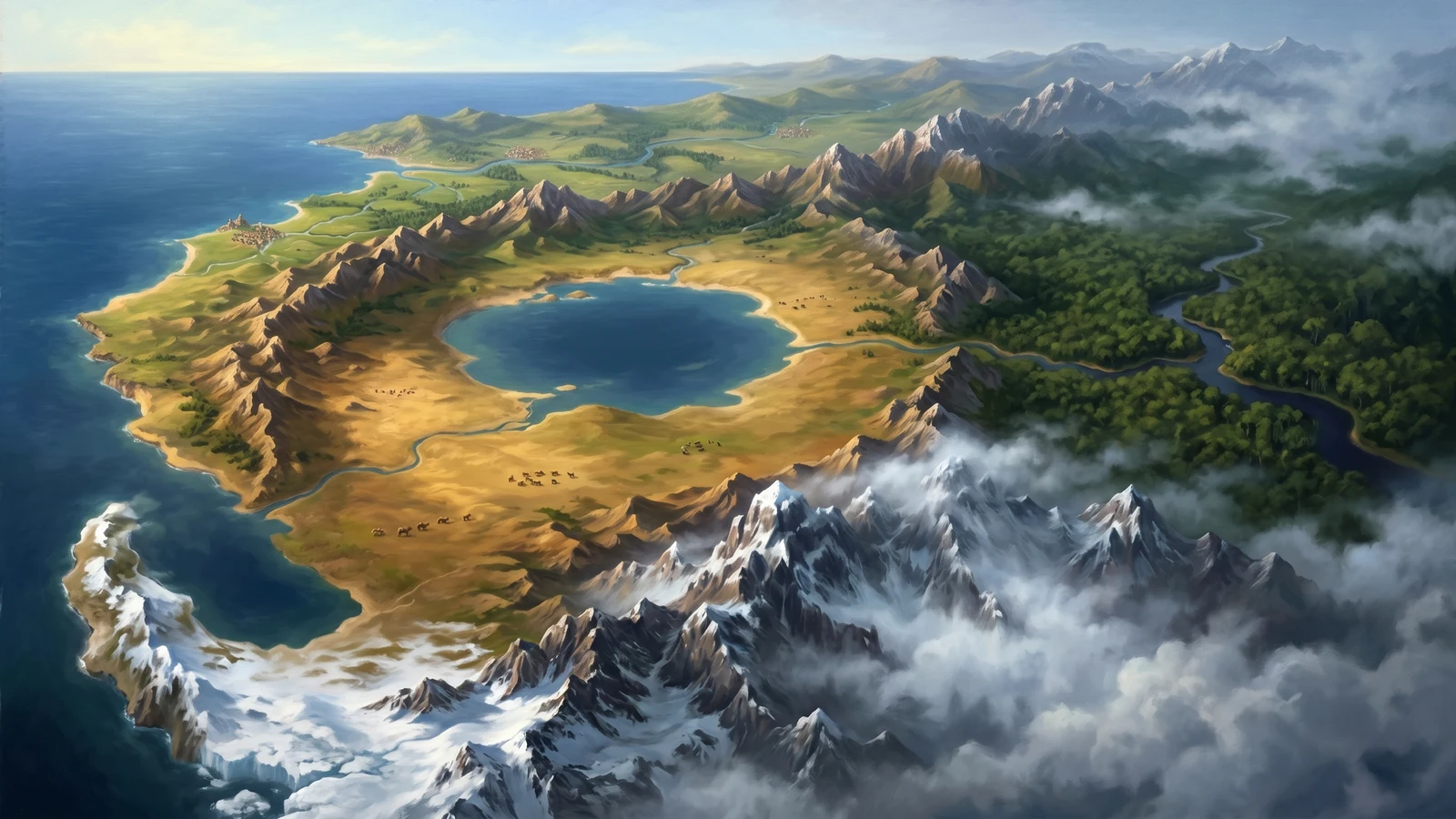
Aboyinzu is the southwestern of Alaria's three central continents, the others being Rimihuica and Upoceax. It is close enough to both that the seas between them are crossings rather than voids. The land has a shape people remember once they have seen it on a chart: a long body that runs down from a temperate northwest, curls back on itself, and tapers into a hooked southern tail. Mountain chains slice the continent into bands, so a traveler walking from the northern coast to the far south crosses temperate states, open savanna, and rainforest before the ground turns to snow. The Deadloop, an inner sea, cuts so deep into the interior that almost nowhere inland sits far from salt water. God's Bathtub and the Sea of Daggers separate Aboyinzu from Upoceax to the west; the South Sea lies along its south and northeast, the crossing toward Rimihuica and the Shacklands. The southern extremity is among the coldest inhabited country in the world, a place the sun's warm band reaches only at its weakest.
Geography
The continent reads as a sequence of climate bands fenced off from one another by rock. In the northwest, Terrenia holds a stretch of temperate coast that ends against the Crystal Mountains. That range runs from the northeast down to the southwest, and at the southwestern tip it joins the Morygun, which carries the highland chain south and east until it merges into the Dragon's Spine. The Spine is the long wall that closes the continent's southern edge, an east-west range that stays cold and mist-shrouded the year round and breaks apart eastward into island chains, the Frostwing and Pindolin groups among them. Between those two boundaries, north and south, lies the broad warm middle.
Most of that middle is savanna, and the Deadloop sits at the center of it. The inner sea reaches so far inland that several states ring its shore, and a forested island, Mikisapi, rises near its heart. East of the Crystal Mountains the highlands climb again into the Dalizi Highlands above Lake Tonactlet Chipe, and north of those the Thundering Mountains fence off the long peninsula that reaches south. The continent puts out two peninsulas that point in opposite directions. The Wanderlands run south into the South Sea, a curved finger of plains and hill country. The Elder Wilds bulge eastward, a single mass of ancient rainforest. Below the Spine, walled off from the rest of the continent by that cold barrier, the southwestern Crimson Coast sits alone with its rivers and its dead.
Major regions
Terrenia occupies the northwestern reach, a band of temperate states running from the coast down to the Crystal Mountains. It is the continent's front door: most traffic arriving from Upoceax across God's Bathtub or the Sea of Daggers lands here first, and the states along the shore compete over who controls the routes inland. The adjacent Riptear Sea holds something the surface nations do not control and cannot reach.
Central Aboyinzu is less a country than a name for the interior, the savanna heartlands wrapped around the Deadloop and the territory between the major ranges. Naga and satyr peoples hold parts of it, the satyrs keeping to the western wilds. The largest single power here is the Dalizi Confederation, a sprawl of human states ringing Lake Tonactlet Chipe, governed under a rotating capital that travels between member territories and split along an old fault line between its highland and lowland halves. Out in the Deadloop, Mikisapi Island carries an old-growth forest that guides peaceful travelers toward the city of Tenches at its center and turns hostile ones around in the trees; its timber resists rot and takes enchantment well, and a Grove Council rations what leaves the island. The lake trade runs on the southern standard, weighed silver rather than minted coin, priced against the rate the Adron banks publish across the sea. The Dalizi keep no coin at all and reckon in cattle instead, an exception that stops at the confederation's edge; the wider money system carries both.
The Wanderlands form the southern peninsula, a long curved spit of plains and rugged hills that reaches down into the South Sea. Wispen halflings and Grendel dwarves live there. Something at the peninsula's southern tip is being held shut, a sealed passage kept under watch, and the region carries more weight in old lore than its size would suggest.
The Elder Wilds cover the eastern peninsula, roughly three hundred and forty thousand square miles of rainforest that has never accepted settlement. Rivers wind through it, ruins stand in it, and most of it has never been mapped on foot. The Gamori, jungle elves who ride giant bats and hunt by night, hold the deep interior and treat the forest as theirs. Beneath the canopy, in the old lowlands, lie things older than the elves.
Dragon's Spine Coast is the cold mountain country along the southern edge, named for the range that runs its length. Snow and mist sit on it most of the year. Three powers share the ground without sharing it well: a dragon in the high peaks, the dark dwarves of Emblydium who raid through hidden mountain doors for slaves, and the surface kingdoms of Dhabisa, Shunde, and Kaftaulo, which deal with both because the alternative is worse. In the Bellowing Mountains stands Azanfrain, a Gondurak fortress four thousand years old, still manned, still watching the south for the ice-things that come up out of the cold.
The Crimson Coast is the continent's isolated southwest, cut off behind the Dragon's Spine and bounded to the south by the ocean its people call the Void. It earns its name. Three states hold the coast: Klevnaf and Istora, the two halves of a Winter Elf kingdom that broke apart in a succession war, and the human kingdom of Tangiern, a seafaring people of the Void coast who give their dead to the open ocean and find the elven war far less pressing than the sea trade at their backs. The rivers here are not safe. The River of Wights, Murder Creek, the Pools of Tragedy, all of them carry the residue of old killing, and Murder Creek's stain is still spreading.
Peoples and powers
No single empire has ever held Aboyinzu. Power sits in regions, and the most interesting things on the continent are the three peoples that share it, because they share almost nothing else.
The elves of Aboyinzu live in three conditions at once. The Gamori of the Elder Wilds are present and entrenched, a nocturnal matriarchy that worships the moon, rides bats over the canopy, and raids the edges of its territory when outsiders push in. The Dark Elves are gone, destroyed in the Dragon Purge, but the Dragon's Spine is full of them anyway: their dragon-riding culture is written into the totems and carved passes of the range, and bloodlines diluted past recognition still surface near the old draconic markers. The Istori of the Crimson Coast are present but at each other's throats, glass elves who forge ice into glass and have spent generations killing one another over a throne. Three peoples, one race, and no common cause among them.
The Kendor are the continent's quiet presence, aquatic and almost never seen on land. The deep-water Cendoriln hold the cold reaches off Terrenia, down in the trenches and around the thermal vents where the water stays warm enough to live in. They keep no contact with the surface states, none with the courtly Kendor of other seas, none with anyone. What they keep instead is secrets, and they have decided the surface holds nothing worth coming up for. A secret large enough might prove them wrong.
You'll see the lights some nights, way down, green and moving. Throw a line, drop a lamp, shout yourself hoarse. Nothing comes up. Forty years I've fished the Riptear and not once has one of them broke the surface. They watch the boats. I'd stake my hull on it. — a Riptear fisher, harbor at Aal Salma
The third people are the reason the southern regions count their neighbors carefully. The Rokunuri look human at rest and live among ordinary communities for months, sometimes years, before they strike. A Rokunuri at rest passes for a person. When it feeds, the neck unspools to fifteen feet and a second row of incisors comes forward out of the throat. They are fast and they are clever, and they choose the south on purpose: cold country and small settlements, where few eyes are watching. The horror of them is not the teeth. It is that one of the three named peoples of the continent is an ambush predator you cannot pick out of a crowd, and the south has learned to live with that knowledge rather than solve it.
Three older forces sit under the regional politics, and each one is a lever a careful party can pull. In the Dragon's Spine, the dragon Kanzekill has spent four centuries hunting for her own true name, which was stolen from her and is now kept by some eight hundred living descendants of the Vaelish line who guard it as the one secret that holds their whole people together. As long as the Vaelish keep remembering the name, Kanzekill cannot reclaim it, so the line has built its whole existence around that one task.
She flies the south ridge every third day, regular as a tide. The second day's the safe one. Anybody tells you different is selling you a guide you don't need. — saying among the Dhabisa highland drovers
In the Elder Wilds, the Anchor Trees are the largest single living thing on the continent and the strangest. They are a distributed consciousness, one mind spread through a root network that runs for miles, grown by druids who long ago sang the corpses of dead titans down into the earth and bound them there. The binding is part Faesong and part Deoric, and the trees are aware. They hold the broken memory of a world that existed before emotion, from a time when the titans whose corpses feed them still walked the earth. Druids who attune to the root network all report the same thing: a single low note under everything, the sound of something vast holding still and keeping count. The trees are waiting, on a scale of patience that has nothing to do with human lives. Their memory is the lever. It holds what the world was before feeling entered it, and the few druids who carry fragments of it have begun, slowly, to remember on the trees' behalf.
The Crimson Coast haunting is the one with a human cause, and that is what makes it worse. The wights in the rivers and the rot creeping out of Murder Creek are not a natural curse and not an old god's work. They are the residue of the violently dead, and the killing that made them runs back through generations of elven civil war to a single event: the murder of the Winter Elf king Istor XXVI, and the war between the claimants Lamenrae and Taoinor that broke open across the country afterward. The blame for the king's death has never been settled, and the two halves of the kingdom each name the other. The rivers do not register the dispute. They hold the violently dead, and the stain from Murder Creek keeps spreading downstream.