Geography
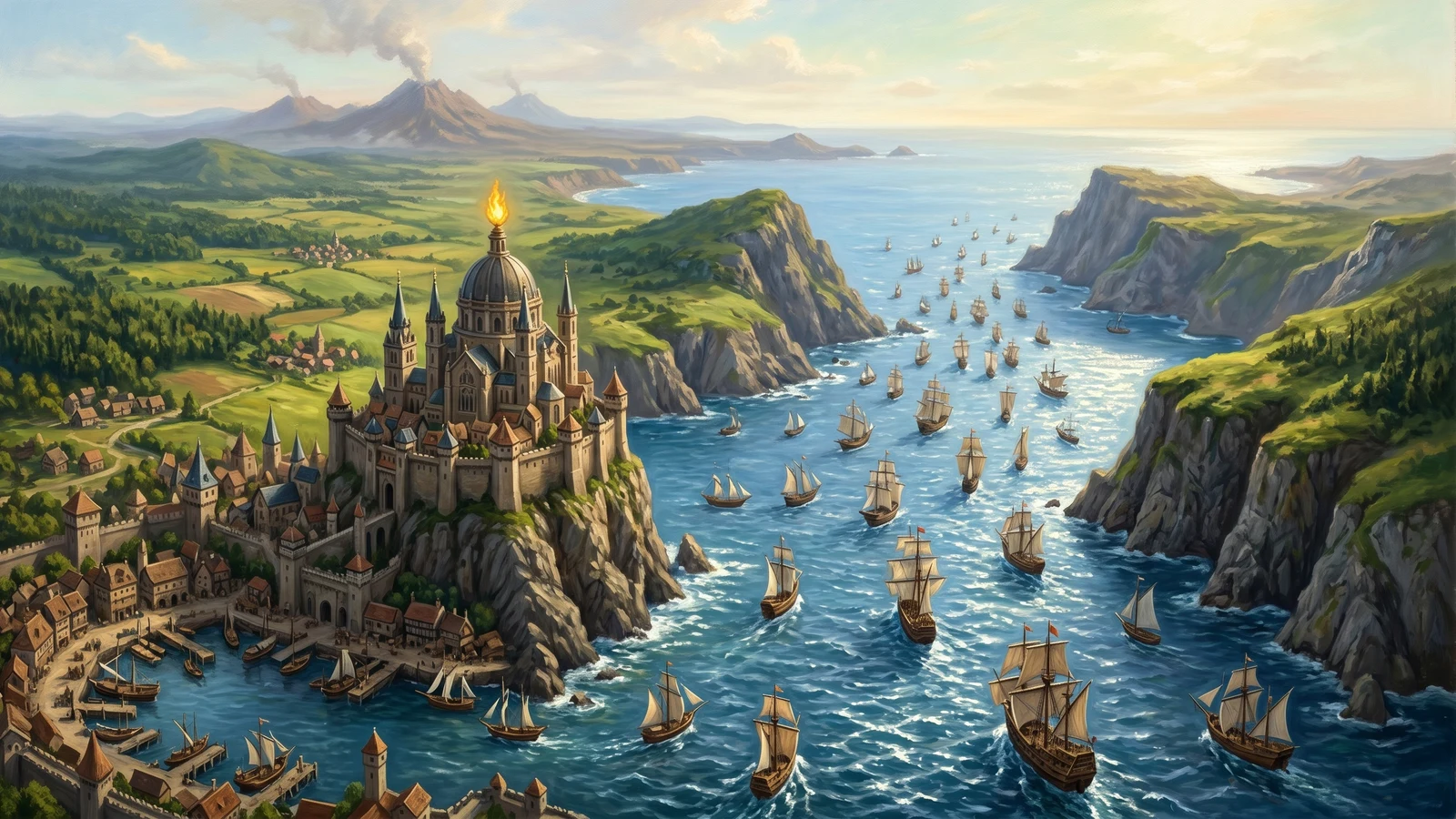
The Tarkhon Empire straddles the critical strait between Clueanda and Rimihuica, controlling territory on both continents and dominating the only sea passage between the Middle Sea and the open western ocean. This strategic position has made Tarkhon one of the most powerful—and most resented—political entities in the region. The Middle Sea opens to the strait at Kazül, the desert glass-kingdom that pays the toll most directly of all the inner-sea coast and skims what trade it can around the edge of the imperial count. The toll at the strait is only the first gate of a longer corridor: a hull that has paid Tarkhon still faces Sheîr's pilots across the Sea of Merchants and Tollgate's fee at the mouth of Phyndarr Sound, two Western Isles powers that tax the same trade the empire would rather tax alone.
On Clueanda (Northern Holdings)
- Nektuna: The imperial heartland, controlling the northern shore of the strait
- Enymu: Agricultural state east of Nektuna
- Kerwin: Halfling kingdom in the far northeast, nominally tributary
- Astrelle: Vassal state of Nektuna
- Vogenfeld: Uline dwarf settlements in the northern mountains, guarding the passes against Hedroscobb
- Murth: Dual-capital state of Rhea scholars and human merchants
On Rimihuica (Southern Holdings)
- Extends from the strait southward to the northern shoreline of the Eronia Range
- Controls the coastal lands north of the great mountains that separate it from Westrim and the Dunes of Kunagi
Southwestern Holdings (Kingdoms of Fire)
- Kabir: Northeastern Neferati kingdom facing the Sea of Merchants
- Gissemari: South of Kabir
- Wadiyah: Southernmost of the western holdings
- Yaif: Western Neferati kingdom
Terrain
The Tarkhon heartlands are temperate and green—rolling hills and fertile plains with easy access to the ocean. This is hospitable land that supports both civilization and agriculture, a stark contrast to the desert and jungle that lies south of the Eronia Range.
To the north, the land grows drier as it approaches Kerwin and the volcanic Fireknife Mountains. To the south, the Eronia Range marks the boundary between Tarkhon territory and the lands beyond—mountains that were cleared of hostile inhabitants two centuries ago by Klor the Blood Lord.
Political Climate
Tarkhon is an empire held together by profit rather than loyalty. Subsidiary states receive preferential trade terms in exchange for fealty, tribute, and cooperation. This arrangement works as long as Tarkhon remains wealthy and powerful—but it means every member is constantly calculating whether the benefits still outweigh the costs.
The current ruler, King Selron II, governs from Tarkhetan. His authority is absolute in the core territories but fades rapidly with distance. The Kingdoms of Fire act as a bloc. The dwarven city-states answer to the First Brotherhood as much as to Tarkhon. And Kerwin's immortal king has outlived every emperor for five centuries.
The empire's great symbol is the Evertorch—an eternally burning flame in Tarkhetan's cathedral. The torch was lit when the Neferati founders established the city six centuries ago, kindled from sacred fire they brought north from Yaif. It has burned there ever since, symbol of an empire that has changed hands but never broken.
What Makes It Interesting
-
The Chokepoint Empire: Tarkhon's entire economy depends on controlling the strait. If an alternative route opened—overland, magical, or otherwise—the empire would collapse. This makes Tarkhon both desperate to maintain control and paranoid about anything that might threaten it.
-
The Immortal Witness: King Ulyas of Kerwin remembers the Neferati emperors, the founding families, the old bargains that bound the empire together. He was ancient when Tarkhon was young. His existence is an embarrassment to imperial narratives—he knows things the current dynasty would prefer forgotten, and he has no reason to keep their secrets.
-
The Necessary Monster: Klor the Blood Lord cleared the southern mountains through systematic genocide. Tarkhon honors him as a hero. The descendants of those he killed—scattered across neighboring lands—remember differently.
-
The Conditional Loyalty: Every subsidiary state is one bad trade deal away from reconsidering membership. The Kingdoms of Fire negotiate as a bloc. The dwarven cities have their own allegiances. Even loyal Enymu could be turned with the right pressure.
What Will Go Wrong
-
The Kingdoms of Fire Departure: If the four Neferati monarchies decided to leave together, Tarkhon would struggle to stop them. Something might push them over the edge—a new trade deal, an insult from Tarkhetan, a better offer from elsewhere. Queen Khalira of Wadiyah is already preparing for something.
-
The Alternative Route: Someone could discover (or create) a way around the strait. A canal, a portal, a mountain pass, a magical transport network. The moment trade can bypass Tarkhon, the empire dies.
-
Ulyas's Choice: The immortal king has been playing along for five centuries because it was convenient. If he decided to stop—if he actively opposed the empire—Kerwin's strategic position and his personal power could cause real problems.
-
The Northern Collapse: Vogenfeld's dwarves have held the northern passes for centuries, but Tarkhon has forgotten to pay them. If the dwarves withdraw—or worse, help the orcs through their secret tunnels—six orcish tribal states from Hedroscobb could sweep south. The orcs have been fighting each other for generations, but if they ever unite, nothing stands between them and Tarkhon except increasingly resentful dwarves.
The Evertorch
In Tarkhetan's great cathedral burns the Evertorch—an eternally burning flame that has never been extinguished since its lighting centuries ago. The torch is Tarkhon's most sacred symbol, representing the empire's eternal dominion and unbroken continuity.
The flame burns without fuel, without maintenance, without apparent source. Scholars have studied it for generations without understanding how it works. Some believe it's fed by a leyline. Others think it's a divine gift. A few whisper that something was sacrificed to light it, and that sacrifice is what keeps it burning.
Leylines
Tarkhon's territory contains several important leylines:
- Yolus (Fire) Leyline: Runs through Nektuna and Tarkhetan, where it produces the firemages who serve as the empire's elite military asset; the same leyline surfaces again beneath the Fleimrut Mountains, where it is unstable and dangerous and responsible for the Fleimrut Awakening
- Time Leyline: Surfaces at Besnoumeru in Nektuna, where the Oracle Merchants buy a stretched moment of local time to read and close a deal a step ahead of any rival
The Imperial Legacy
The Neferati founders understood from the beginning that controlling the strait meant controlling trade. They built Tarkhetan on the Needle, lit the Evertorch, and established an empire based on commerce rather than conquest.
For nearly three centuries, Neferati emperors—or their increasingly diluted descendants—ruled from Tarkhetan. They expanded through trade agreements and tributary arrangements, absorbing states like Kerwin through negotiation rather than war.
Then came the Severance, and human hands took the throne. The new rulers maintained the symbols and traditions of their predecessors while slowly forgetting their origins. The Evertorch still burns. The institutions still function. But the fire that founded them has withdrawn to the Kingdoms of Fire, waiting.
The orcs beyond the passes
Tarkhon's maps end the empire at the Wurmspine, and the court rarely looks past them. Beyond the Vogenfeld passes lies Hedroscobb and five more orc states, and when Tarkhetan speaks of the orcs at all it speaks of them as vermin: a northern infestation penned behind the dwarves, not a power to be reckoned with or bargained with. The contempt is policy as much as prejudice. An empire that grew by buying its neighbors has no language for a people who cannot be bought, so it has decided they are beasts and left the matter there. This suits the orcs well enough. They are not massing for conquest and want nothing Tarkhon could sell them; they are simply watching to see how long the dwarves keep standing on the wall.