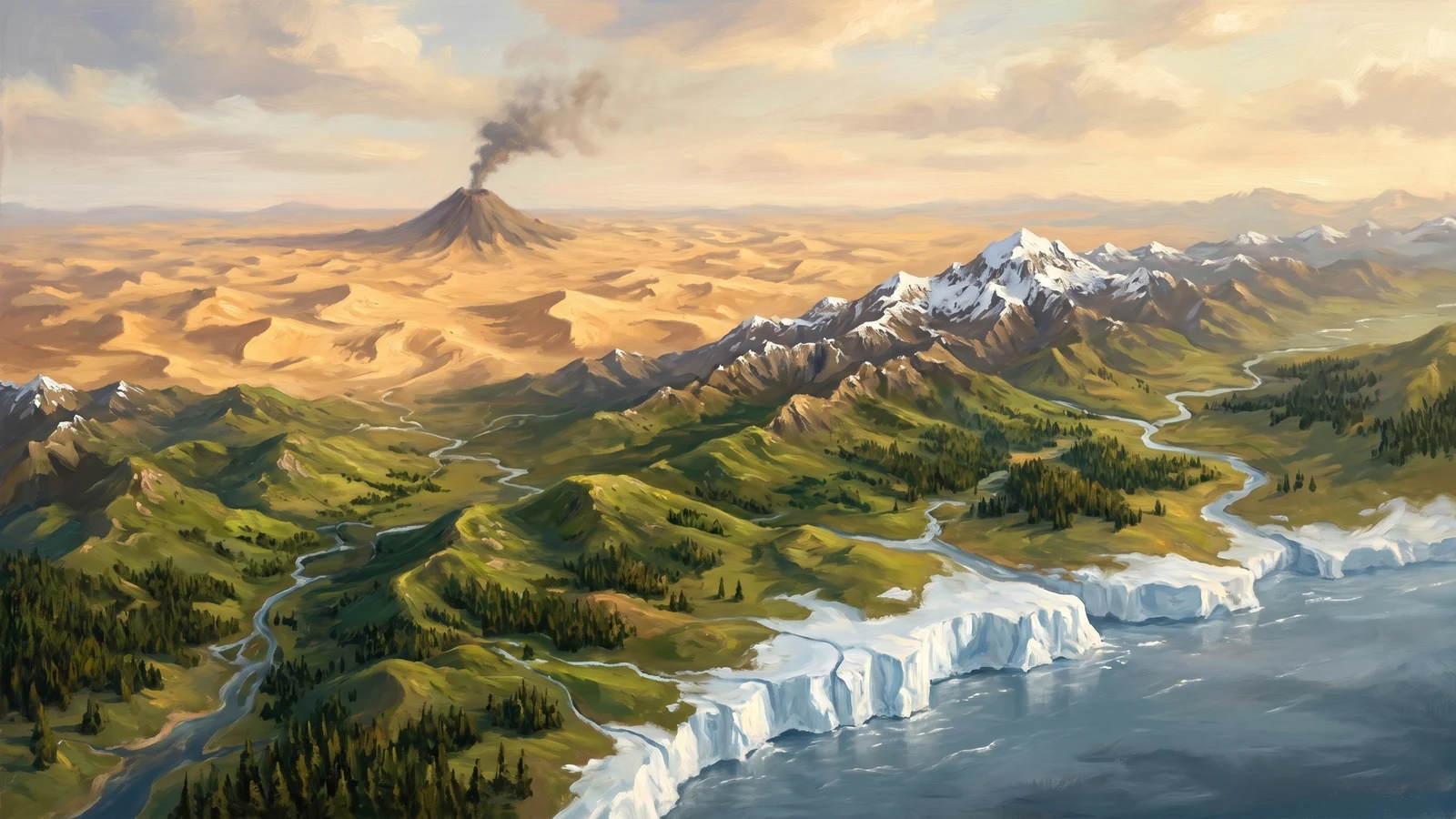
Upoceax (pronounced "YOO-poe-say") is one of the three major continents of Alaria, located in the southwest. It stacks itself in bands, from a barren northern desert coast down through forested elven kingdoms, a mountain-ringed giant heartland, and broad boreal plains, before ending in the polar ice of Venalthier. The Ocean of Elorinia bounds it to the west. God's Bathtub and the Sea of Daggers separate it from Aboyinzu to the east.
Geography
Upoceax divides into four rough latitudinal bands. The northern third is swallowed almost entirely by the Sandreach desert, the Mendari in the west and the Luquihn in the east, a scorching waste broken only by the volcanic peak Belu Jenari and the salt flats at its northeastern tip. The Sandreach Mountains cut east to west across the continent's middle. Their rain shadow feeds the desert to the north, while their southern slopes fall away into forested and hilly country. The central interior, ringed on several sides by those peaks, is the Giant Lands: rolling hill country held by giant populations and the cyclopes who keep the forges of Phlethageros. East of the mountains the land flattens into Sequestria, a roadless plain of savannah and wasteland that runs toward the western approaches of the Free Isles. The south and southeast belong to Wycendeula, an enormous expanse of boreal forest, open plain, and tundra reaching from the Eceraen Mountains north to the Sandreach range. Beyond the Eceraen lies Venalthier, the continent's polar terminus, where the sun's trail never reaches and the land is glacier and ice plain backed by white cliffs.
The western coastline runs in two distinct formations: the cliff-and-island archipelago of the Seacleft Coast in the northwest, and the long forested shore of the Farlands further south, backed by the north-south Kelder Mountains. Offshore to the west, the Free Isles make an independent merchant archipelago, cut off from the mainland by the Scaley Sea and Belter Bay.
The continent's mountains are a single connected problem. The Kelder range running north-south and the Sandreach range running east-west meet at a tangled junction in the western interior, walling off the highland zones and governing all movement between the desert, the elven south, and the giant-held center. Most of the major rivers rise in these ranges. The Kilgre rivers of the Farlands drain west to the Ocean of Elorinia; Wycendeula's rivers run east toward God's Bathtub and the Bay of Wolves.
Major regions
The Seacleft Coast is the rugged northwestern archipelago, where cliffs drop straight into the Ocean of Elorinia and island city-states hold the western maritime gateway. Merchant-dominant Iqes presses commercial tribute on its smaller neighbors while piracy simmers in the outer isles. Eskiloko, a thinly settled stretch on the coast's inland fringe between the cliffs and the continental interior, falls within its shadow.
The Farlands run nearly six hundred miles down the western shore, hemmed against the sea by the Kelder Mountains. Civilization gathers in the south under three ancient elven kingdoms, Lenora, Illron, and Deo Esari, bound for some four thousand years by the Three Kingdoms Treaty. The nomadic Rakite hunt buffalo across the northern plains. The northern two-thirds of the strip is empty wilderness.
The Sandreach is the desert that takes up the entire north, split into the Mendari in the west and the Luquihn in the east. The volcanic Belu Jenari rises from its interior, and the Salt Flats mark where the sand reaches the northeastern coast. It is ungoverned and all but uninhabited, a barrier more than a place.
The Sandreach Mountains are the east-west spine dividing the desert from the southern lowlands. Several sub-ranges thread the system: the Drystone, the Lyagnadarr, the Scarlet Peaks, and the Caffas, where rival force-user and fire-user tribes hold competing ground. The dragon Svorinthak nests in the Lyagnadarr, on the range's northeastern shoulder above the centaur plains. In the western foothills lies Deadman's Lake, whose water does not let the dead rot.
Past the Grognil descent you'll come on Deadman's Lake. Good fishing, if the company doesn't trouble you. The drowned don't rot here, they just lie on the bottom and look up, and some of them are wearing armor older than this road. Take your catch and go. Don't swim, don't wade, don't drop anything you mean to keep. — a Grognil route-guide's standing advice to White Wastes caravans
Sequestria, rendered Siquestrya in the older local tongue, is the savannah and wasteland plain east of the mountains and south of the desert, stretching toward the Free Isles approaches. No road crosses it and no town anchors it. It belongs to centaur confederacies who are permanently at war with one another, each under a chieftain who keeps his place only as long as he can win it in single combat. Armor is rare among them, too heavy and too costly for a centaur to carry at speed, so they fight with spear and bow and curved scimitar. They want no outsiders, and travelers caught on their ground are usually taken alive and kept. With Svorinthak's ridge closing the northwest and the centaur bands roaming the flats, the overland route from the mountain interior to the eastern coast is shut to anyone without an army.
The Giant Lands fill the hilly interior ringed by the Sandreach and Kelder Mountains, home to giant populations and the Güli mountain giants. Its best-known feature is the Cyclops Forges of Phlethageros, where six cyclopes work metal as fine as any in the world.
The Free Isles are the merchant archipelago off the western coast, four city-states each held by one of the patron families under the Blood Pact: the Valdrossi, the Gattorini, the Torvachi, and the Marrovini. Quarrels are settled in the arena. The cities are rich and lethal, and officially abolitionist in a way the practice does not bear out. Their silver is weighed by the chest: each family casts and stamps its own silver marks to the southern standard, and a Kokotintin moneychanger bites every one, priced against the cross-rate the distant Adron banks publish.
Wycendeula is the continent's vast southern reach. The haunted Eyendra forest fills the southeast, where the ancient Riin civilization merged with the land two thousand years ago and the forest has remembered them ever since. Satyr herds roam the open plains, and the Eceraen Mountains wall off Venalthier to the south. At Eyendra's heart lie the forbidden waters of Kama Sa'malina. The region alone is larger than most nations on the continent.
The dreaming waters give back names. Not yours. The ones the forest is still holding. A man who hears his grandfather called by his true name will walk in to answer, and the forest keeps him too. We graze three valleys off and we teach the children one rule before they can ride: at Kama Sa'malina, if the water says a name, it is not talking to you. — a satyr elder of the Wycendeula plains
Venalthier is the frozen southwest, a band of ice roughly eleven hundred miles wide with fewer than a thousand permanent residents. Katabatic winds pour off the glaciers and the white cliffs of The Face front the polar sea. The Nabuhe dwarves at East Whitewall mine Frostfire, the only dependable warmth in a place the sun's trail has never reached, and that monopoly is the nearest thing the region has to a government. Old charts still mark cities out under the southern ice, left from an age when some coalition held the sun this far and then lost it.
Peoples and powers
No single empire spans Upoceax. The three-kingdom elven confederation of the Farlands is its oldest stable polity. The patron families of the Free Isles command its greatest concentrated wealth. The giants and cyclopes of the central highlands answer to no framework but their own. The Sandreach and Venalthier are governed by nothing at all, and Sequestria is governed by whoever won the last fight.
The Three Kingdoms Treaty has held for four thousand years, and four thousand years has not made it fair. Each kingdom gets one voice and four representatives, two men and two women, no matter its size. Lenora is by far the largest of the three, close to four hundred thousand people, and its grain pays for much of what the confederation does. Yet on any matter of tradition Deo Esari sides with tiny Illron, and Lenora loses two to one. The grievance is old and it is quiet. It sharpens every time the question on the table is who pays and who decides.
The harder pressure is titan bone. Deo Esari holds something near nineteen of every twenty parts of the world's supply, and titan bone is the one material that carries a Deoric charge without rotting, which makes it the only durable medium for charged ritual work and fine handmagic. Two hundred years ago the kingdom's southern harvesting grounds, the Eshbya Hills and the settlements scattered through them, were abandoned after a contamination disaster that emptied them in a season. They still stand empty. Nobody has confirmed whether the contamination has faded, and nobody has wanted it badly enough to go and learn. Demand has not dropped. The northern grounds cannot feed it forever. Someone will push south again, and the only open questions are who and when.
On the northern plains the Rakite keep one law above the rest: to foul a river is the gravest thing a person can do. Roule colonists east of Kro Shiik have spent a generation damming the streams and running farm waste into them. The tribes gather each autumn at the Kro Shiik convocation to decide whether to send envoys or send riders, and each year they put it off again. How close the patience is to ending is written in the smoke on the horizon at convocation.
In the fae country of Iyaklomori Grera stands Kilren's Palace, three thousand years sealed. King Kilren raised a fortress on ground the fae had forbidden. Ten thousand of his soldiers vanished in a single night, and the king walked out of it mute and hollow and never spoke again. Inside sits the finest titan-bone armory ever assembled. Everyone who has gone in to claim it has come back the way Kilren did, or not come back, so it stays where it is, a fortune nobody can spend.
The Free Isles run on a fiction. They board slave ships, free the captives, and call themselves abolitionist. Then the freed come ashore owing passage debts and protection fees that never shrink, and some of them work those debts off in the arenas. The Valdrossi of Kokotintin, richest of the four families, keep a hand in every port and every ledger. Kyagos and Shackland slavers test the enforcement constantly, because the gap between what the Free Isles say and what they do is wide enough to sail a ship through.
Two things sit outside the Blood Pact and keep it nervous. The first is Bathemiel, the dragon the Gattorini of Mpehi keep chained beneath their city. The family's wealth is built on its blessings, and the Pact that binds every quarrel to the arena has nothing to say about a captive dragon of the old Dragon line. The second is the Velathi of Hik, who hold Xabraedia across the Spout and were never fully bound by the Pact. A dispute that cannot be won in the arena can sometimes be routed through them.
Venalthier's politics reduce to heat. The Nabuhe dwarves at East Whitewall draw Frostfire from the body of a dead titan beneath The Face, and at the polar terminus, where Bryn's trail has not passed in any remembered age, it is the only warmth that does not have to be sung into place. Everyone living south of Wycendeula buys it on Nabuhe terms. A collapsed vein, a contested succession in the clan, or an outsider bold enough to move on East Whitewall would be felt in every household on the ice.
The continent's peoples are split along the same lines as its powers. The Farlands hold the ancient elven lineages and the nomadic Rakite, giants range the central highlands, the Nabuhe work the southern ice, and the centaurs keep Sequestria for themselves. The coasts and islands draw the widest mix by far. The Free Isles ports alone host Chargon, Nyolci, Eloweir, Swuigrach, Craven, Ayblek, Shapers, and Qord'ik among the families' holdings.