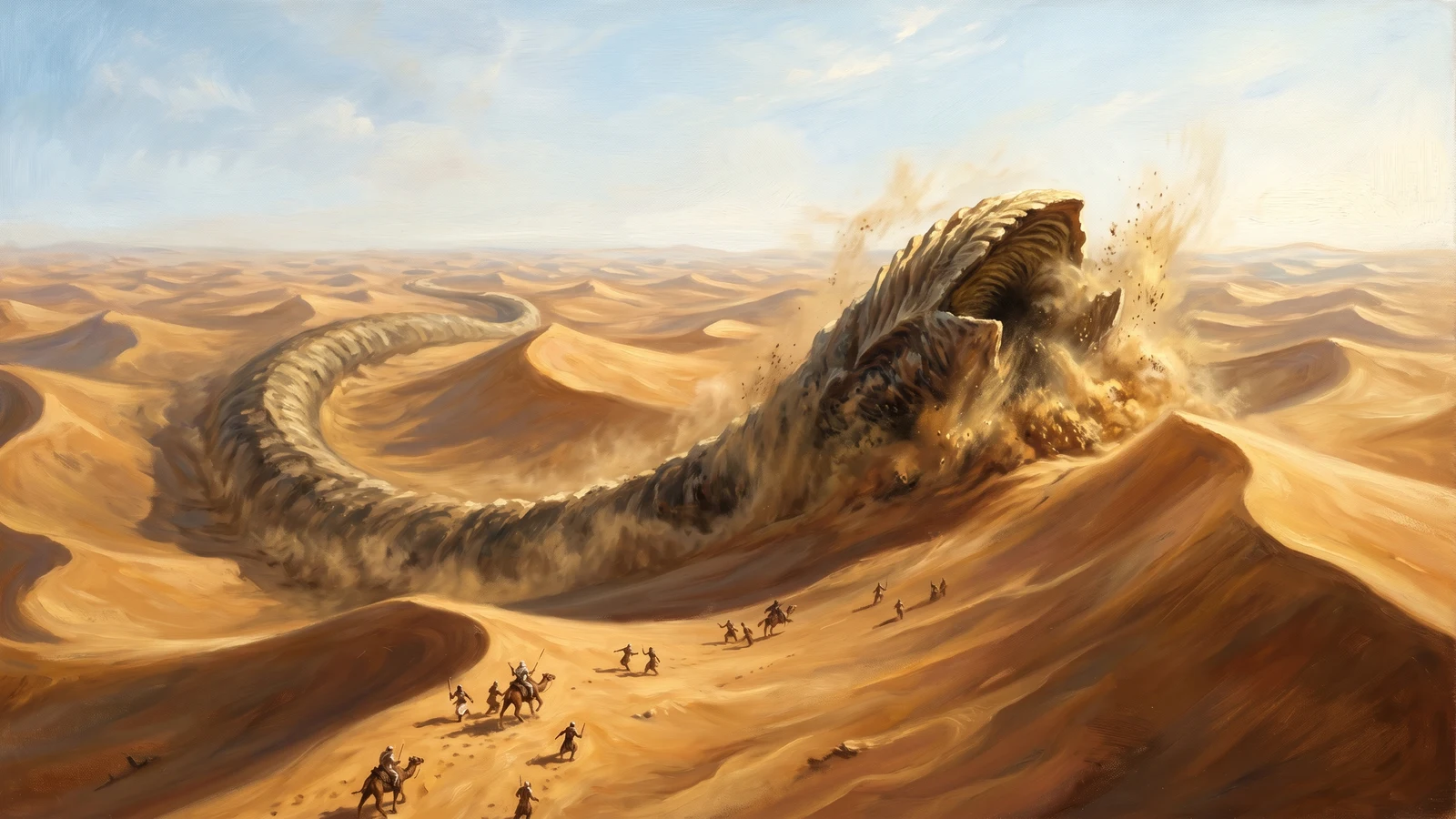
The Dunes of Kunagi fill the interior of Westrim, a kidney-shaped sea of sand walled along its northern edge by the Eronia Range. Those mountains take the weather coming down from the north and wring it dry before it reaches the basin. The dunes are what grows in that shadow. Nothing crosses them quickly, and most things that try do not cross them at all.
The deep interior is open megadune country: slip-faced crescents that march and rebuild with the season's wind, tall enough to swallow a watchtower, with no landmark steady enough to steer by. A dune you camped beside at dusk may have moved a quarter-mile by dawn. The margins are different. Rock lies close under the sand along the northern rim and at the feet of the surrounding hills, and that single fact, where the bedrock is shallow and where it is not, governs everything about how the desert is survived.
The sand wurms
The giant sand wurms are the reason the open basin is unusable as a road. These are not the Titanwurms of deep prehistory, the corpses that became mountain ranges. The Kunagi wurms are living animals, smaller than that but large enough to take a laden pack-string down whole, and they hunt the loose deep sand the way a fish hunts open water.
They hunt by tremor. A wurm cannot see and does not need to; it reads the rhythm of weight moving across the surface and rises beneath it. This is also its limit. Where bedrock sits close under the sand, a wurm has no depth to swim in and no run-up to strike, so the shallow-rock margins, the northern rim, the approaches to Benshu's Promise, the hard ground at the hills' feet, are passable in a way the open basin never is. Steady, even footfalls carry farthest and read clearest; a column marching in step is announcing itself for miles. Caravans that must cross the loose interior break their stride on purpose, scatter their spacing, and move by night when the cool sand packs harder and carries tremor poorly.
What a wurm eats in a near-empty desert is mostly other wurms. The interior cannot feed many large predators, so the young eat smaller young, and a grown wurm may go years between true meals, banking a single large kill against the long hunger. After the rare rains the deep sand briefly blooms with burrowing scuttle-life, and the wurms feed and breed in that short window; the rest of the year they lie dormant and deep, packed into the cool sand below the reach of the day's heat. The hot dry season is when they rise, because loose hot sand carries a footstep best. A crossing timed for the cool months is not safe, but it is survivable in a way a high-summer crossing is not.
A pack-mule went down at the head of the line without a sound, sand closing over it like water over a dropped stone, and the rope went taut and then slack. The drivers did not run. Running is a rhythm. They stood still, every one of them, and waited for the swell under the sand to lose interest and sink.
Crossing the sand
Two lines cross the Dunes, and both exist because the alternative is worse. To go around the basin means weeks along the Eronia foothills or a passage through the Ishnit Jungles, and the Ishnit kills more reliably than the sand. The Dunes are a deadly shortcut that remains, on balance, the shortcut.
The northern-rim road is the one caravans actually use. It runs along the shallow-rock margin under the southern feet of the Eronia Range, staged out of the Atriik city-state of Shinii, whose watchtowers track the desert and whose militia collects the tolls. From Shinii's last reliable springs the road runs perhaps eight to ten days east to Benshu's Promise, the only open water in the whole interior. The oasis is guarded by the sphinx Benshu, who sets a price in riddles before anyone drinks, so a caravan's survival turns on answering for the water as much as on reaching it. Shinii sells the two things that decide a crossing: water-rights at the rim and a reading of the wurm season. Both are expensive, and both are cheaper than the desert.
The southwestern approach picks up the Bone Road where it leaves the Husakas margin and bends north into the basin. It follows the old seasonal channels, which is its danger as much as its use: the channels are precisely the loose, deep, tremor-carrying sand the wurms prefer. Traders out of the Spotted Forest and the southern Atriik lands take it anyway, because the channels are the only thing in the open interior a person can actually follow.
The southern rim and the hills
The Dunes do not fade into the country south of them; they end against it. Along the southwestern edge the sand breaks on the fossil hills of Gyerekas and thins through Husakas, the scorpion-riders' territory, where the streams carry their own curse and the desert begins to surrender to the Spotted Forest. Further south and east the sand simply drowns. The Ishnit Jungles climb the southern rim and pull the dunes under a wall of flooded green, an abrupt frontier between the deadliest desert in Westrim and one of the deadliest jungles in Alaria.
The Malasi Karkus range, in the hills south and southwest of the basin and distinct from the Gyerekas fossil margin on the same southwestern edge, is not the wurms' country. It belongs to the Blitzlings, the electric goblins of the settlement of Shyalaviin, who hold the dry-lightning high ground above the sand and have no reason to descend into it. Travelers sometimes confuse the two dangers. They are not the same, and the ground tells them apart: where rock holds the goblins' hills, sand holds the wurms.