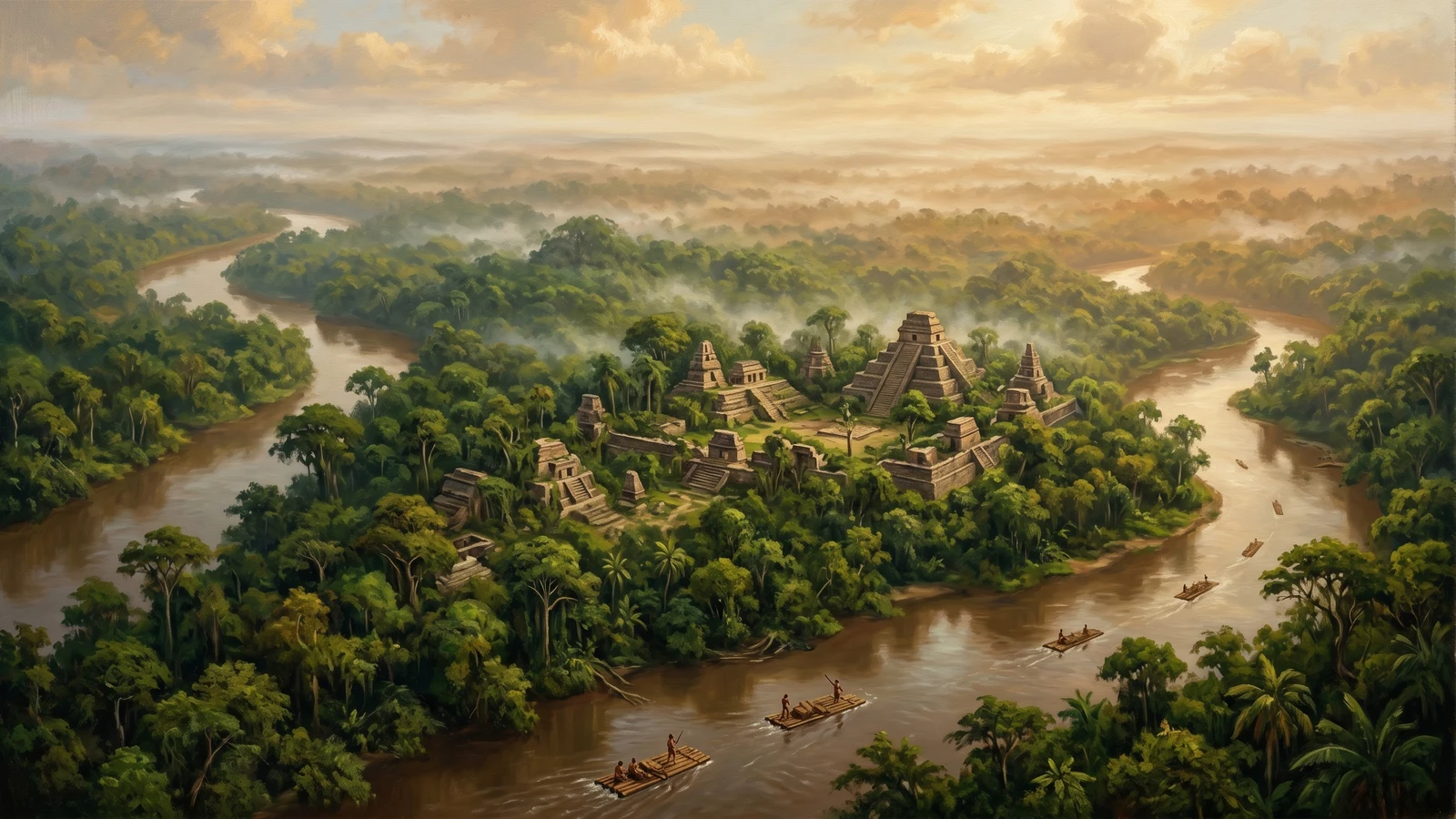
Six hundred miles of jungle. Three great rivers. A million souls. Gorath sprawls across southern Rimihuica like a green stain on the map, the largest territorial state on Alaria and one of the most aggressive. The jungle canopy stretches unbroken for hundreds of miles in places, punctuated by hill country, river valleys carved through dense vegetation, and the scattered stone cities of the Gorathi empire.
This is not wilderness in the classical sense. Much of Gorath is claimed, mapped, and theoretically controlled by the empire. But "controlled" is relative when the jungle grows back faster than you can cut it. Outside the river corridors and fortress-cities, Gorath remains profoundly wild. A hundred miles of untamed canopy separates many settlements. Creatures that have never seen a human hunt in the deep green. And in the Moon Wilds, even the empire fears to tread.
Overview
Gorath occupies the southeastern portion of Rimihuica's mainland, bounded by:
- North: The Myjornis Mountains and the highland frontier
- West: The Moon Wilds and the open water leading to the Western Isles
- South: The Divinity Passage and the Sea of Selegos, beyond which lies Pesalolo
- East: The Deserted Hills and contested borderlands with Nashua
The terrain divides roughly into three zones: the river corridors (settled, economically productive), the hill country (partially tamed, resource-rich), and the deep jungle (wild, dangerous, and largely unexplored).
The Eternal March
Gorath is a republic in the narrow, brutal sense that it does not inherit its rulers. The empire elects its emperor from among its generals, and has for three centuries, so the throne belongs to whoever can keep taking ground. This is why Gorath has never stopped expanding. The office itself runs on conquest, and an emperor who lets the legions sit still is an emperor the marshals replace. The current holder is Veramus, sixty-three and on his fourth decade of campaigns, kept on the throne the only way the throne is kept.
The faith marches with the army. The Iron of the Eternal March is Gorath's war-church, and its chaplains travel with every legion, blessing the advance and reading conquest itself as a sacrament; its primacy seat is at Azantir. There is an ugly knot at the center of it. The daemon the church took for its war-patron is the forge-daemon of the dwarves, the same people Gorath has held in bondage for three hundred years and works to death on the Slaver's Coast. The empire made a war-god out of its slaves' god, and most Gorathi have never thought to notice.
Three centuries of advance ran into the Moon Wilds and stopped. Veramus sent three legions west under Drauso to take the jungle on Gorath's own border, and the Vexlings broke them and sent them home. It was the first frontier in living memory the Eternal March could not cross. The empire that tells itself it conquered the unconquerable now has a reminder on its western edge that some ground does not yield, and the failure is quietly unmaking the emperor who ordered the campaign.
The Three Rivers
Gorath's civilization follows its rivers. The jungle is too dense and too quick to reclaim cleared land for overland travel at scale; everything moves by water.
The Lucenia is Gorath's spine, flowing south from the Myjornis Mountains through the heart of the Jungles of Titania before emptying into the Divinity Passage at the coast. This is the empire's primary artery: the route connecting the northern frontier to the coastal ports, the highway for troops moving to the Nashua front, and the conduit for most of Gorath's internal trade. The river is navigable for most of its length, though rapids in the upper reaches require portage during the dry season.
The Droaz runs roughly parallel, further east, draining the Purlin Hills and central Jungles of Titania. The Droaz valley is Gorath's logging heartland; the great bloodwood and ironwood groves that supply the empire's construction and export industries cluster along its banks. Log rafts float downstream to coastal mills and export docks.
The Torga drains the southeastern jungle between the Bata Nujo and Deserted Hills, emptying near the eastern coast. The youngest of Gorath's river corridors, the Torga valley has been actively settled over the past three generations as the empire pushes toward Nashua. It carries heavy military traffic alongside colonial barges and commerce.
The Hill Regions
Five distinct hill regions break up Gorath's jungle lowlands, each with its own character.
Poison Hills run north-south through western-central Gorath, separating the Moon Wilds from the Jungles of Titania. The name comes from the region's extraordinary biodiversity of toxic flora and fauna: venomous snakes, poison-dart frogs, contact-toxic plants, and flowers whose pollen induces hallucinations or worse. Paradoxically, this makes the Poison Hills valuable: Gorathi alchemists prize the region's resources, and local communities have developed partial immunities over generations.
The Purlin Hills occupy the center of the Jungles of Titania between the Lucenia and Droaz. These are Gorath's most civilized hills, crisscrossed with trails and dotted with logging camps. Slaves work the camps under legion guard, felling bloodwood and ironwood for the empire's endless appetite for construction timber.
Bata Nujo Hills east of the Droaz mark the transition to the expanding frontier, more rugged, with deeper valleys and mineral wealth (iron, copper, occasional silver) exploited through mining operations.
The Deserted Hills run along Gorath's eastern edge as a natural buffer with Nashua. The name is misleading: they are sparsely populated rather than empty, the result of difficult terrain and proximity to the active front. Military outposts watch for Ix'Vasyla incursions; the few civilians here are stubborn settlers or those who benefit from reduced imperial attention.
Jungles of Titania fill the heart of Gorath between the Lucenia and Droaz, the empire's central jungle expanse and the original territory from which Gorathi power spread. See that entry for detail.
The Wilds Between
Between the river corridors and fortress-cities stretches the jungle. Hundreds of miles of it, never cleared, home to creatures that have never seen a human and pathways that exist only in the memories of those who've walked them. Travel through the deep jungle is measured in weeks, not days. Trails exist but require constant maintenance against the vegetation's relentless advance; most Gorathi never venture more than a day's walk from the rivers.
The jungle sustains Gorath: its timber, its exotic resources, its very identity as a people who conquered the unconquerable. But the jungle also defines Gorath's limits. The empire can claim six hundred miles of canopy. Actually controlling it remains another matter entirely.