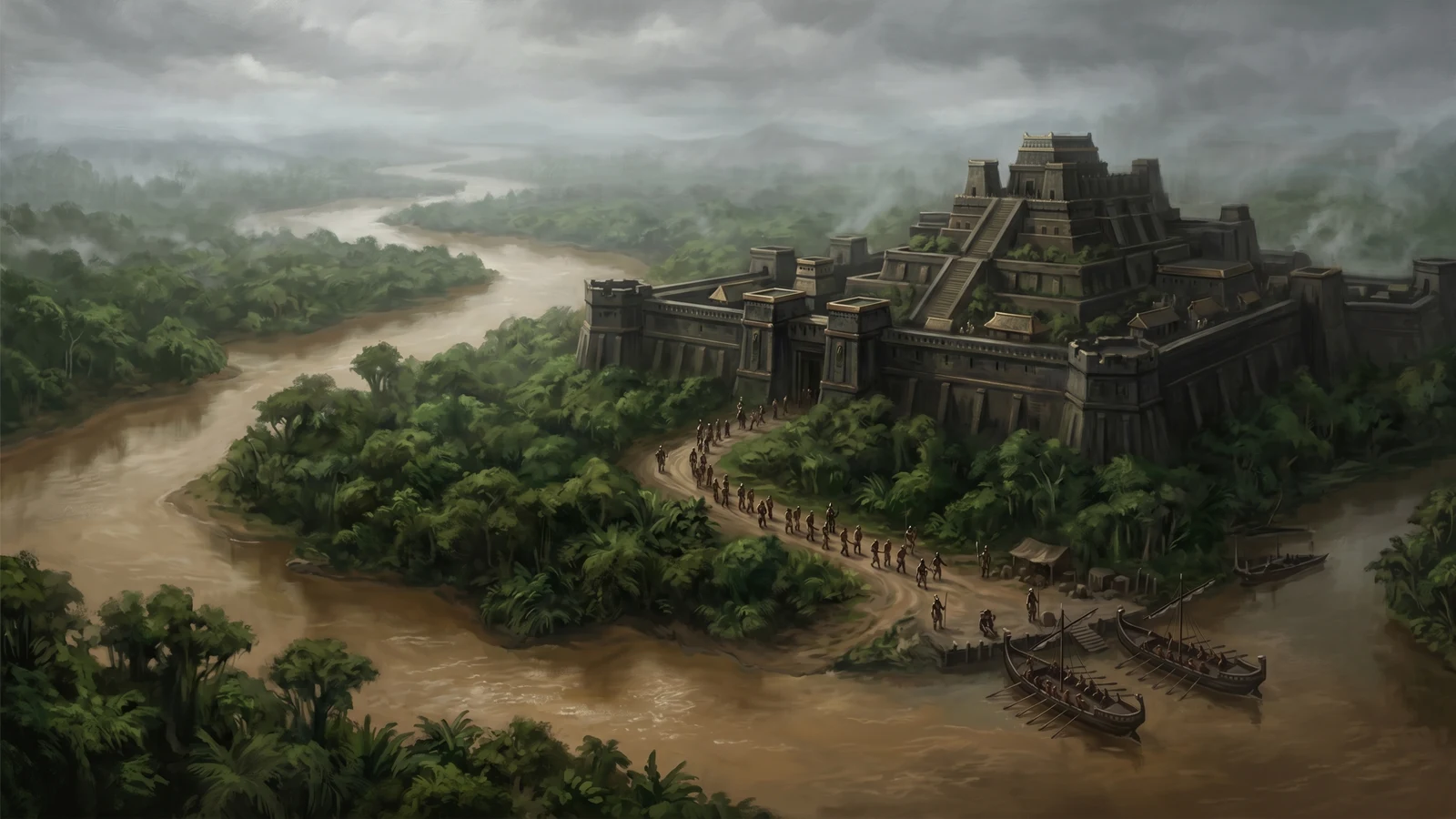
Geography
The Shacklands are not a single contiguous territory but rather a collection of southern regions united by their participation in the slave trade. The name comes from the shackles worn by enslaved dwarves, a grim legacy that defines the region's character. These scattered territories stretch across the southern reaches of Rimihuica, from the mainland jungles to distant island chains.
The Concept
Unlike other regions defined by geography, the Shacklands are defined by economy and practice. States belong to the Shacklands not because they share borders but because they share in the brutal commerce of slavery. This makes the region's boundaries fluid and political rather than natural.
The slave trade provides the economic glue holding these disparate territories together. Tamadrez supplies the labor—primarily Drasnian dwarves, though other peoples are caught in the system too. Gorath provides the demand, the military muscle, and the infrastructure. Smaller states participate as middlemen, suppliers, or simply beneficiaries of the wealth that flows through the region.
Gorath
The dominant power of the Shacklands and the largest territorial state on Alaria. Six hundred miles of jungle, three great rivers, and over a million souls organized into a militaristic empire that has spent three centuries conquering its neighbors and shows no sign of stopping.
Gorath occupies the southeastern mainland, bounded by:
- North: The Myjornis Mountains, beyond which lies Nashua and the Inner Rim
- West: The Moon Wilds—Gorath's most dangerous frontier
- South: The Divinity Passage and the Sea of Selegos
- East: Contested borderlands with Nashua
Key features include:
- Jungles of Titania: The settled heartland between the Lucenia and Droaz rivers
- Moon Wilds: A haunted jungle that has defeated every attempt at conquest
- Divinity Passage: The maritime highway connecting Gorath to the slave trade
- Azantir: The capital, largest city in the Shacklands
Gorath operates as a military republic with elected emperors chosen from successful generals. The empire's core values—glory, conquest, discipline, assimilation—have created a state that grows stronger with every victory, absorbing conquered armies into its own legions.
Kyagos
A mountainous, cloud-shrouded peninsula in the far southeast—almost island-like in its isolation. Kyagos is covered in peaks and perpetual mist, containing numerous city-states (Tekos, Syvlius, Sy, Vassum) and jungle territories. It lies south of Phirexes, separated by the Sea of Seven Snakes.
Tamadrez
The source of the slave trade. Tamadrez covers Pesalolo, a large island in the far south separated from the mainland by the Sea of Selegos. The island's Drasnian dwarves have become the primary commodity of the Shacklands economy—a grim distinction that has shaped their entire society.
The relationship between Tamadrez and Gorath is exploitative but stable: Gorath operates the Slaver's Coast on Pesalolo's southern shores, taking slaves while leaving the north nominally independent. This arrangement persists only because Gorath finds it more profitable than outright conquest—for now.
Surrounding Seas
- Sea of Selegos: Separates the mainland from Pesalolo, crossed regularly by slave ships
- Divinity Passage: The main maritime corridor connecting Gorath to the outside world
- Deaddorf Strait: A passage within the Shacklands region
- Cindrak Sea: Southern waters
Political Climate
The Shacklands lack unified governance—they're defined by participation in slavery, not political allegiance. However, Gorath's dominance creates a de facto hierarchy:
Gorath sets the terms. Their military power, economic might, and willingness to use both give them effective control over the slave trade and significant influence over neighboring states. They don't rule the Shacklands, but they shape it.
Tamadrez provides the supply. Their relationship with Gorath is unequal but stable—cooperation keeps them independent, and the threat of Gorath's military ensures compliance.
Smaller participants fill specialized roles: brokers, transporters, secondary markets. They profit from the system while lacking the power to challenge it.
The result is an economic zone masquerading as a region. States that have nothing else in common share the taint of slavery—and the wealth it generates.
The Coin of the Trade
For a region built on one commerce, the Shacklands strike no money of their own. The markets settle in weighed silver, the same southern mark Kyagos and the Free Isles keep their scales for: fine metal assayed by weight, with no face that counts and no mint standing behind it. Gorath pays its legions in marks. The slavers who sell along the Slaver's Coast settle in marks. A Drasnian dragged onto the block at Azantir is priced in a weight of silver and bought with one.
Not all of that silver belongs to the men spending it. Belmonte, who keeps the oldest banking house in Azantir, lends to Gorath by the chestful, advances secured against ground the legions have not taken yet. A campaign that wins repays its bond out of the bodies it hauls back. One that stalls leaves a hole only the next campaign can fill. The creditor who holds the empire's debt needs the war to keep paying, which is the same as needing it never to end.
What Makes It Interesting
The Drasnian dwarves of Pesalolo built the Shacklands' economy and carry its deepest contradiction. Three centuries of bondage have not dissolved Drasnian identity. They run when they can, and the Moon Road — the escape network that moves them through the Moon Wilds — has been running them for decades. Gorath cannot close that route without entering territory the empire has already admitted defeats it. The most dangerous frontier on the continent is, for the people it has swallowed, the only way out.
The war-church that drives Gorathi expansion has produced the system's cruelest irony. The Iron of the Eternal March presses to erase Tamadrezan dwarf culture and supplies the legions' chaplains who bless the lash. But Krondeum, the forge daemon the Iron claims as its patron, is also the daemon the Drasnian bondspeople worship across the same anvils. Master and enslaved Drasnian bend knee to the same god and call him two different things. The Iron is fracturing from inside over whether this is a bridge or a corruption, and neither faction can charge the other with heresy without the split widening past what anyone can manage.
The system does not yield to simple pressure. Freeing a runaway is not a revolution; the Moon Road frees hundreds, and Gorath is still Gorath. Every participant in the trade has a reason not to be the one who breaks it first.
The Shacklands are also intensely physical places: massive jungles, dangerous waters, fortress-cities rising from impossible terrain.
What Will Go Wrong
The system is stable but not static, and several pressures are working against it at once.
The Moon Wilds are stirring. Something the Gorathi call the Argent Mother has drawn the Vexlings of the western jungle into a single coordinated hive, and the containment line on the Myublin River holds only so long as she lets it. If the hive comes east in force, Gorath fights a war on the one front it has already lost.
Emperor Veramus is sixty-three and has held the throne longer than any recent predecessor. Gorath elects its emperors from among its generals, and Veramus has no fresh victory to point to and no heir the office can pass to. When he dies, or falters, the succession will be settled the Gorathi way, between armies.
The war-church is hardening the empire's cruelty into doctrine. The Iron of the Eternal March, Gorath's martial faith, presses to erase what remains of Tamadrezan dwarf culture and supplies the legions the chaplains who bless the lash. It is also fracturing from the inside, which is a danger of a different kind.
The enslaved have not forgotten, and they have a way out. Three centuries of bondage have not broken the Drasnians, and the escape network called the Moon Road moves them through the one country Gorath will not follow them into. Beyond the region, the dwarves of Trømgar have never accepted what was done to their kin, and they are watching for the empire to stumble. The grinding war with Nashua may be the stumble.
None of these pressures waits on the others. The danger to the Shacklands is that they arrive together.
Moon Wilds
Gorath's western frontier is the one direction the empire has stopped advancing. West of the Poison Hills, across the Myublin River, lies the Moon Wilds, a jungle the legions have never been able to hold because of what lives in it. The Vexlings, the apex predators of the Wilds, have lately stopped behaving like animals and begun behaving like an army, drawn together by the thing the Gorathi call the Argent Mother. Three legions went in to conquer the Wilds and came back broken; the empire now watches the Myublin line and cedes the rest. The grim turn is that the deadliest ground on the continent is also the safest road off it, because the Vexlings do not chase runaways and Gorath will not follow them in. The full account lives in the member entries: the Moon Wilds, the Vexlings, and the Myublin River.