Geography
The Westwilds occupy the southwestern corner of Clueanda, forming a transitional zone between the frozen Northlands and the maritime regions to the south. This is the southern coast of Clueanda, stretching from Tarkhon in the east to the waters overlooking the Western Isles in the west.
Boundaries and Position
- North: Transitions into the Northlands; the frozen tundra gradually gives way to arid scrubland
- East: Meets Tarkhon territory; some desert coastline marks this transition
- South: Faces the open ocean, with the Western Isles visible offshore
- West: Reaches the coast overlooking the Western Isles
Terrain
The Westwilds have a yellowish-green hue suggesting dry steppe or scrubland. The region is less fertile than the Middle Sea lands but more hospitable than the frozen north—a rugged zone of hardy grasses, wind-worn rock, and arid soil. While not a true desert, the land is parched and demanding.
Climate Transition
The Westwilds represent one of Clueanda's major climate transitions. The frozen winds from the Northlands lose much of their bite here, but the region receives little rainfall. The result is an austere landscape—neither frozen nor verdant, but something in between.
Political Climate
TODO
What Makes It Interesting
TODO
What Will Go Wrong
TODO
Shazuihn
An orc state in the interior Westwilds, notable for its extensive forests and proximity to dangerous geothermal features.
The Plains Beyond
North of the Shazuihn Forest lie open plains marked by violent magical phenomena.
The Scorches
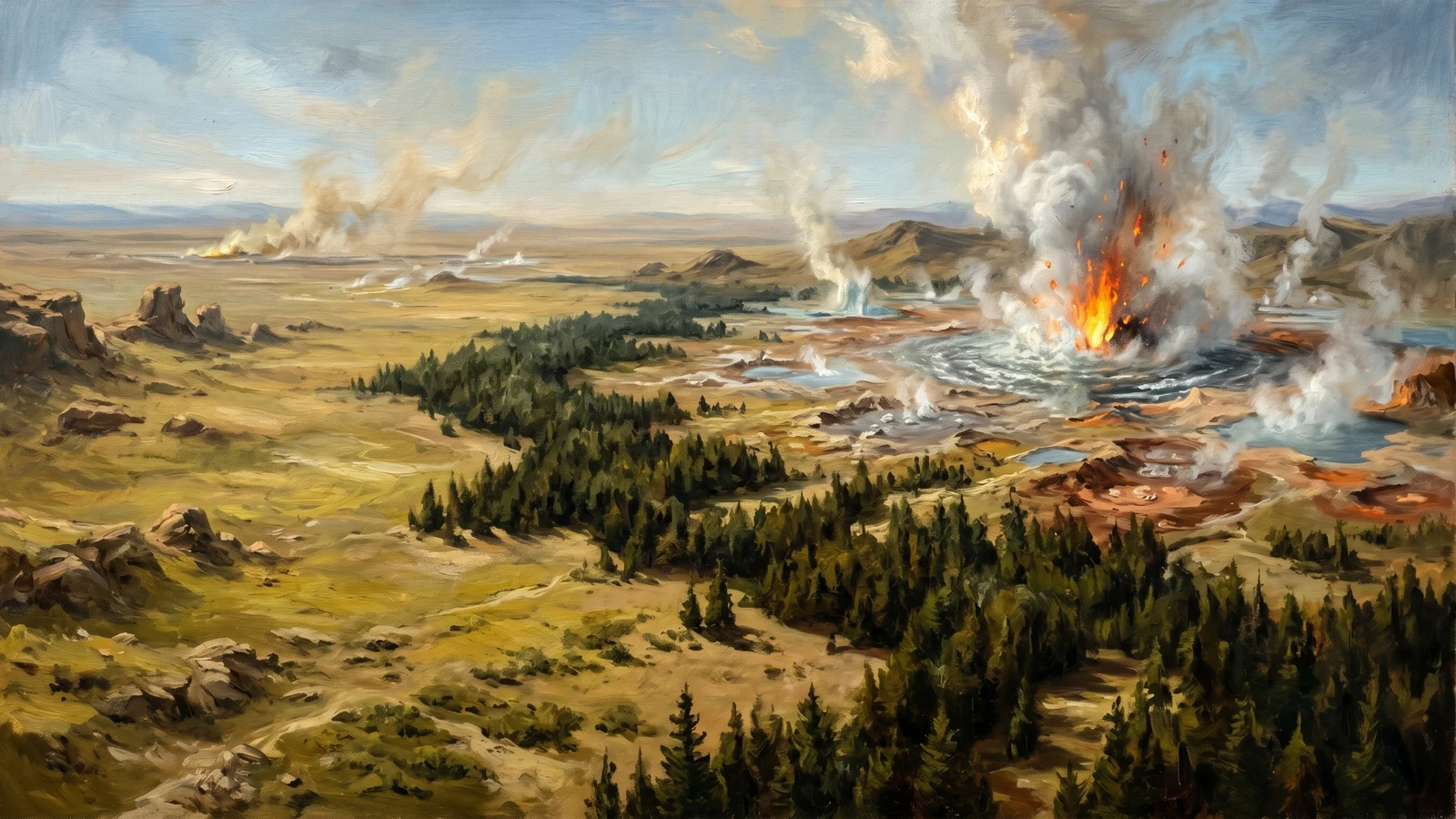
Northeast of Dragon Spout lies the Scorches, a region of hotsprings and geysers where geothermal activity creates a landscape of bubbling mud pots, scalding pools, and steam vents. The heat here is natural rather than magical, but no less deadly.
At the heart of the Scorches is a massive boiling whirlpool where superheated water churns with such violence that it becomes super-aerated, causing anything that enters to lose buoyancy and sink immediately. Gouts of fire erupt from the whirlpool at irregular intervals, and the area is inhabited by steam elementals—creatures born from the intersection of water and fire. The Scorches are extremely dangerous, and few who venture too close to the central whirlpool survive.
The Orc States
The southern and western portions of the Westwilds are divided among six major orcish states, each controlling territory in the vast forested region:
- Glivornax
- Hedroscobb (northeast of the Plains of Oblivion)
- Grieb (home to the Grieb Lakes and the Griebi people)
- Shazuihn (detailed above)
- Tarn (detailed below)
- Uhionai
These states maintain a loose confederation, cooperating for defense against external threats while fiercely competing for resources and territory within the Westwilds.
Tarn
One of the central orcish states in the Westwilds, positioned along the Grand Tolkarsus river system.
Mountains Semaphois
West of the Grand Tolkarsus and south of the northern plains rise the Mountains Semaphois. To the mountains' west lies Ichneum, a large forest. North of the range are the mountains of Miphori, the Zhorheim Mountains (marking the northern edge of the forest), and the Hills of the White Terror, which stretch northeast into the Northlands.
Koshasyn
A small trading settlement in the clearing between Pystinwood and Milrar Forest, Koshasyn (sometimes spelled "Koshasya" on older maps) serves as the primary meeting point between the orc states, the steppe nomads, and the scattered communities of the northern Westwilds. It's not quite a town, not quite a camp—something in between that has persisted for generations without ever quite becoming permanent.
Geography
Koshasyn occupies a natural clearing roughly three miles across, bounded by Pystinwood to the north, Milrar Forest to the south, and open grassland transitioning to the Steppe of Aziirn to the east. The clearing exists because of soil conditions—the ground here is rockier and less fertile than the surrounding terrain, unable to support the dense forest growth on either side.
The Market Ground: The center of the clearing, where traders set up temporary stalls and permanent residents maintain a few modest buildings. Nothing is elaborate; everything is built for function over form.
The Northern Camp: A semi-permanent encampment where pystin sap traders from the north gather. During harvest season, dozens of sap-tappers congregate here to sell their product.
The Steppe Gate: The eastern edge of the clearing, where the grassland begins and steppe nomads make camp when visiting to trade. A few carved posts mark the traditional boundary.
Function
Koshasyn exists because everyone needs it and no one wants to control it:
Neutral Ground: Like Telwood to the south, Koshasyn is recognized as neutral territory. The orc states don't claim it; the northern communities don't fortify it; the steppe nomads don't raid it. Violence here is punished by exclusion—anyone who causes trouble is banned from trading.
Trade Hub: The settlement handles exchange between wildly different economies. Pystin sap goes east; steppe horses go west; orcish metalwork goes everywhere; information flows in all directions. The clearing sees more cultural exchange in a week than most regions see in a year.
Information Market: Beyond physical goods, Koshasyn trades in knowledge. News from the orc states, rumors from the steppe, reports from the northern forests—travelers share information here, and those who pay attention can learn the state of the entire region.
Population
Perhaps two hundred people live in Koshasyn year-round, maintaining the market ground, running the few permanent establishments, and facilitating trade. During peak seasons—spring and autumn—the population can swell to over a thousand as traders arrive from all directions.
The Permanent Residents: A mix of outcasts, entrepreneurs, and people who simply prefer neutrality to belonging. They maintain the settlement's infrastructure and enforce its rules.
The Seasonal Visitors: Traders, herders, diplomats, and the simply curious who pass through regularly but don't stay. Some families have visited Koshasyn every year for generations.
Why It Matters
Koshasyn is a node in the regional network—a place where connections are made, deals are struck, and news travels. Its neutrality makes it valuable; its persistence makes it reliable. For players traversing the eastern Westwilds, Koshasyn offers supplies, information, guides, and a temporary respite from the wilderness's challenges.
Laeire
A city-state in the Westwilds.
TODO
Seyiki
The Seyiki, a distributed nation of dragonfly-riding gnomes, hold the Chakatann pillars in the southwestern Piktiniti Desert and sell their crystal, chitin, and locust-flour out through the port of Jüt; their people, society, and the desert itself are covered in their own entries (Seyiki, Piktiniti Desert).
Twaan Forests
The Twaan Forests are a sprawling woodland complex in the northeastern Westwilds, bounded by the Kharvorn Mountains to the east and the arid scrublands to the west and south. Three distinct forests make up this region—Turxis Golathi in the north, Sorix Melar in the west, and Zlyverth Korn in the center—though locals and the Twaan themselves treat them as one continuous territory.
This is Twaan land. The large, bitter skaag-relatives have claimed these forests as their own, and they do not welcome outsiders. Their sprawling burrow-settlements honeycomb the ground beneath the trees, housing extended families in warrens that can stretch for miles. Above ground, the forest appears wild and trackless. Below, it's a civilization.
Why They Came Here
The Twaan speak of a betrayal. The details vary by clan, but the shape of the story remains: they once lived elsewhere, among other peoples, and were driven out. Some say humans broke treaties. Others blame elves, or orcs, or simply "the world." Whatever the truth, the Twaan retreated to these forests generations ago because no one else wanted them.
The Westwilds are harsh—arid scrubland with little water and less mercy. But the Earth ley line that runs through this region creates an anomaly: soil rich enough to support dense forest where none should grow. The Twaan found sanctuary in this improbable woodland, and they've defended it ever since.
Their bitterness runs deep. They trade reluctantly, speak to outsiders rarely, and trust no one who isn't Twaan. Visitors who stumble into their territory are watched, guided out if they're lucky, and simply vanish if they're not. The Twaan remember what happened last time they trusted outsiders.
Relations with Neighbors
Gymlstik Goblins: The goblin-controlled mountains to the east are a constant low-grade threat. Goblin raiders probe Twaan territory regularly, and Cirthikin hunting parties sometimes venture into the forest edges. The Twaan and goblins have fought skirmishes for generations, neither side able to gain a decisive advantage. The Burning Corridor helps—goblins don't handle fire well.
Orc States: The orcish nations to the south and west view the Twaan Forests with a mixture of frustration and grudging respect. Several orc states have tried to claim the fire-wood trade; all have failed. An uneasy understanding exists: the Twaan don't expand, the orcs don't invade, and both sides pretend the other doesn't exist.
Everyone Else: The Twaan don't distinguish much between humans, elves, dwarves, or anyone else. They're all outsiders. They all betrayed the Twaan (or would, given the chance). Trade happens at the forest's edge, briefly, with weapons visible. That's as friendly as it gets.
What Travelers Should Know
- Don't enter the forest without permission. The Twaan will know you're there.
- Don't cut any trees. Not even dead ones. Not even branches.
- Don't approach burrow entrances. You won't see them until you're standing on one, and then you'll have a dozen angry Twaan explaining your mistake.
- If you're escorted out, go. The alternative is not being escorted out.
- Fire-wood can be purchased at the western edge of Sorix Melar, if you have enough gold and enough patience. The Twaan will make you wait. It's a test.