Overview
The Kingdoms of Fire are four Neferati monarchies—Yaif, Kabir, Gissemari, and Wadiyah—that occupy a peninsula in southwestern Tarkhon. Though each kingdom is independent with its own ruler, they act as a political bloc, coordinating foreign policy and presenting a united front to the wider empire.
This alliance is existential, not a matter of convenience. The Neferati founded Tarkhon six centuries ago. They lit the Evertorch. They established the institutions that made the empire possible. And three centuries ago, they were pushed aside when the Severance passed the throne to the human line.
The Kingdoms of Fire remember. They consider themselves founders in exile, not tributaries. The Evertorch burns with Neferati fire. Tarkhon was built on Neferati foundations. The humans may have forgotten this, but the Neferati have not.
The Four Eternal Flames
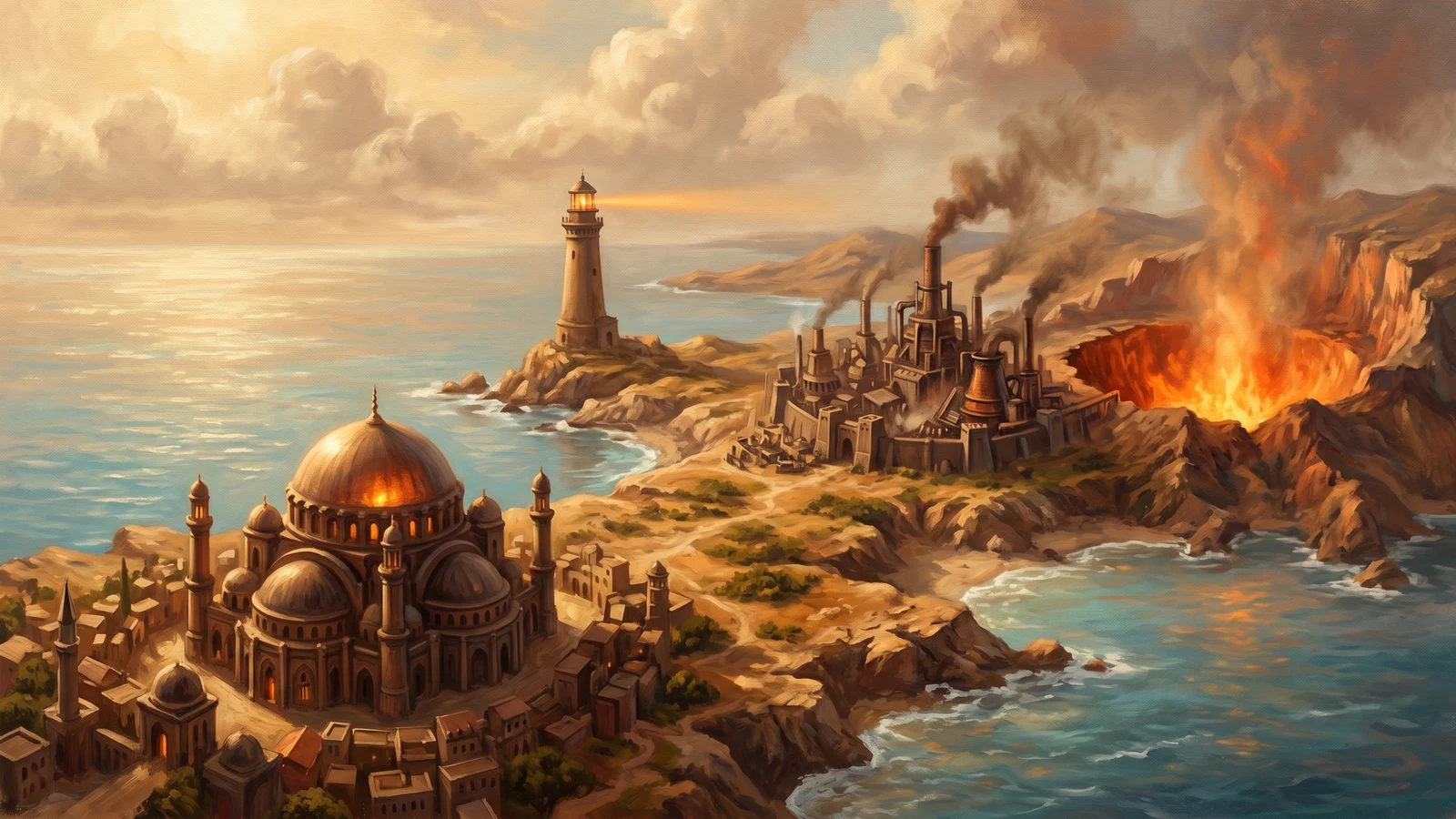
Each kingdom is built around an Eternal Flame, a fire that has burned since the world's creation, sustained by magic older than civilization. These flames are the heart of Neferati spirituality, the source of their fire magic, and the model for the Evertorch that burns in Tarkhetan.
- The Flame of Yaif: The oldest and largest, burning in the Temple of First Fire. Said to be the flame from which all others were kindled.
- The Flame of Kabir: Burns in a lighthouse that has guided ships since before human memory. Its light never wavers.
- The Flame of Gissemari: Burns in a great forge where master craftsmen create works of legendary beauty.
- The Flame of Wadiyah: Burns in a pit so deep that none have seen its bottom. The oldest priests say it connects to the world's molten heart.
The Evertorch in Tarkhetan was kindled from the Flame of Yaif, carried north when the empire was founded. The flame was lent to the new city, not surrendered to it, and the bloc's claim on the Evertorch rests on that loan rather than on sentiment. See The Carried Fire.
The Neferati People
The Neferati are children of fire, born when primordial flame danced with divine essence. Their distinctive red skin seems to flicker with inner fire in certain lights. Curling ram horns crown their heads, their eyes are dark as coals, and their hair is black as charcoal.
To the Neferati, fire is more than an element. It is life itself. They gather regularly for sacred fire ceremonies, basking in heat that would kill other races. Fire dancing blurs the boundary between dancer and flame. They approach everything with burning intensity: loving fiercely, experimenting boldly.
The Neferati don't sleep as other races do. Instead, they must spend four hours each night near fire, at least a campfire's worth. This requirement shapes their architecture, their culture, and their sense of community. Every Neferati home has a hearth. Every Neferati gathering has flames.
The Council of Four Flames
The four monarchs meet regularly at the Council of Four Flames, rotating between kingdoms. Here they coordinate policy, resolve disputes, and decide how to present their collective interests to Tarkhon.
The council has no formal leader; decisions require consensus among all four monarchs. This makes the bloc slow to act but nearly impossible to divide. Nektuna has tried to buy off individual kingdoms; all attempts have failed. The Neferati remember what happens when they're not united.
Current monarchs:
- Queen Seraphel of Yaif: The eldest, most respected, and most patient. She remembers the old ways.
- King Rashaan of Kabir: The wealthiest, most pragmatic, and most willing to deal with Tarkhon. Some call him accommodating; he calls it strategic.
- Prince-Consort Vhelan of Gissemari: Rules as regent for his young daughter. An artist-king who values beauty over politics.
- Queen Khalira of Wadiyah: The youngest monarch, the most radical, and the most eager to challenge Tarkhon. She believes the time for patience is ending.
The Founding Legacy
Six centuries ago Neferati from Yaif founded Tarkhon on the strait and carried fire north to light the Evertorch. For nearly three centuries fire-blooded emperors held the throne, and much of what still governs the empire was written in Neferati hands. That founding is told in the Neferati Founding and the loan of the flame in The Carried Fire; what matters to the bloc is that the fire was lent on recorded terms and never returned.
Then the bloodline thinned. Generations of marriage to local humans faded the fire from the imperial line until the emperors were Neferati in little more than name. At the Severance the throne passed to a fully human heir, the Neferati who resisted were outmaneuvered, and the pure-blooded withdrew south to the Kingdoms of Fire. The Evertorch stayed in Tarkhetan. The Kingdoms have called themselves founders in exile ever since.
Why They Stay
The Kingdoms of Fire could leave Tarkhon. They have the military strength to resist reconquest. Four kingdoms of firemages in defensible terrain would be nearly impossible to subdue. So why do they remain?
Trade: The strait makes everyone rich, including the Neferati. Leaving would mean losing preferential access to the greatest trade route in the world.
Heritage: This is the harder truth. The Neferati don't want to leave Tarkhon. They want to reclaim it. Walking away would mean admitting that the humans won, that the Severance was final, that the Evertorch belongs to Tarkhetan now.
Patience: The Neferati live fast but think long. Three centuries seems like a long time to humans. To a culture built around eternal flames, it's a temporary setback. They're waiting for the right moment.
Division: Not all Neferati agree on strategy. King Rashaan thinks accommodation is wise. Queen Khalira thinks it's cowardice. Until they reach consensus, dramatic action is impossible.
Why They Might Leave
Several scenarios could push the Kingdoms of Fire out of Tarkhon:
The Evertorch Claim: If the Neferati formally asserted their right to the Evertorch, demanding its return or acknowledgment of their heritage, and Tarkhon refused, it could trigger a break.
Imperial Overreach: If Nektuna tried to impose direct control, extract excessive tribute, or station troops in the kingdoms, the bloc would resist.
A Restoration Opportunity: If a succession crisis, military defeat, or other disaster weakened Tarkhon enough, the Neferati might see their chance to restore fire-blooded rule.
A Better Offer: If someone offered the kingdoms a superior arrangement (perhaps a rival trade route, or alliance against Tarkhon), they might take it.
Relations with Tarkhon
The relationship is stable but not warm. The Kingdoms of Fire pay their tribute, maintain trade agreements, and participate in imperial councils. In return, they receive preferential trade terms and effective autonomy.
But there's always an edge. The Neferati ambassadors in Tarkhetan are too numerous, too well-informed, too interested in the Evertorch's flame. High Priestess Salenne has noticed them studying the torch, measuring its light, taking notes.
King Selron II knows the Kingdoms of Fire are dangerous. He treats them carefully, grants them respect, and never pushes too hard. His greatest fear is that they'll remember their claim, and act on it.
The Individual Kingdoms
Yaif — The westernmost and most traditional. Home to the Flame of First Fire and the oldest Neferati temples. Queen Seraphel rules with ancient wisdom.
Kabir — Northeastern, facing the Sea of Merchants. The wealthiest kingdom, built on trade. King Rashaan balances profit and pride.
Gissemari — South of Kabir. The artistic heart of Neferati culture. Prince-Consort Vhelan rules as regent for his young daughter, Queen Ishari.
Wadiyah — The southernmost and most isolated. Home to the deepest flame and the most radical politics. Queen Khalira believes the time for patience has ended.
What Will Happen
The Kingdoms of Fire are waiting. They've been waiting for three centuries. But the current generation of rulers is more divided than any before:
- Seraphel councils patience.
- Rashaan wants to maintain profitable stability.
- Vhelan doesn't care about politics; he wants to make beautiful things.
- Khalira wants to burn Tarkhetan and take back what's theirs.
The consensus that has held the bloc together is fraying. If the four monarchs can't agree on a path forward, individual kingdoms might start acting alone.
And if one kingdom breaks from the bloc, either toward accommodation or toward confrontation, the careful balance that has kept the Kingdoms of Fire stable for three centuries will shatter.
Something is going to change. The only questions are when, and how much fire will be involved.