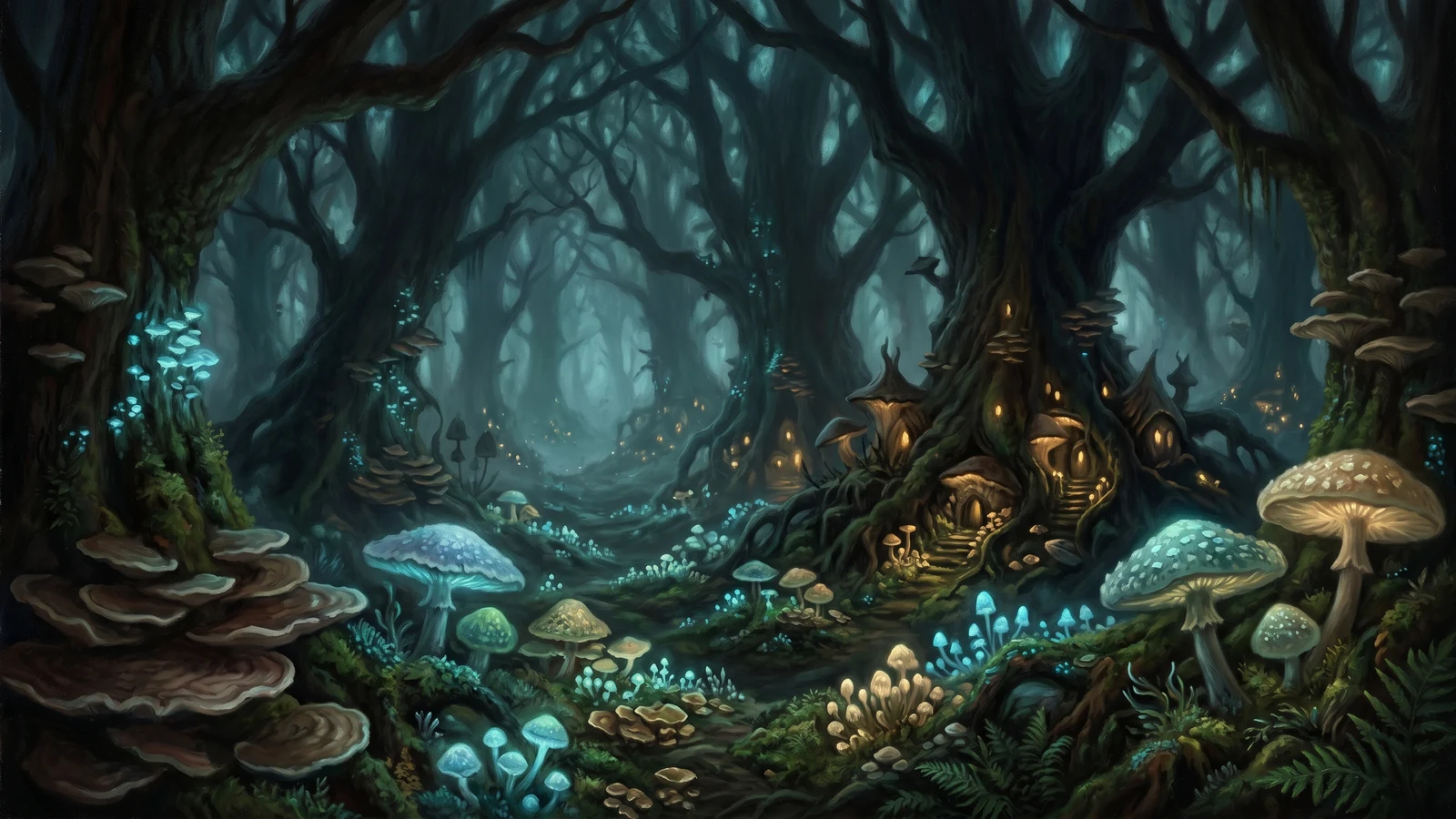
A vast forest stretching across the southern Krenglelan Range and into the lowlands beyond, the Everwood is no ordinary forest. It is a single, continent-spanning organism that has been growing for millennia.
The Living Forest
Nothing can rot in the Everwood. The trees cannot die. When a branch falls, it doesn't decay. It lies there, slowly absorbed back into the greater whole. The entire forest is one organism, its root systems interconnected beneath the soil in a web that extends for hundreds of miles.
The canopy is so dense with interlocking branches that no light reaches the forest floor. Below the green ceiling lies a twilight world, and in that darkness the understory has become entirely fungal. Vast carpets of mushrooms, shelf fungi the size of tables, and bioluminescent growths that provide the only illumination. The air is thick with spores.
The Myushli Villages
Scattered through this fungal understory, the Myushli have built something between villages and hive-colonies. Their settlements glow faintly in the darkness, bioluminescent fungi cultivated to mark paths and buildings, structures grown from living mushroom-flesh rather than constructed.
The Myushli are genuinely kind. They believe the "beautiful transformation" they offer, infection by their spores and gradual absorption into the collective, is a gift. Their villages are populated by Myushli and by "converts": travelers who wandered too close, breathed too deeply, and now serve with glassy-eyed devotion. The converts do manual labor, tend spore-gardens, and seem content. The Myushli don't understand why outsiders fear them. When they say "join us," they mean it as an invitation to paradise.
Travelers who must pass through the Everwood learn to wrap cloth over their mouths and noses, to never stop moving, and to never, ever accept hospitality.
The Fire Cycle
Because nothing rots, deadfall accumulates. Fallen branches pile atop fallen branches; dead leaves carpet the ground in drifts yards deep. The Everwood becomes a tinderbox.
Every few decades, catastrophic fire sweeps through. Lightning strikes, careless travelers, or sometimes the Myushli themselves set the blazes deliberately, since they survive underground and benefit from the nutrient release. The fires burn hot enough to consume even the seemingly immortal wood, turning vast swaths of forest to ash.
But the Everwood regenerates with terrifying speed. Within weeks of a fire, new growth erupts from the roots. Within a year, a burned section is dense forest again. The cycle continues.
Dangers
The Roots: Sleeping on the forest floor in any season but winter will cause the roots to find you. They grow fast in the Everwood, fast enough to envelope a sleeping body overnight. By morning, you're wrapped in a cocoon of living wood. By the following week, you're gone. Only the cold of winter slows them enough to make ground-sleep survivable.
The Spores: Myushli aren't the only things releasing spores. The fungal understory is alive with them: most harmless, some hallucinogenic, a few deadly. Symptoms of spore-sickness include vivid waking dreams, loss of direction, and an overwhelming desire to sit down and rest.
The Sameness: The Everwood looks the same in every direction. No landmarks, no variation, just endless trees and fungal twilight. Getting lost is almost inevitable; many who enter never find their way out.
The Water Drain
The Everwood's root network extends far beyond the visible forest, reaching deep into the water table and drinking greedily. South of the Everwood, the land becomes the Piktiniti Desert, and the desert exists largely because the Everwood has drained it dry. Every drop of water that would flow southward is instead pulled north, feeding the immortal forest's endless growth.
Autumn
For a few weeks each year, the leaves fall. The canopy thins, and for the first time, the sky becomes visible from the forest floor. Light reaches the understory, and the fungal growths retreat into dormancy.
This is the safest time to travel the Everwood: the spores are less active, the Myushli more sluggish, the roots slower to grasp. But it's also the driest time, and the accumulated deadfall is at its most dangerous. Many fires begin in autumn.