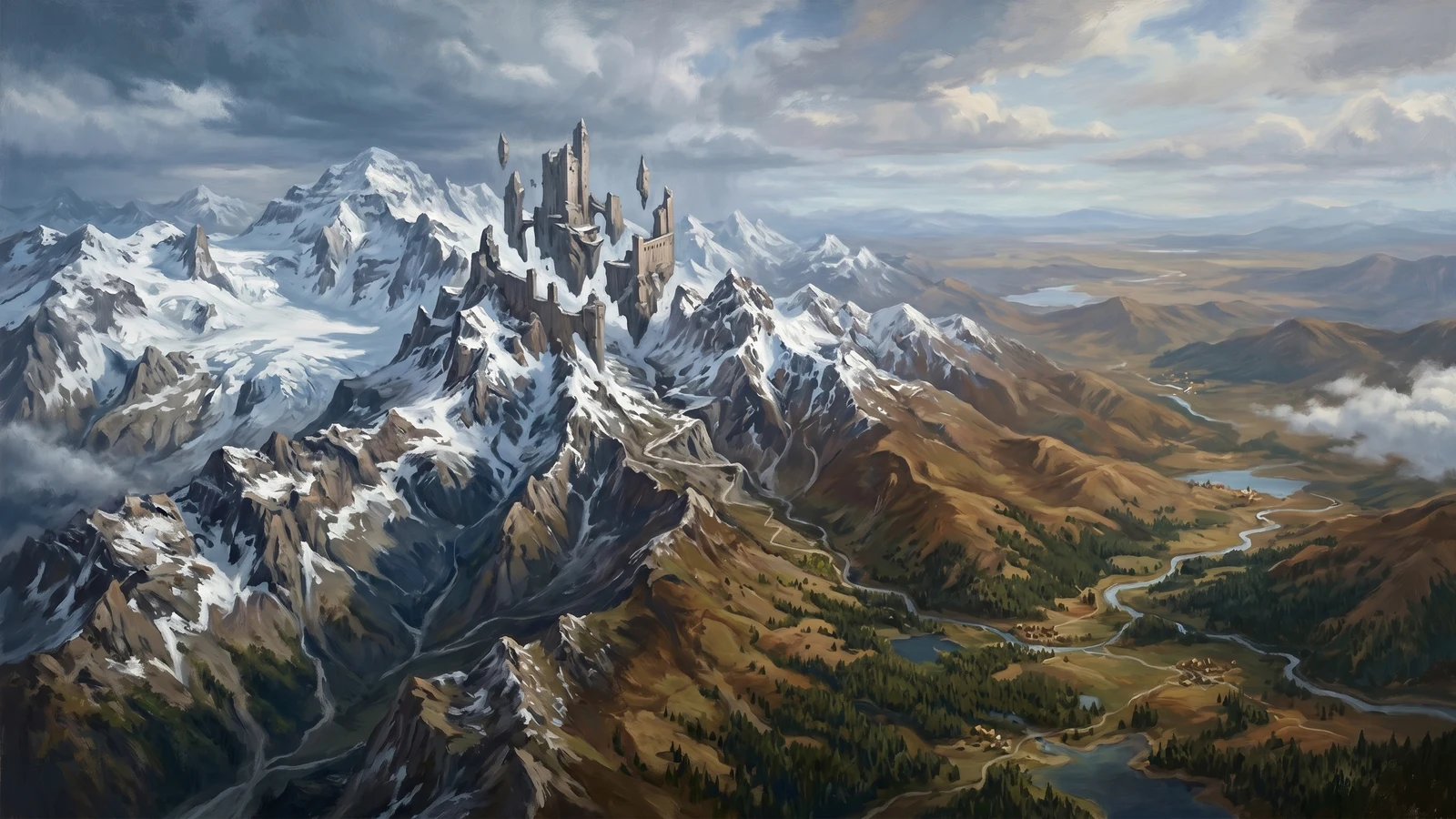
Geography
The Kharvorn Mountains are a massive diagonal range that defines the heart of Clueanda, running from the center-north down to the southeast and spanning roughly half the map. Unlike the east-west Nysanna Range to the north, the Kharvorn cuts diagonally across the continent, creating the fundamental division between the frozen northern reaches and the temperate lands of the Middle Sea.
Position and Extent
- Northwest terminus: Meets the eastern tip of the Nysanna Range at approximately a 120-degree angle
- Southeast terminus: Ends near Adron, where the mountains give way to the coastal states of the Middle Sea
- North: The Celedrim Plains and their forests (Winterwood, Plutochranes) lie beyond the range
- South: The temperate Middle Sea region and its coastal kingdoms
Climate Barrier
The Kharvorn is a hard climate boundary. North of the range lies perpetual winter, the frozen steppes of the Celedrim Plains. South of the range, the climate warms dramatically, supporting the agricultural lands and trading cities of the Middle Sea coast. The peaks are white-capped with heavy snowfall, while the foothills transition into the brown and green of the lower lands.
Sub-Ranges
The Kharvorn comprises numerous distinct mountain ranges along its length, from northwest to southeast:
- Pelmar Mountains
- The Knives
- Nirvanis Mountains
- Aquendrakons
- Gymelstik
- Argysis (Winterwood Forest lies to its north)
- Hephake
- Myorna (Plutochranes Forest lies to its north)
- Ngül
Political Climate
The Kharvorn's high passes and interior valleys host Ikriel — the frost-transformed pixie predators who haunt cold environments across the world. They hold no territory, moving through it, hunting travelers and feeding on whatever warmth they find. No range of the Kharvorn is entirely free of them, and the passes draw them because the passes draw prey.
The northern sub-ranges have changed hands within living memory. Two centuries ago the brother-dragons Rothogomos and Tepheranos came down on the dwarven kingdom of Argysis and broke it, and the southern basin of Anarak fell to dragon rule in the same generation. That fall pushed a wave of dwarven refugees east into Hephake and left the upper Kharvorn split between two dragons who have not moved against each other since.
TODO
What Makes It Interesting
TODO
What Will Go Wrong
TODO
Egül Mountains
A sub-range of the Kharvorn Mountains, positioned north of the giant-infested basin that lies between Camaran (to the west) and Adron (to the south). This region is remote and treacherous, avoided by most travelers.
Nedgar's Castle
Deep within the Egül Mountains stands the ruins of Nedgar's Castle, a collapsed fortress of impossible architecture. Nedgar was a reclusive hermit mage, famous throughout the realm for his paragon attunement to stone. He built a castle that defied the laws of physics and geology, with towers that twisted in impossible angles and walls that seemed to float without support.
When Nedgar died, the castle collapsed, as if his will alone had held the structure together. Now the ruins are inhabited by animated stone beings: golems, statues, and fragments of architecture that aimlessly walk the halls, endlessly performing tasks for a master who no longer exists.
The animated stone guardians will not permit anyone who lacks stone attunement to enter the ruins. Those who try are crushed by falling masonry or torn apart by stone hands. However, for those rare geomancers with stone attunement, the ruins are accessible—and within lie multiple earth-stones, crystals of concentrated geomantic power that Nedgar collected during his lifetime.
Desert of One Million Shards
Northwest of Ta Minn lies the Desert of One Million Shards—a vast expanse of shattered glass stretching as far as the eye can see. The desert's surface glitters under the sun, beautiful and deadly in equal measure. Walking across it is treacherous, as the sharp glass edges can slice through boots and flesh alike.
At the center of the desert lies a massive crater containing a huge lake. In the middle of that lake rests Ulm, a colossal meteorite that struck in ancient times, creating both the crater and the lake. The impact also melted and scattered the surrounding rock into the endless field of glass shards that now defines the region.
Blue Shale Peaks
Many warfaring giants live here. Massive skeletons litter the ground from their destroyed bodies. One of the more powerful giant lords recently died, resulting in a large power vacuum.
Ruins of a halfling civilization present. Nothing of the city, known as Tem Shyanna remains, but the fortress walls do. Trapped within are a small enclave of halfling explorers, taking care of an old, senile, fire attuned halfling, who keeps them warm during the winter and provides the warmth for their food. The man is too senile to move, and trying to force him out makes him go berserk.
The walls protect the halflings from the giants, but not the wyverns. Either way, they are trapped here. Have been living here for 5 years now.
Grey Mountains
A sub-range of the Kharvorn Mountains positioned between Hephake and Myorna, named for the perpetual overcast that shrouds their peaks. The Grey Mountains are sparsely populated, heavily forested at lower elevations, and home to things that prefer to avoid the attention of their more powerful neighbors.
Geography
The Grey Mountains are mid-sized by Kharvorn standards—not as dramatic as the central ranges, but substantial enough to form a barrier between the dwarven and Sivakr territories. Dense pine forests climb the lower slopes, thinning to alpine meadows and bare rock above. The peaks rarely see direct sunlight; heavy cloud cover is the norm year-round, giving the range its name.
The Mnurvlyon
The Grey Mountains' most notable inhabitants are the Mnurvlyon, a people born of ancient unions between mountain giants and Kharvorn dwarves. They stand eight to ten feet tall, broader and more heavily built than either parent race, with the durability of both.
The Mnurvlyon live in scattered steadings throughout the Grey Mountains, neither fully accepted by giants nor dwarves. They are taciturn, isolationist, and deeply suspicious of outsiders. Their settlements are built into mountainsides, part giant hall and part dwarven hold, sized for their unusual frames.
They mine, they forge, they keep to themselves. Trade with lowlanders is minimal and conducted at arm's length, literally, through window-slots in their steading walls. They have no interest in Hephakean politics, Myornan intrigues, or the broader conflicts of the world. They want only to be left alone.
This wish is not always granted. Both Hephake and Myorna have attempted to bring the Mnurvlyon into their spheres of influence. Both have failed. The half-giant-dwarves are too few to be worth conquering and too stubborn to be worth negotiating with.
The Bears
The Grey Mountains are home to enormous cave bears—fourteen feet at the shoulder, territorial, and utterly unafraid of anything. The Mnurvlyon have reached an understanding with the bears over generations: certain valleys belong to the bears, certain valleys to the Mnurvlyon, and the boundaries are respected by both sides.
Outsiders who wander into bear territory rarely survive long enough to understand their mistake. The bears are not malicious, simply apex predators who do not distinguish between a lost traveler and a meal.
The Howling
At night, especially during full moons, strange howls echo through the Grey Mountains. The Mnurvlyon bar their doors and refuse to discuss the matter. The few outsiders who have investigated report finding wolf tracks of unusual size, claw marks on trees at heights no natural wolf could reach, and occasionally, human belongings abandoned in the forest.
Whether the Grey Mountains harbor true werewolves, some other lycanthropic curse, or simply very large and very cunning wolves, the Mnurvlyon are not saying. They have clearly reached some accommodation with whatever hunts their mountains at night. Outsiders are not included in this arrangement.
Relations
The Grey Mountains form a buffer zone between Hephake and Myorna—two powers that deeply distrust each other. Neither wishes to see the other control the passes through the Grey range, so both tacitly accept Mnurvlyon autonomy as preferable to the alternative.
The Mnurvlyon exploit this dynamic with quiet skill. They trade with both sides, favor neither, and ensure that any attempt at annexation would be more trouble than it's worth. Their isolation is a political choice as much as a cultural one.
Myorna
A state in the Kharvorn Mountains.
TODO
Ngül Mountains
The northern arm of the Gül Mountains, forming the upper boundary of the Breidleheis basin. The Ngül range is the most heavily settled of the three Gül ranges, with the majority of Güli giant clans claiming traditional territories among its peaks and valleys.
Geography
The Ngül are lower and more weathered than the central Kharvorn peaks, their slopes gentled by millennia of wind and ice. Deep valleys cut between the mountains, providing sheltered grazing land for the giant herds. The northern faces drop steeply toward the lowlands of Camaran and Adron.
Giant Holdings
Most Güli clans maintain permanent winter lodges in the Ngül valleys—massive stone structures sized for giants, often built into cliff faces or around natural hot springs. Summer sees the clans disperse across the basin to follow their herds, but winter draws them back to ancestral territories passed down through generations.
The largest concentration of giants lives in the eastern Ngül, near Gülheim. Proximity to the king brings prestige (and obligations), making these territories the most contested in inter-clan politics.