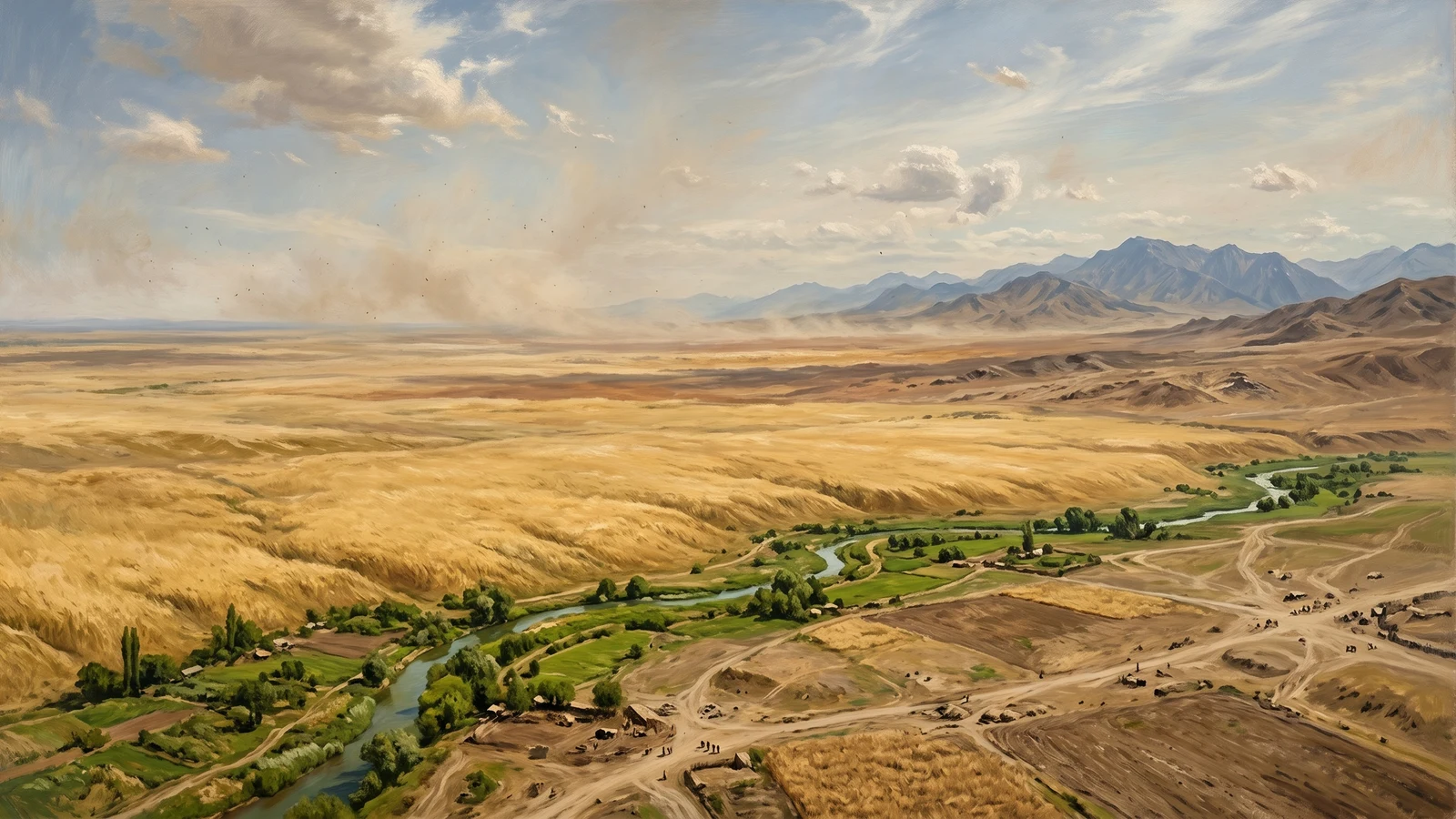
A vast expanse of dry grassland stretching east from the three eastern forests (Pystinwood, Milrar, and Telwood) toward the distant Kharvorn Mountains and the territories beyond. The steppe is named for Aziirn, a legendary figure—variously described as a giant, a hero, or a god—who is said to have walked these plains in ages past, his footsteps so heavy they flattened the land.
Geography
The Steppe of Aziirn covers an enormous area—several hundred miles east to west and north to south—though its exact boundaries are disputed. For practical purposes, the steppe begins where the eastern forests end and continues until the terrain changes: mountains to the east, more fertile land to the south, frozen tundra to the north.
The West Edge: Where the steppe meets the eastern forests. This transitional zone shifts with climate—the forests advance during wet periods, the steppe during dry ones. The boundary has moved miles in either direction within living memory.
The Grand Tolkarsus Valley: The river cuts across the southern portion of the steppe, its valley a ribbon of green through otherwise endless grass. Most travel across the steppe follows the river.
The Central Plains: The heart of the steppe—flat, dry, and featureless. The grass grows waist-high in spring and dies to brown stubble by late summer. Navigation depends on sun position and stars; there are no landmarks.
The Eastern Rise: The steppe gradually gains elevation toward the east, eventually becoming the foothills of the Kharvorn range. This eastern portion receives slightly more rainfall, supporting scattered trees and richer grass.
Climate
The steppe is defined by its climate: hot summers, bitter winters, little rainfall, and constant wind. The soil is fertile enough, but the lack of water limits what can grow. Grasses dominate; trees survive only along watercourses.
The Wind: The steppe is never still. Wind blows from the east in summer, from the north in winter, varying in intensity but never stopping. Travelers learn to turn their backs to it or go mad.
Seasonal Extremes: Summer temperatures can kill; winter temperatures can kill faster. The steppe offers no shelter—no forests, no hills, no caves. Survival depends on preparation.
Inhabitants
Nomadic Herders: The steppe's primary inhabitants are nomadic peoples who follow grazing animals—horses, cattle, sheep—across the grasslands according to seasonal patterns. These groups are diverse, speaking different languages and following different customs, but sharing an understanding of steppe survival.
The Empty Quarter: The central steppe is genuinely uninhabited for much of the year. Even the nomads avoid the deepest interior during the harsh seasons. Anyone encountered there is either lost, desperate, or extremely dangerous.
Border Communities: Where the steppe meets other terrain—along rivers, at forest edges, in foothills—small settled communities survive. These serve as trade points between the nomads and the wider world.
Why It Matters
The Steppe of Aziirn is primarily an obstacle. It separates the Westwilds from the Kharvorn region, the orc states from the eastern territories, the known from the unknown. Crossing it is possible but difficult; avoiding it is usually easier. The steppe's emptiness creates a buffer zone that has shaped politics for centuries—invasions bog down, trade routes detour, and populations stay separated.
The Grand Tolkarsus provides the only practical route across the steppe's southern portion, making Tarn's control of the river strategically important far beyond the immediate region.