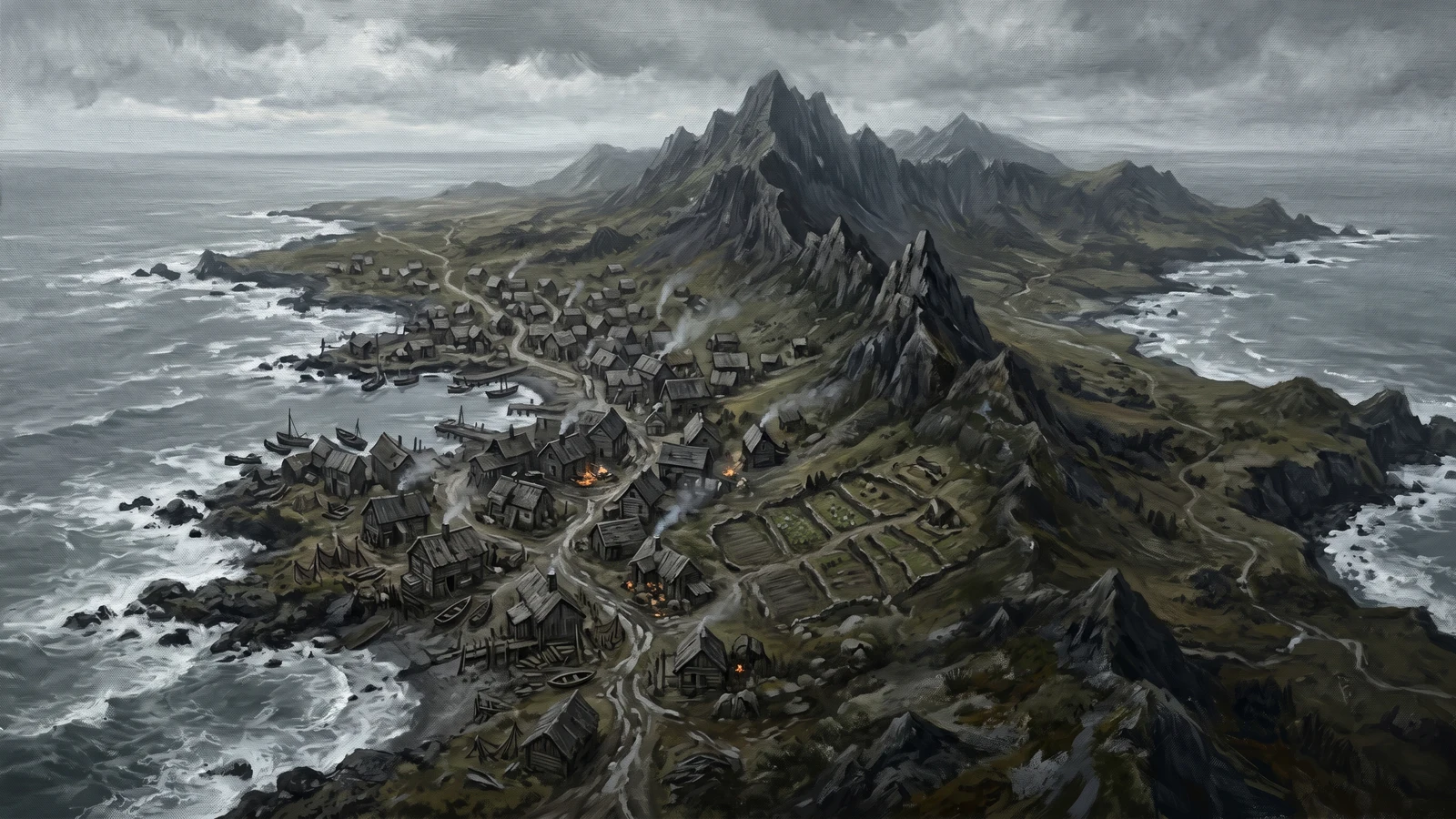
Tamadrez is the northern half of Pesalolo, the half the Freedom Mountains keep on the far side of the slave coast, and on paper it is a free country. In practice it is the part of the island Gorath decided was not worth the cost of conquering. There is no king and no capital, only a string of harbor villages along the northern shore: Nadang, Embok, Pelaka, and a dozen smaller, each run by its own headman and represented to the empire by a Harbor-Reeve who answers for the tribute. The villages share a coast, a creole tongue three centuries in the making, and a common understanding of what their freedom is actually worth.
It is worth exactly what they pay for it, and they pay constantly. Gorath does not garrison the north because it does not need to. The mountains wall it off, Agtakkeri's dragon-haunted waters wall off the sea approaches, and the only thing the empire wants from Tamadrez it can extract without ever stationing a legion there. The north's whole political life is the management of that extraction.
The price of not being conquered
Tamadrez pays Gorath a tribute, and part of the tribute is people. The headmen are handed a levy each season, a count of bodies the north must produce for the ships, and they fill it the way such things are always filled: with debtors, with the convicted, with the surplus poor, with whoever a village can least afford to defend. It is smaller than the mass extraction of Drasnian dwarves on the southern coast, and it is the more corrosive for being self-inflicted. The Slaver's Coast is robbed. The north sells.
The levy comes due at Nadang the week after the long tides. The reeve's clerk reads the count from a slate, and the headmen who are short stand at the back and do not meet each other's eyes. No one has ever rioted on a levy day. Everyone has done the arithmetic that says it is better the man beside you than the man in your own house.
The rest of the tribute is service. The northern harbors provision the slaver fleet, repair its hulls, sell it rope and salt fish and fresh water, and ask no questions about the cargo two coves over. This is the bargain that keeps the legions out: be useful enough to be worth more standing than razed, and poor enough that razing earns nothing.
The navigation-fee economy
The thing that actually runs the north is graft, and the graft has a name. The navigation fee is a payment a village makes so that the Slavewatch patrols will be elsewhere on a chosen week. It is collected on the Tamadrezan end by the Harbor-Reeve of Nadang, Kishuntar, who carries it down through the passes to the fortress and into the ledger of Helmo, Tribune Volso's broker. This is one mechanism with two ends, not two arrangements. What Slavewatch books as a comfort-fund donation is what a northern headman books as the cost of a quiet week. Beneath it sits a whole economy of smaller bribes, festival gifts to garrison sergeants, and brokered debts, kept turning by creole middlemen like Tamboxal who know everyone's accounts and settle them without anyone going to law.
The fee began as a smuggler's tool, a way to move untaxed fish and contraband past the patrols. It still does that. It also, in a fact known to almost no one, moves escaped slaves: the same patrol-blind window a village buys for its contraband will pass a column of fleeing Drasnians just as well, and the man who sets the windows has quietly made the empire's own bribe-channel the safest road off the island. The collaborator the north most despises is the reason the escape network works at all. That contradiction is not resolved anywhere; it simply sits under the coast's whole economy, paying for itself either way.
Not looking south
The defining habit of the Tamadrezan north is the refusal to look south. A people who provision a slave trade and fill a body-levy to stay free do not survive on it morally; they survive on it by not examining it. The creole culture of the harbors prizes the near and the small: your boat, your debts, your village's count. The larger horror across the mountains is treated as weather, a fixed condition you neither caused nor can change. Outsiders read this as cowardice or complicity, and it is both, and it is also three centuries of a people learning that the ones who looked south and acted on what they saw are not around to give advice.
The resistance that waits
There is resistance, and its leaders know better than to spend it. Ixchanil holds the north's scattered cells folded shut, waiting for one opening: a Gorathi succession crisis, the moment an emperor falls and the legions on Pesalolo turn inward to fight over the throne. The plan is coordinated across the mountains with Torven Vorekan, who organizes the enslaved Drasnians of the Slaver's Coast, so that when the rising comes it comes on both coasts at once. It is funded from outside. A Trømgar agent named Sigvar Dnyhak works the northern harbors under a trader's cover, moving the Warcouncil of Levke's gold into hands that will need it the day the watching stops. And the sea itself has become an asset: smuggler-captains like Achtomo carry the freed north through Agtakkeri's waters, the one stretch of coast no imperial hull dares follow them into.
None of it has moved yet. The opening has not come, the gold accumulates, the cells stay shut, and the levy comes due every season on schedule. The north is a held breath, and the question is only whether it is released on purpose or knocked loose by accident.