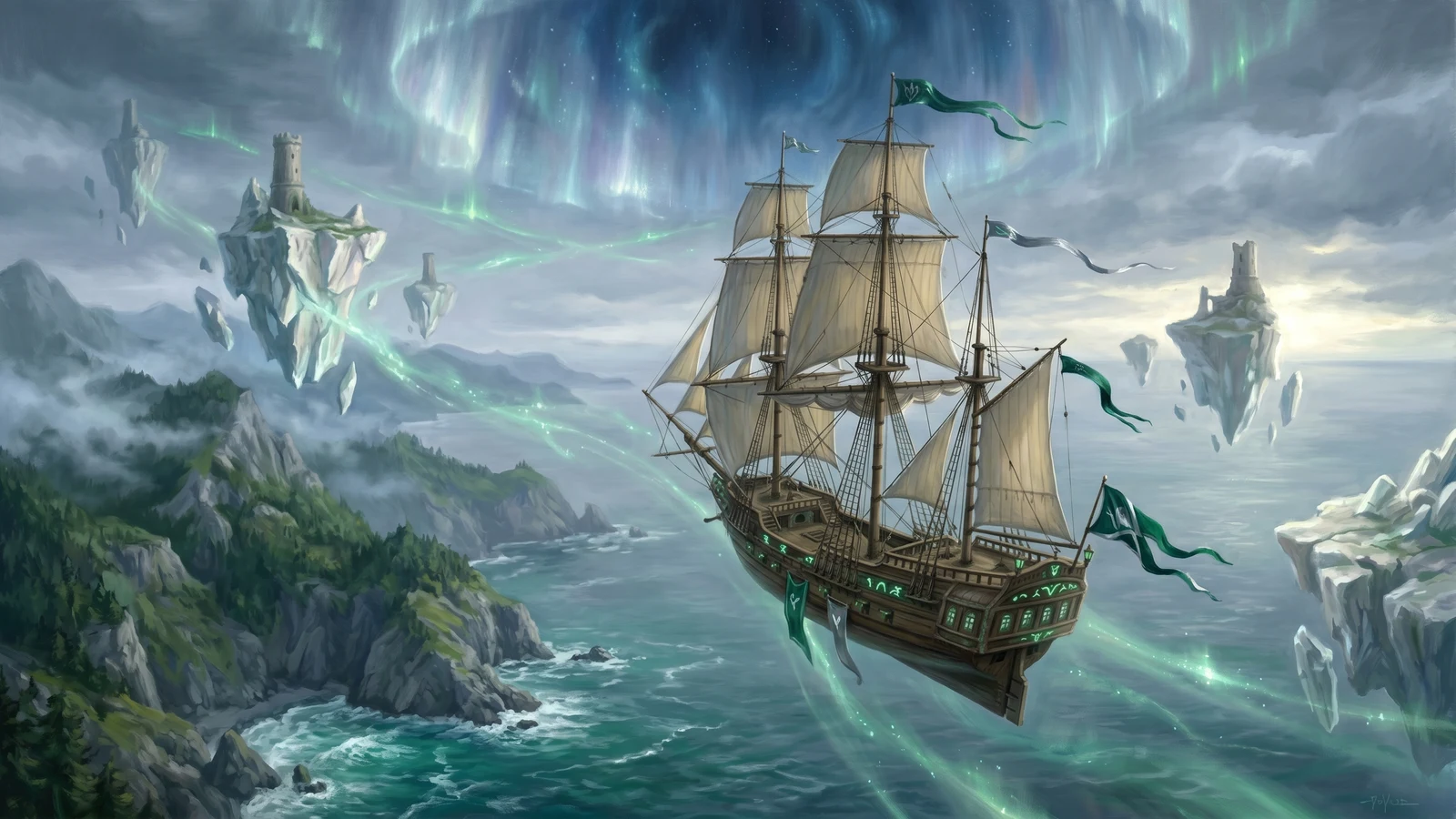
The Astral Sea is not still. Vast currents sweep through its depths, carrying the floating islands in slow, predictable orbits. Where these currents pass close to the Material Plane, in the transitional zone where astral ocean becomes material atmosphere, they create invisible highways across the sky. The sky trade of Alaria depends entirely on these currents.
The Nature of Currents
The Astral Plane exists as a massive ocean above the Material Plane, and like any ocean, it has currents. These are natural phenomena, not magical constructs, not the will of any god, not the dreaming of Lyzaria. They flow in circular patterns, carrying the floating islands of the Astral Sea in slow, centuries-long orbits.
The currents extend downward into the transitional zone where the Astral Sea meets the Material Plane's atmosphere. Ships cannot reach the true Astral Sea, which would require ascending thousands of miles into increasingly dense astral solution, but they can ride these currents where they dip closest to the ground: a few thousand feet above the surface.
Souls, rising toward Aurus after death, move independently of these currents. The currents are physical (or astral-physical) phenomena; the soul's journey is metaphysical.
The Five Great Currents
Five major circular currents sweep across Alaria, each completing its circuit over the course of roughly a year. They vary in size, altitude, and danger.
The Emerald Circuit
The central and most-traveled current. It sweeps over Gorath, the Emerald Coast, and Kyagos in a broad oval, passing conveniently close to the continent's wealthiest trade centers. Ships on this route can reach the major markets of the Shacklands and Inner Rim without ever touching the dangerous northern routes. Most sky captains spend their entire careers on this circuit.
The Ophrenian Loop
The northwestern current passes over Clueanda, including the Western Isles, the North Sea, the Northern Plains, and Ophrenia. This current overlaps with the Emerald Circuit near the Middle Sea, making it the primary connector between the central trade routes and the Ophrenian powers. Adron and Tornia, both with major sky shipyards, sit near this convergence point.
The Elder Current
A smaller loop over the Elder Wilds and the Alaric Ocean. Less commercially important, but provides access to remote regions that would otherwise require months of overland travel.
The Frost Circuit
The northeastern current sweeps over the Alaric Ocean, the Frost Marches, and the Northern Isles. Extremely dangerous. The route passes through regions plagued by blizzards, dragons, and the hostile environment of the far north. Few ships attempt it; fewer return.
The Nysanna Loop
The far northwestern current clips the Nysanna Range at the North Sea. Massive storms, territorial dragons, and perpetual blizzards make this route effectively impassable. Last Chance, a fortress refueling station on the range's edge, marks the point of no return; ships swept past it are rarely seen again.
Southern Currents
Several currents exist in the far south and southwest, but they are commercially useless. Some loop off the edge of the known map, meaning ships would be carried into Celestia, the flip-side of the Material Plane, with no practical way to return. Others are isolated circuits with no connection to the main network. The southern seas remain the domain of traditional ocean shipping.
Current Width and Speed
The currents are a few miles wide, enough for ships to maneuver but tight enough that collisions remain a real risk in poor visibility. Fog, clouds, and storms force constant course corrections to stay centered.
Ships on a current travel roughly ten miles per hour. With a favorable tailwind (sails still work at altitude), speed increases modestly; headwinds slow progress. Travel times are predictable enough for scheduled trade, but weather variance means arrivals are approximate.
Changing Currents
Where the great currents overlap, ships can transfer between routes. This requires leaving the stable flow of one current and crossing the dead zone to catch another. Without the current's pull, a ship burns expensive Aether to motor through the gap.
These convergence points are the most valuable locations in the sky trade. The cities beneath them, particularly those near the Middle Sea, benefit enormously from the traffic passing overhead.
Astral Stones
During the massive earthquakes that periodically shake the Astral Plane's floating islands (roughly once per millennium), chunks of astral stone break free from the islands' lower crusts and plummet toward the Material Plane. These iridescent gray stones possess a unique property: buoyancy in the Material Plane's atmosphere.
Each stone has an equilibrium point, an altitude where its natural buoyancy balances against the pull of the material world. This ranges from a few hundred feet to several thousand feet, depending on the stone's density. Low-density stones float lower; high-density stones rise higher (the highest reach altitudes where stars remain visible during daylight, and are often inhabited by the Synger).
Astral stones that reach the surface are incredibly valuable. Some lodge in the ground upon impact; others drift through the skies until netted. Either way, extracting and securing one is a massive capital investment, the foundation of the entire sky trade.
Ship Construction
A sky ship is, at its core, a traditional sailing vessel suspended from an astral stone by chains. The ship hangs below the stone, which provides lift; the ship's sails and Aether engines provide lateral movement and altitude control.
The critical component is the chain. Regular metal cannot maintain a connection between astral matter and material construction; the chain would phase through the stone or the ship. Sky ship chains are forged from astral steel: an alloy of iron and astral filings.
Astral filings are ground from small, unusable astral stones, fragments too small to lift a vessel but still possessing the transitional properties of astral matter. The filings are smelted with iron to create astral steel, which can simultaneously grip astral stone and connect to material-world construction. The Dwarven holds of the Thunderdark Peaks produce the finest astral steel, though several human smithing traditions (particularly in Adron) have developed competitive techniques.
If a ship's chains are cut, the stone continues drifting on its current while the ship plummets. The stone might be recovered eventually, or might drift forever. This makes chain-cutting the ultimate threat in sky piracy.
Aether engines
The astral currents provide movement across the sky, but ships need propulsion for three critical operations: transferring between currents, maneuvering for docking, and maintaining altitude during station-keeping.
Aether engines provide this propulsion. Aether, an exotic meta-fluid that arrived in Alaria from the planar stack Lanthornia, exists invisibly throughout the atmosphere; it is not native to the world and not one of the four sources of Alarian magic. Sensing and extracting it is an exotic working, not a chemistry that could be taught from a manual, and the only creatures who can do it commercially are the aether-tappers, who harvest raw Aether and fix it with water into usable fuel.
The engine mechanism involves Lanthornium, an uncommon gray-blue stone that requires expensive purification. When purified Lanthornium vibrates at a specific frequency and contacts processed Aether, the Aether rapidly expands and discharges as it slips back toward the insubstantial, driving pistons or turning propellers. Well-designed engines use self-striking mechanisms: the initial strike causes vibrations that trigger subsequent strikes, creating a sustained power cycle similar to a steam engine. What the cycle burns is the release of an off-world substance, not a combustion that any foundry could copy or scale.
Aether is expensive. A ship on the currents uses little, just minor course corrections. But burning Aether to motor between currents, hold position during combat, or chase down another vessel consumes fuel rapidly. This cost shapes sky trade economics: only the wealthiest merchants can afford to deviate from the currents, and pirates who burn Aether to catch prey must ensure their prize is worth the fuel.
Aether-tappers
The extraction of Aether from the atmosphere requires creatures sensitive to its presence. Aether-tappers possess this sensitivity, an adaptation that developed after Lanthornia's eruption deposited Aether across Alaria. They pull raw Aether from the air using methods that resemble both breathing and weaving, then process it with water into the liquid fuel that powers engines.
Aether-tapper clans operate wherever the sky trade reaches, but the largest concentrations cluster around major docking hubs. Prices vary by location: isolated towers pay premiums, while competitive markets near convergence points offer better rates. The goblins guard their extraction techniques jealously; attempts to replicate the process without goblin involvement have consistently failed.
Navigation
At cruising altitude (typically 1,500-2,000 feet), ships operate above most weather but not above clouds. Poor visibility is constant; midair collisions are a real danger. Captains navigate primarily by dead reckoning, using the current's predictable flow to estimate position.
Experienced captains develop a feel for the current itself. Souls passing through the Astral Sea are slightly influenced by the currents, and captains with strong intuition can sense where the current runs strongest. This skill, somewhere between navigation and divination, separates competent captains from great ones.
The currents' stable altitude helps with mountain ranges; the current rises over peaks rather than driving ships into them. However, this means the current can be 200 feet above ground in some locations and 2,000 feet above in others, complicating docking.
Docking Towers
Sky ships cannot simply land. Their astral stones want to rise to equilibrium; bringing a ship to ground level requires burning Aether to motor downward, then holding position against the stone's buoyancy.
Docking towers solve this problem. These structures, typically 100 to 200 feet tall, allow ships to approach at a lower altitude and tie off rather than fighting their way to ground level. The ship moors to the tower's platform, exchanges cargo and passengers, then releases and floats back to cruising altitude.
Tower construction is expensive. The structures must withstand the forces of ships pulling against their mooring, weather exposure at altitude, and the constant traffic of heavy cargo. Most docking towers are owned by cities, though wealthy merchant houses and contested frontier territories operate their own. All charge substantial tariffs and docking fees.
The atmosphere at docking towers resembles a high-security port more than a casual harbor. The stakes are too high for informality. A mishandled mooring can cost a fortune in lost cargo, a damaged ship, or a drifting astral stone. Tower operators run tight operations with strict protocols.
Mountain Bridges
In mountainous regions, the current passes close enough to peaks that ships can reach fixed platforms, bridges extending from cliffsides at current altitude. These are cheaper to build than freestanding towers but limited to specific geography. The Nysanna Range's Last Chance is the most famous example: a fortress-monastery built on a mountain bridge at the edge of passable sky routes.
Major Trade Hubs
The sky trade concentrates wealth in specific locations:
Gorath dominates the Emerald Circuit. Its docking towers never sleep; the slave trade that defines the nation's economy relies heavily on sky transport. Slaves can be moved faster and in larger numbers by air than by sea or land, and the journey is far less likely to be interrupted by naval patrols or border crossings.
Kyagos shares Gorath's position on the Emerald Circuit and its involvement in the slave trade. The two powers maintain an uneasy cooperation; competition for sky trade could easily escalate to open conflict.
Adron (particularly the city of Shipmarsh) builds sky ships. The Middle Sea's traditional shipwrights adapted their craft to astral construction, and Adron's position near the Emerald-Ophrenian convergence means easy access to both major trade networks. Adrak, the capital, handles financing; its banks underwrite most of the continent's sky vessels.
Tornia competes with Adron for the Ophrenian shipbuilding trade. Its location on the same convergence point means ships built in Tornian yards can reach any viable route, and the marine underwriters of its Corvalin quarter (sea-hull and cargo risk through Ofrenian waters, never sky-routes) bank the deep credit Tornian shipwrights build against.
The Western Isles are notably absent from the sky trade. Reaching them by air requires passing through the Nysanna Loop or the Frost Circuit, both effectively impassable. The isles' economy remains tied to ocean shipping, creating a cultural and economic divide between the sky-trading powers and the maritime west.
Sky Piracy
Piracy in the skies differs fundamentally from its ocean equivalent. On water, a faster ship can run; in the air, everyone moves at the same speed (the current's). Escape requires burning Aether to motor off-current, an expensive gamble that pirates can match if they're willing to spend the fuel.
This creates a different calculation. Pirates don't chase; they ambush. Convergence points and docking approaches are the danger zones. Ships transferring between currents or descending to dock are vulnerable; ships cruising mid-current with no reason to slow are nearly impossible to intercept.
The ultimate pirate threat is the chain. Cutting a ship's astral steel chains, or credibly threatening to, forces immediate surrender. The ship falls; the cargo is lost; the astral stone drifts away forever. No captain risks that outcome for cargo insurance.
Pirate vessels need astral stones of their own, which means organized piracy requires substantial capital. Most sky pirates operate from legitimate-seeming trade vessels that turn predatory when opportunity presents. True pirate fleets with multiple dedicated raiders are rare and well-known; evading them is a matter of intelligence and route planning.
Military Use
Dropping fire from the sky is devastatingly effective. Armies with no counter to aerial bombardment have been routed by single sky ships. Fortifications designed to resist ground assault become deathtraps when the enemy approaches from directly above.
But military sky operations face constraints:
You cannot hold position for free. A ship on-current keeps moving; staying over a single location requires burning Aether to motor against the flow. Extended bombardment campaigns consume vast quantities of expensive fuel.
You cannot be everywhere. The currents go where they go. Regions away from the major routes are nearly impossible to threaten by air; the Aether cost of reaching them and returning is prohibitive.
Ground forces cannot support you. Coordination between sky units and surface armies requires precise timing; the ship cannot wait overhead while ground forces maneuver.
Despite these limitations, every major power maintains some sky capability. Even a small air presence forces enemies to disperse, fortify against vertical attack, and commit resources to anti-sky measures (of which few are effective). Nations under the major currents cannot afford to ignore the sky; nations away from the currents cannot afford to reach it.
Capital Investment
An astral stone of adequate size to lift a trading vessel represents a fortune. Most are owned by established merchant houses, state navies, or trade guilds rather than individual captains. A captain who owns their own stone has either inherited it, been extraordinarily lucky, or pulled off something worth asking about quietly.
The ship itself costs comparable to a large ocean-going vessel, substantial but manageable for a successful merchant. The chains (astral steel, custom-fitted) add considerably. The Aether engine (Lanthornium, complex mechanisms, specialized knowledge) adds more. Ongoing Aether costs depend on route and operations.
Total investment for a modest trading vessel runs roughly three times the cost of an equivalent ocean ship. Returns are proportionally higher: sky trade reaches markets that would take months to reach by surface, and carries cargo across terrain that would be impassable otherwise.
Trade Advantages
The sky trade's value lies in what it makes possible:
Overland reach. Ocean ships must find ports. Sky ships can reach any point under the currents, including landlocked cities with docking towers. Interior markets that would require caravans become directly accessible.
Speed. Ten miles per hour is modest compared to a fast sailing ship with good wind, but it's consistent. No doldrums, no contrary winds, no navigating through straits. Point-to-point travel times are predictable.
Capacity. Astral stones can lift enormous weights. Cargoes that would require multiple ocean vessels or months of caravan travel can move on a single sky ship.
Slave transport. This is the trade's ugly truth. Sky ships carry slaves faster, in larger numbers, and with less risk of interdiction than any surface method. Gorath and Kyagos built their sky fleets on slave money; the two industries are inseparable.
Who Cannot Participate
Regions away from the currents are excluded from the sky trade. Reaching them requires burning Aether for the entire journey, and for the return trip, if you want to come back. The Western Isles, much of the far south, and interior regions away from current paths rely on traditional surface transport.
This creates economic stratification. Nations under the currents have access to faster, more efficient trade networks; nations outside them compete at a disadvantage. The divide shapes Alarian geopolitics as fundamentally as access to ocean ports shapes surface trade.
Sky Sailors
The crews of sky ships come from mixed backgrounds. Some are trained in dedicated guilds that teach astral navigation, Aether engine maintenance, and the peculiarities of high-altitude sailing. Others are ocean sailors who crossed over, learning sky work as an extension of their existing skills.
The work is different from ocean sailing in key ways. The rigging serves a similar purpose (catching wind), but altitude effects and thinner air change the feel of the sails. Collision risk is constant; someone is always watching for other ships, and fog triggers heightened alert. The stone and chains require inspection (failure is catastrophic), and engine maintenance demands specialized knowledge.
Sky crews develop their own traditions, superstitions, and slang. They tend to view themselves as a cut above ocean sailors (who cannot claim to sail at the edge of the Astral Sea) and far above ground-bound merchants (who have never seen the stars in daylight from a high-floating stone). Whether this arrogance is earned depends on who you ask.
Navigational Intuition
The best sky captains develop a sense for the current, an awareness that verges on the supernatural. Souls passing through the Astral Sea are slightly influenced by the same currents the ships ride; captains who can feel this influence navigate more precisely, sense current boundaries before crossing them, and predict weather that surface-dwellers cannot anticipate.
This skill cannot be taught directly. It develops over years of high-altitude sailing, and not all captains achieve it. Those who do command premium wages; their ships arrive on schedule, avoid collisions, and make current transfers with minimal Aether expenditure.
Cultural Attitudes
The peoples of Alaria view the sky trade variously:
Gorath and Kyagos treat it as essential infrastructure, as natural as ocean ports and as tied to their economic identity. Sky captains occupy a social position comparable to successful merchant mariners.
Adron and Tornia emphasize craftsmanship. Building sky ships is a point of national pride, and the industry supports significant portions of both economies. Sky sailors are respected workers in an admired trade.
The Western Isles view the sky trade with suspicion or dismissal, an eastern obsession that does not reach their waters, and therefore does not matter. Some western mariners consider sky sailing a form of cheating that avoids the honest challenges of the sea.
Landlocked interior regions without docking towers see sky ships rarely, and usually only in military contexts. For many farmers and villagers, the sight of a vessel hanging from a floating stone is ominous rather than exciting. Nothing good has ever dropped from the sky onto their fields.