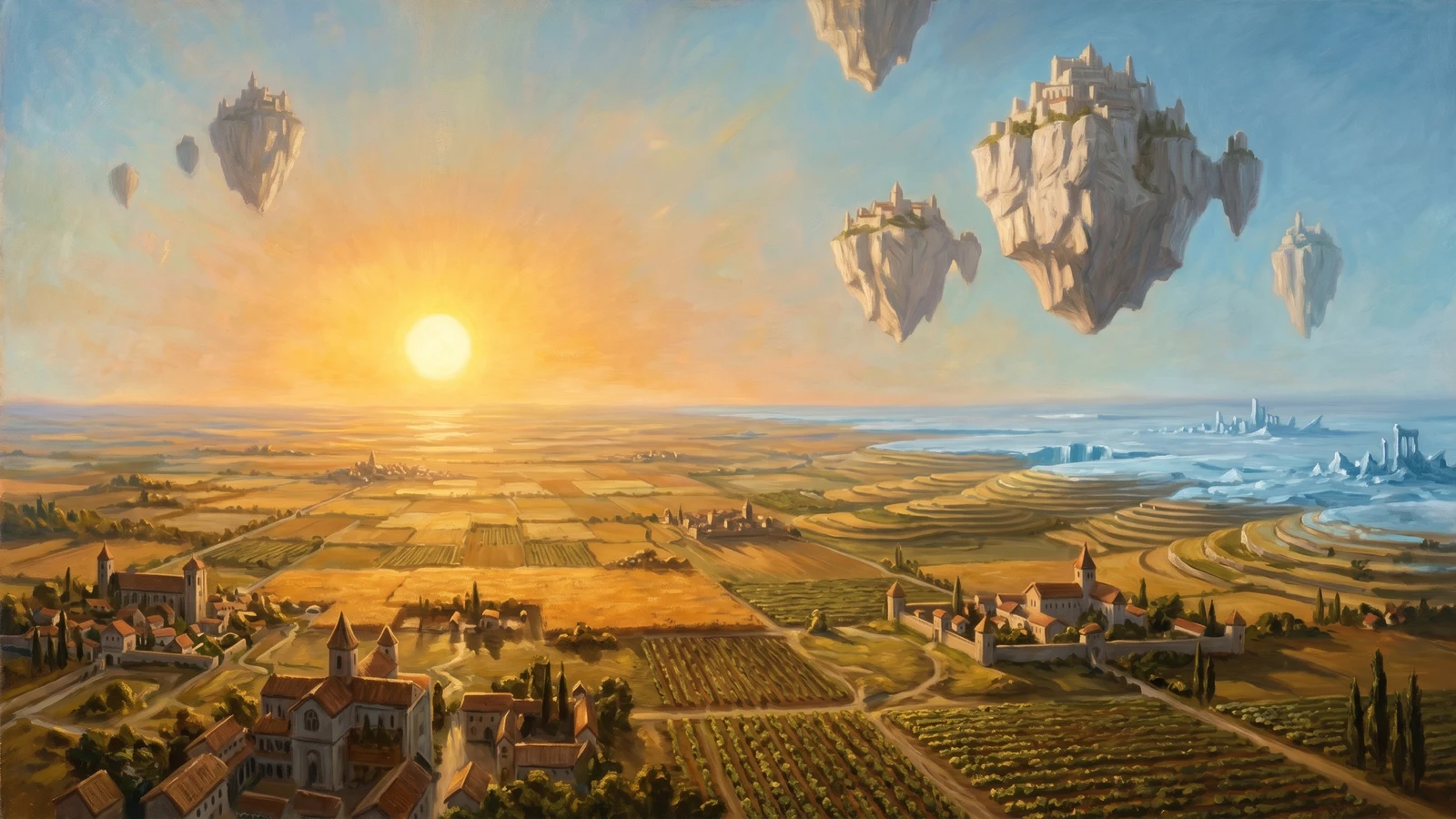
The Skies are the open air above the Surfacelands, the layer that begins where the last mountain peaks give out and rises until the stars hang close. Bryn crosses them once a day. Clouds and weather keep to the lower reaches, where the wind-lanes that sky ships ride run thickest. Higher up, the air thins past what a mortal chest can draw, the blue drains out of it, and the stars come out at noon. That upper band, airless by any surface reckoning, cold without bottom, is the Syngers' true home.
To a sky-ship captain the word means the working altitudes and nothing over them: the lanes a loaded hull can hold before the sail stops biting. The country above those lanes goes unrecorded on any surface chart. The Syngers live in it.
Where the air gives out
Every sky ship has a ceiling. A crew climbs until it starts to suffocate, then turns back, and the exact height shifts with the load a hull carries and the season. Below that line is the trade. Above it is the Syngers' country, and the one good both have reason to want.
Skystone, the dense high-floating rock that drifts in the band just beneath the stars, is what every sky fleet runs short of. The highest, heaviest grades sit above the breathing line, where no mortal crew can work them loose. Syngers can. They have no need of the stuff and little patience for the crews who beg for it, but now and then a vessel of theirs will trade a hold of skystone for something that caught its eye, on terms no captain can predict and none dares refuse. A house that secures a Synger supplier rises. When the Syngers lose interest, as they always eventually do, it falls again.
Beneath the stars
The stars themselves are not part of the Skies. They hang above it, the titan-glass orbs the Starborn tend from within, and the Syngers sail under them the way a coastal boat sails under cliffs: close enough to navigate by, never reached. The colored trails their vessels leave are sometimes visible from the ground on a clear night, taken for falling stars or for some trick of weather. The Syngers pass over a sleeping world without touching it.
When the planar light bleeds, in the killing-moon periods when looking up too long can kill a mortal outright, the Syngers go dark. Their trails vanish from the night sky for years at a stretch. Whether they withdraw or simply stop caring to be seen, no one below has ever learned. The trails return when the danger passes, and the surface takes their reappearance as the surest sign the sky is safe to watch again.