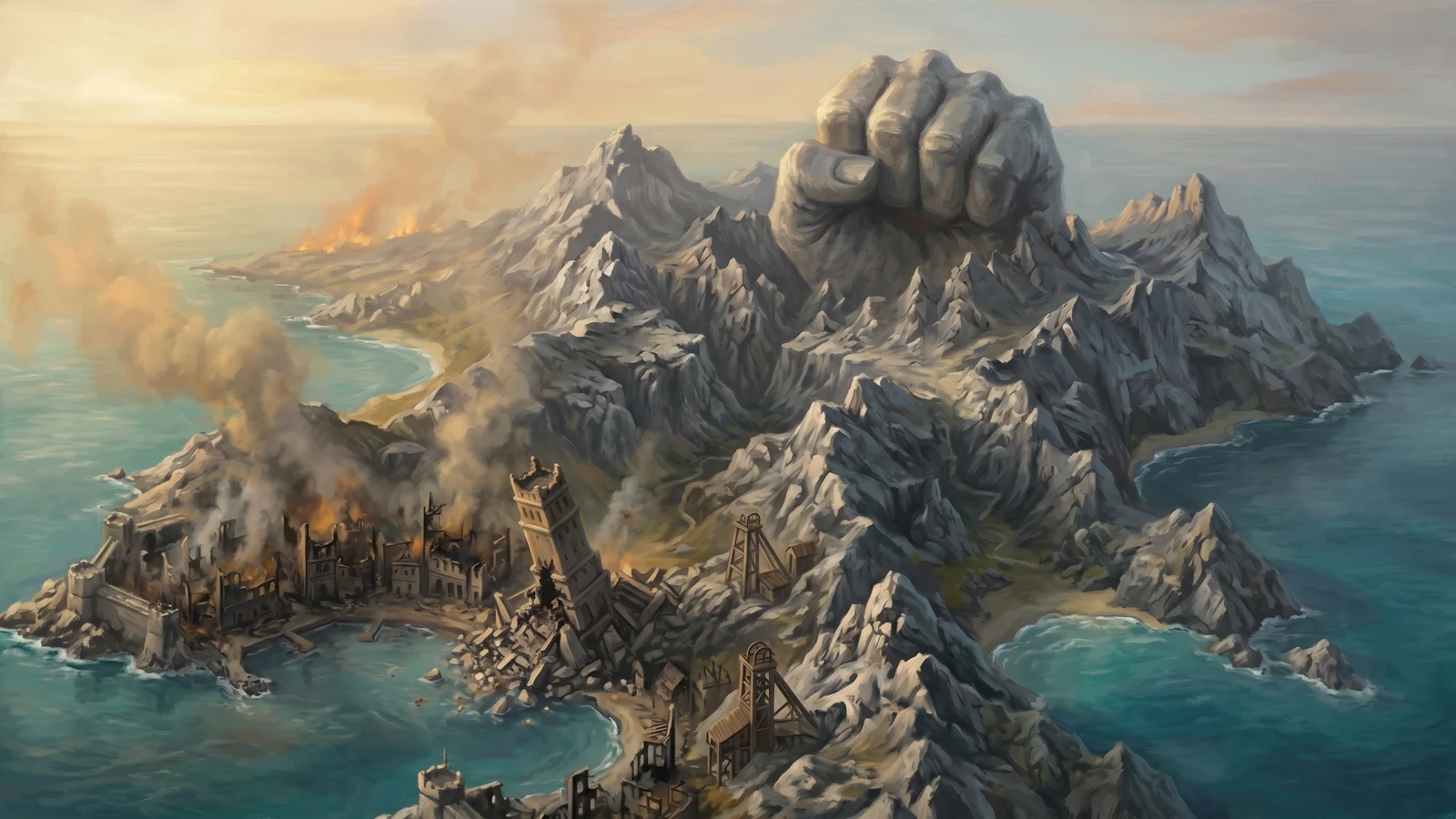
A mountainous island roughly 400 miles across, Kyagos rises from the waters between the Sea of Seven Snakes and the Alrock Ocean like a clenched fist of stone. The Aktarvkus Mountains dominate the interior—an impassable tangle of peaks, ravines, and wind-scoured passes that effectively divides the island into isolated coastal territories. This geography explains why Kyagos never unified into a single nation: four city-states emerged independently around the island's rim, each controlling its own slice of coast and whatever mountain approaches it could defend.
The Sylthik who rule these city-states measure worth in scars. Cheek-scars mark rank—one for minor distinction, five for the highest lords. Outsiders receive handkerchiefs around their necks marking them as rightless visitors. The economy runs on mining, the mines run on slaves, and for three centuries the Drasnian dwarves shipped from Gorath's Slaver's Coast have extracted Kyagos's legendary gems and metals from the deep shafts beneath the mountains. The trade settles the way the whole southern sea settles, in weighed silver rather than minted coin (worn openly here, and scarred like the men who carry it), priced against the cross-rate the Adron banks publish a continent away.
That arrangement shattered recently. Syvlius, the largest and wealthiest city-state, burned. Slaves rose, a trade tower fell, and the Dead Moon Tribe swept down from Moonwood to finish what the uprising started. The other three city-states now face an island transformed—one quarter in chaotic ruin, the native humans emboldened, and every remaining slave watching to see what happens next.
Towns & Villages
The city-states don't exist in isolation. Smaller settlements dot the coasts and mountain approaches—mining camps grown into permanent towns, fishing villages that supply the cities, waypoints on the few safe routes through the interior. Most owe allegiance to whichever city-state controls their region, though that control has always been lighter than the city-states pretend.
Vassum's Sphere
Eleza — A mining town in the foothills southeast of Vassum, positioned where the road toward Mount Essel begins its climb. Before the revolution, Eleza processed ore coming down from smaller mountain operations before it continued to Vassum's warehouses. Now it's swollen with refugees who couldn't afford passage into Vassum proper.
Eko — Fishing village on the western coast, technically under Vassum's protection but practically independent. The villagers pay nominal tribute and otherwise ignore the city-state's existence. Their boats work the Sea of Seven Snakes despite the pirate risk—the fishing is good, and they know the coastal waters better than any raider.
Tissen — Southwestern coastal town near where the Jungula Serpentine peninsula meets the main island. Vassum uses Tissen as a naval outpost, such as it is—a few patrol boats watching for smugglers and pirates. The posting is considered punishment duty.
Syvlius's Ruins
Shaz — A waypoint town on the mountain roads between Vassum and Syvlius. Before the revolution, merchant caravans rested here; guards rotated through on patrol duty. Now Shaz is caught between factions—Drasnian refugees fleeing the chaos, Dead Moon patrols pushing south, and Vassum interests trying to maintain the trade route. No one's in charge.
Eiv — Small settlement on the approaches to Syvlius, close enough that the smoke from the burning city was visible for days. Most residents fled during the revolution. Those who remained are now under the loose authority of whatever Drasnian faction controls the nearby district of the ruined city.
Shia — Village on the shores of Lake Shikaya, now absorbed into the refugee camps that ring the lake. The distinction between "Shia village" and "Shikaya camps" has blurred—it's all one sprawling, chaotic settlement of freed slaves trying to build something new.
Tekos's Territory
Kilum — Town in the southern foothills where the Tyatach River emerges from the Killing Hills. Kilum exists in a state of permanent tension—Kuru raiders come down from the hills regularly, and the town's militia has more combat experience than Tekos's actual army. The Tekosi lords resent this competence.
Vim — Eastern town near Lake Teklan, primarily agricultural. Vim's farms feed Tekos; Tekos's guards theoretically protect Vim. Since the revolution, those guards have been pulled back to the city, leaving Vim increasingly exposed to Kuru probing from the west.
Lus — Southeastern settlement in the Mythlias jungle, as far from Tekos's direct control as you can get while still nominally being part of the city-state. Lus survives by trading with anyone—Tekosi merchants, Kuru hunters, even the occasional Ulvsjael who wanders out of Traevluong. The Tekosi consider this treasonous flexibility; the Lusians consider it survival.
Sy's Border
Sygosa — The largest settlement outside the four city-states, positioned on the southeastern coast where the Sygum River meets the sea. Sygosa serves as Sy's primary port—the city itself sits inland, away from the werewolf-haunted coast, so Sygosa handles maritime trade. It's a tense place, with silver worn openly and weapons never far from hand.
The Unaffiliated
Istriv — A fishing village on the far southwestern coast, in the no-man's-land between Vassum's reach and the Sea of Sighs. Istriv owes allegiance to no city-state and pays tribute to none. The villagers are poor, isolated, and stubbornly independent. They fish the dangerous waters near Viper Rapids and sell their catch to whoever shows up with coin.