Geography
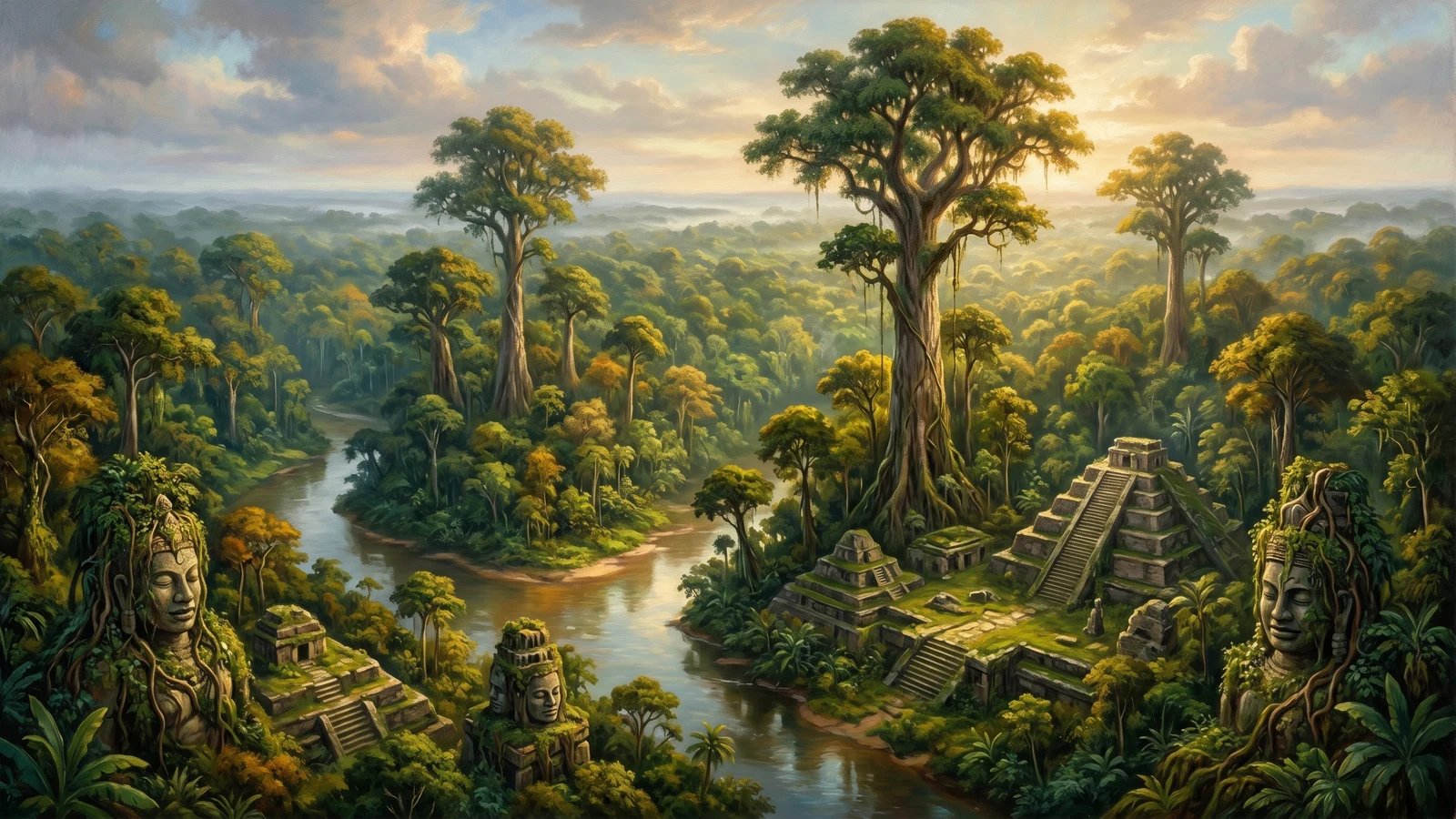
The Elder Wilds occupy the entire eastern peninsula of Aboyinzu, a vast region of ancient rainforest, winding rivers, and primordial wilderness. This is one of the oldest and least tamed regions of the known world, where the jungle has grown undisturbed for millennia.
The region earns its name from the Anchor Trees, colossal individuals scattered throughout the wilderness, rising hundreds of feet above the canopy. These ancient giants mark the tombs of titans buried by druids in the aftermath of the Ezz Rift, 12 million years ago.
Boundaries and Position
- North: The South Sea and the waters separating Aboyinzu from the Shacklands
- East: Eastern coastline facing the Slumbering Abyss
- South: The Dalizi Highlands rise to the south
- West: The Wanderlands peninsula and the South Sea
Terrain
The Elder Wilds are dominated by massive rainforest, with dense canopy, tangled undergrowth, and countless rivers cutting through the green expanse. The terrain varies dramatically:
- Northern Peninsula (L'Coth D'hari): Dense jungle covering a multi-lobed landmass, controlled by the Gamori elves
- Central Highlands (Seyiy): Rolling hills and dramatic waterfall systems, the highest ground in the region
- Western Lowlands (Aphenlein): Flat, flooded jungle with slow-moving rivers forming moat-like channels between trees
- Eastern Forests (Bygos Shemazari, Runeglades): Rainforest giving way to seasonal floodplains along the coast
Why It's Empty
Three points of interest across 340,000 square miles. The Elder Wilds are wilderness that refuses habitation, not frontier waiting for settlement.
The beasts here are simply not worth the cost. Forty-foot apes roam the Apelands, territorial and violent. Pterodactyls hunt from the Archfalls. Water hags lurk in the river systems. Brain-eating amoebae infest the pools. Shadow hounds stalk the blue ruins of Everlong. The flooded Aphenlein forests can't support permanent structures: the moats shift seasonally, and anything built sinks.
What settlements exist are either ancient (L'Coth D'hari's hidden Gamori communities), inaccessible (Urzula beneath its waterfalls), or the territory of beings who prefer solitude over company.
Relationship to Surrounding Regions
The Elder Wilds form a natural barrier between the Wanderlands to the west and the Dalizi Highlands to the south. The South Sea provides water access to both the Wanderlands and the distant Shacklands across the strait. An astral current crosses the region diagonally, but with no settlements along its route, it sees virtually no traffic.
The Anchor Trees
Scattered throughout the Elder Wilds, from the Apelands in the north to the edges of the Dalizi Highlands in the south, stand the Anchor Trees. These colossal individuals dwarf even the ancient rainforest canopy, rising three hundred feet or more, their trunks so massive that small communities could live within hollowed sections.
Origin
When the Ezz Rift flooded Alaria with Melera's music 12 million years ago, the titans experienced emotion for the first time. For beings of pure Deoric order, this contact with raw feeling was unbearable agony. Many killed themselves. Others fled to distant planar stacks.
Those who died in the Elder Wilds were buried by the druids, the only beings who could safely handle titan remains while channeling Faesong to bind the cosmic energies. Where druids sang titan corpses into the earth, the Anchor Trees grew. Their roots wrap around titan bones that never decay. Their sap carries traces of Deoric resonance.
The Collective
The Anchor Trees are aware. No single tree is more sentient than any ancient oak, but together they form a slow, distributed consciousness. They communicate across decades through root networks and spore dispersal. They remember fragments of the titans they anchor: impressions of an age before emotion, echoes of Deoric speech, the traumatic flood of feeling that ended everything.
Druids can sometimes perceive this collective awareness. Faesong practitioners hear it as a bass note beneath their music, impossibly deep, impossibly slow. Psy-sensitives approaching an Anchor Tree feel the weight of geological time pressing against their minds.
The trees are not hostile. They are patient beyond mortal comprehension. They are waiting, though for what, no one knows.
The Shemazari Ruins
Dotted throughout the Elder Wilds are the remnants of an ancient civilization: step pyramids swallowed by jungle, stone faces worn smooth by millennia of rain, processional ways now choked with strangler figs. These are the ruins of the Shemazari, a kingdom that flourished during the early Third Eon before vanishing without historical record.
What Remains
The Shemazari built in pale stone that the jungle has since stained green and black. Their structures share distinctive features:
- Stepped pyramids with flat tops, often partially collapsed, found near river confluences
- Carved faces worked into cliff sides and boulder surfaces, expressions serene or anguished
- Canal systems now flooded and integrated into the natural waterways
- Underground chambers beneath the pyramids, most long since looted or collapsed
The largest concentration of ruins lies in Bygos Shemazari ("Old Shemazari" in corrupted local dialect), the eastern rainforest where the civilization likely centered. But smaller sites appear throughout the region, suggesting the Shemazari controlled far more territory than the jungle has revealed.
What Happened
No one knows. The Shemazari left no decipherable writing, no clear descendants, no legend of their fall. The proposed causes are plague, internal war, ecological collapse, or magical catastrophe. The Gamori of L'Coth D'hari claim the Shemazari "went into the trees," though whether this is metaphor, myth, or literal truth is unclear.
Some adventurers note that the oldest Anchor Trees often stand near Shemazari sites. Whether the Shemazari worshipped the trees, tended them, or were destroyed by them remains a matter of speculation.
Everlong
Blue ruins, huge crumbling walls, labyrinthine. The stone itself carries a faint azure tint, some mineral in the original construction, or perhaps staining from the blue and black lotus flowers that grow throughout the ruins.
Everlong predates the Shemazari. Its builders are unknown. Its original purpose is lost. What remains are walls that seem to extend forever, turning and twisting in patterns that may once have had meaning. An onyx crystal of significant size and unknown purpose lies somewhere within. Multiple expeditions have sought it, few have returned.
The ruins are inhabited by shadow hounds, creatures of Malstaric origin that have somehow established a permanent presence in the material plane. They hunt at night, invisible in darkness, and their bites drain not blood but shadow, leaving victims diminished, faded, less substantial with each wound.
Forest of Statues
An ancient, eerily silent stretch of the Elder Wilds where time runs unevenly. The forest is the site of the Stillness, a permanent Izzus breach that has stood open since the Lost Ages, and it is among the most dangerous places in Alaria for a reason most travelers never live long enough to understand.
The Stillness
Time does not keep one rate inside the forest. An Izzus seam runs beneath it the way time leylines run beneath places like Besnoumeru, but here it does not lie quiet underfoot. It surfaces raw. The breach opened the time-layer onto the material world in the deep past and never closed, so the seam presses through unbounded, and the local rate runs fast in some pockets, slow in others, and in the deep zones nearly stalled. Each pocket holds its own pace, and the boundaries between them give no warning.
The boundary is the danger, and the danger is to the hurried. A traveler who walks into a slowing pocket without feeling it slows along with it. Their steps lengthen, their thoughts stretch, and from outside they seem to freeze in place while from inside a single moment swells to fill what the world counts as years. The statues that name the forest are those people: travelers caught in the deep slow, held so far out of the world's pace that the rain wears them toward stone faster than they can lift a hand. Some have stood for centuries. Others arrived last season. None of it is cosmic. The Great Cycle runs on past the Forest of Statues exactly as it runs on past everything, the way it runs on past the Salt Tomb and every other place an Izzus seam has bent. What the breach bends is only the local rate, pocket by pocket. A statue is not frozen outside of time. It is a living person running so slow that the world has walked away and left it standing.
Concentrated Izzus also settles into stone here. Time stones are turned up in the slow zones, dense little knots of the seam's own substance, and a worker who carries one can lean on it to bend the local rate in a small space, the way a shaper standing on a strong leyline reaches further than open ground allows. They are rare, the time-witches hold nearly all of them, and they are no shortcut past the element's limits. A time stone amplifies; it does not unlock history. The rate is all it touches.
The time-witches
A people lives in the Stillness, and the world outside calls them time-witches. They call themselves the Sevrai. Generations of dwelling in the breach have bred into them a wide channel to Izzus and an instinct for which way the rate runs underfoot, so they cross the Forest of Statues at an easy walk while a stranger turns to stone a hundred yards in. They guard the breach and its time stones jealously and rarely teach an outsider anything. For all the strangeness of where they live, they are mortals and nothing stranger, fully alive and dying as mortals die. What they are and how their dying differs from the haunting kind of time-touched is the matter of their own account.
Ciri
Ciri is the oldest and most storied of the Sevrai. By the outside world's calendar she has been alive for close to four centuries, yet she is not deathless and has worked no magic to lengthen herself. She has spent that time in the slow heart of the Stillness, where a year outside passes in a few days within, and her body has run through a long but mortal span of its own slow time while the world aged on ahead of her. Carried out of the breach, she would keep the world's rate like anyone. The age is the ground's doing, not hers.
She still takes students, the determined and the capable, and teaches them to feel the breach and to hold the slow. The price the traveler's tales make so much of is not what they say. It is not a fragment of the soul. It is the toll the element takes from anyone who works it past their depth. A student learns to summon the Izzus register, the patience and the regret and the long anticipation, and to pour it into the breach, and the pouring leaves them emptied of exactly those feelings, numb and flat for days until the feeling seeps back. Train long enough and hard enough under Ciri and it stops coming back all the way. Such students return unhurried, unsurprised, and never quite present, turned toward a then they can no longer step out of. They are not diminished in their souls. They are emptied in their hearts, and that emptiness is the whole of what the teaching costs.
Apelands
TODO
Bloodwood
TODO
Bygos Shemazari
TODO
Kidwood
TODO
L'Coth D'Hari
The northern peninsula of the Elder Wilds, a multi-lobed landmass of dense jungle surrounded by the South Sea. Territory of the Gamori, an elven people obsessed with death, transformation, and the sacred hunt.
L'Coth D'hari functions as a loose republic with multiple communities and elected leadership. The Gamori consider the Elder Wilds their hunting grounds and rarely welcome outsiders.
Sub-locations
- Eriyen — The primary gathering place of the republic
- Thorne — Domain of an ancient druid who predates the Gamori
- Breathless Bay — Western inlet, fog-shrouded and still
- Paradise Inlet — Central waterway dividing the main lobes
- Farthing Inlet — Southern boundary with the Apelands
See: Elder Wilds - L'Coth D'hari
Lemru Nymor
TODO
Minori Ezag
The territory of an ancient, powerful, and thoroughly insane druid in the northeastern Elder Wilds. Three Anchor Trees stand in unusual proximity here, the only place in the region where multiple Anchor Trees grow so close together.
See: Elder Wilds - Minori Ezag | Minori Ezag (NPC)
Runeglades
Floods every year. Dolphins swim up from the ocean.
Seyiy
TODO