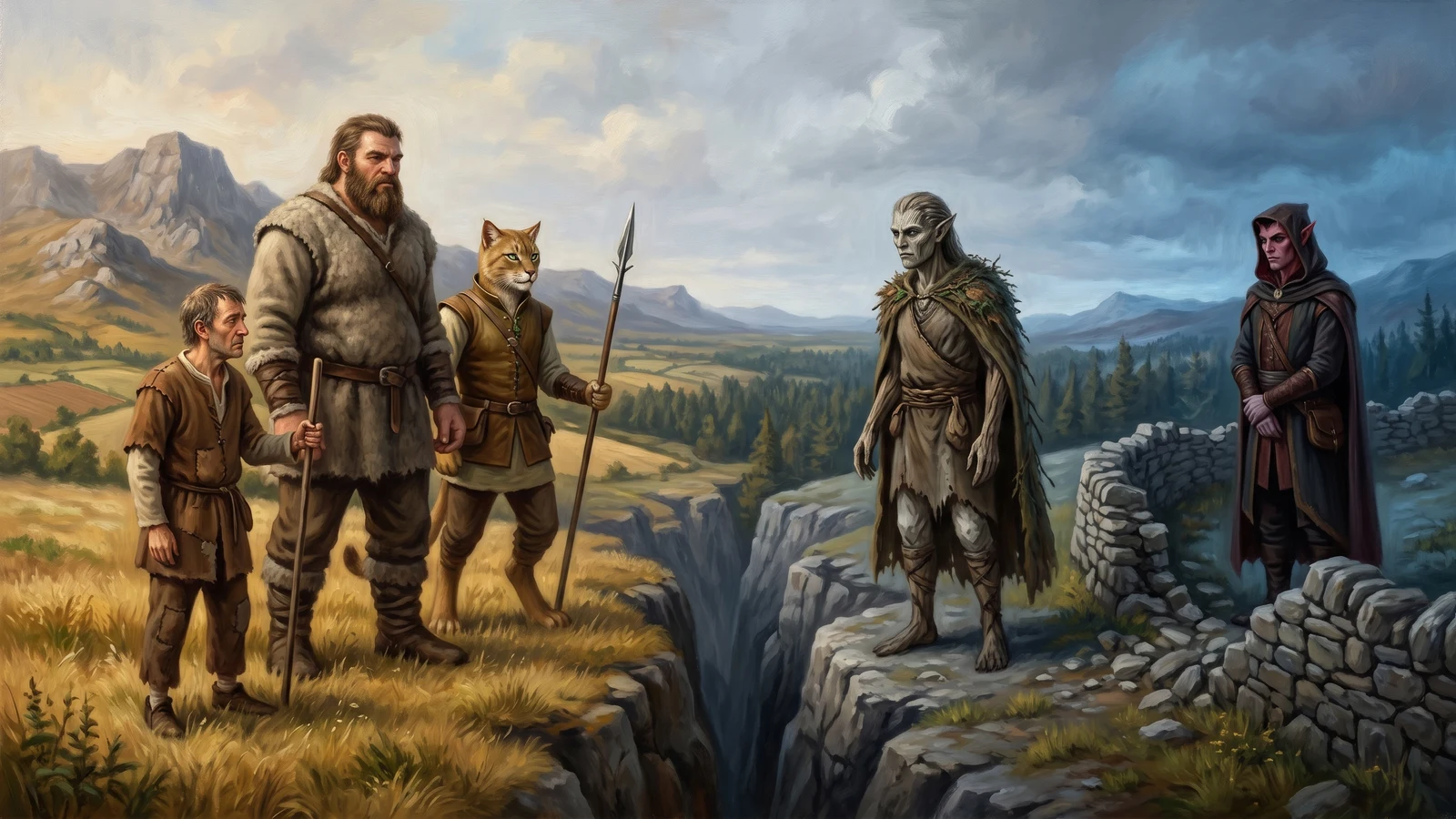
Ask two Alarians from different peoples whether they are kin and you will get an argument that goes back to the making of the world. A human farmer and a dwarf trader can marry, raise flesh-and-blood children, and be buried in the same ground. A human and an elf cannot. The elf could outlive the human's great-grandchildren and still be reckoned a stranger to the family in a way that has nothing to do with custom. The line between them is older than custom. It runs down to what each was made from, and in Alaria what a people is made from settles almost everything about who it can join.
That is the first thing to understand about the peoples of this world. They do not descend from one stock that branched and drifted. They were made, by different hands, out of different stuff, at different times across deep history, and those origins still govern the living. A people in Alaria is less a population than a kind of thing with a fixed definition. Three broad families account for most of the world's peoples, and the boundaries between the three are hard.
The flesh-children of Gaea
The largest family is Gaea's. The titan-goddess poured herself out across the long Gaeaic Eon, building living things from her own substance, and the flesh-children are what remain of that work: humans, beastmen, giants, and trolls. Because they share one substance, they cross. Half-giants are born and live. Trollkin are born, though rarely, and the world is hard on them. This is the family most newcomers picture when they think of "the peoples," and it is the one that has spread furthest. Humans are the most prolific of all, scattered into more cultures than any single mind holds, and abundant past counting; knock one human realm flat and another stands up a generation later.
Beastmen belong here too, though they are easy to mistake for something grander. They are Gaea's minor animal-children, shaped with the beasts rather than alongside the high lineages, and they run to as many forms as there are beasts to echo. The feline Koren are beastmen, split between the courtly Kor and the feral Korel. The line between a beastman people and a sacred line is not a matter of how impressive the creature looks. It is a matter of descent, and the beastmen do not descend from the fallen three.
The made peoples: elves
Elves are not Gaea's. They were crafted by the druids out of wood, stone, and river-mud, shaped rather than born, and that difference in material is the hardest border in the world. An elf cannot cross with the flesh family. There are no half-elves in Alaria. The cross is a flat impossibility, the way water will not braid with oil. The Walk of Elves seeded them across the world more than two million years before the Birth of Man, which makes the youngest elf older in lineage than the oldest human bloodline, and the elves do not let anyone forget it.
They have had the time to become strange. A single elven kind can split into peoples that share almost nothing: the city-building Amverela, the void-touched Vyko who travel the dark between planes, the Ythari each quickened from a single tree and dead the hour it dies. The common thread is patience and a long memory, which from the outside reads as arrogance and from the inside reads as simple proportion. An elf who will see five human lifetimes does not hurry to a human's war.
First they made us from the river bank, and the river kept moving, and we did not. That is the whole of it. The young peoples think we look down on them. We are only looking from further off. — Saying attributed to the Istori glassmakers of the frozen north
The daemon-descended lines
The third family is smaller and follows no single rule. These are the peoples seeded by daemons who fathered or mothered children on mortals, and each such line inherits by its own terms rather than by any shared law of blood. The Children of Anubis carry the death-judge's gift down an unbroken thread, every child able to weigh a soul by touch and bound at adolescence to serve their divine ancestor or forsake him forever. Other lines run colder or stranger. What they hold in common is only the manner of their making, not a substance, so a daemon-descended people cannot be sorted into the flesh family or the made peoples. They sit beside both.
Why a people stays itself
One fact ties the families together and explains why Alaria has no smooth ladder of related species. Peoples in this world do not drift. A true name is a definition, and to be named in the titans' tongue is to be fixed as what one is, so a kind that has a name cannot slide into another kind across the generations. This is why elves remained elves across more than two million years and why humans have not become something other than human in half a million. Time does not erode a people into its neighbor. The boundary you see between two kinds today is the same boundary that stood when both were made.
That fixity makes the sharp lines permanent, but it leaves enormous room inside each line. A people splits by scattering into new cultures, never by drifting into a new species, and the scattering has been relentless. The dwarf is one kind with dozens of heritages. Some sail, like the Gruynmar who keep the secret of gunpowder. Some are barely flesh at all, like the Hestrube, whose bodies have become living stone and who pass through solid rock at will. The orc spans more lands than most empires, clan by clan, and the elf does the same. None of these crossings ever blurs the kind; they only multiply the cultures.
The fallen three
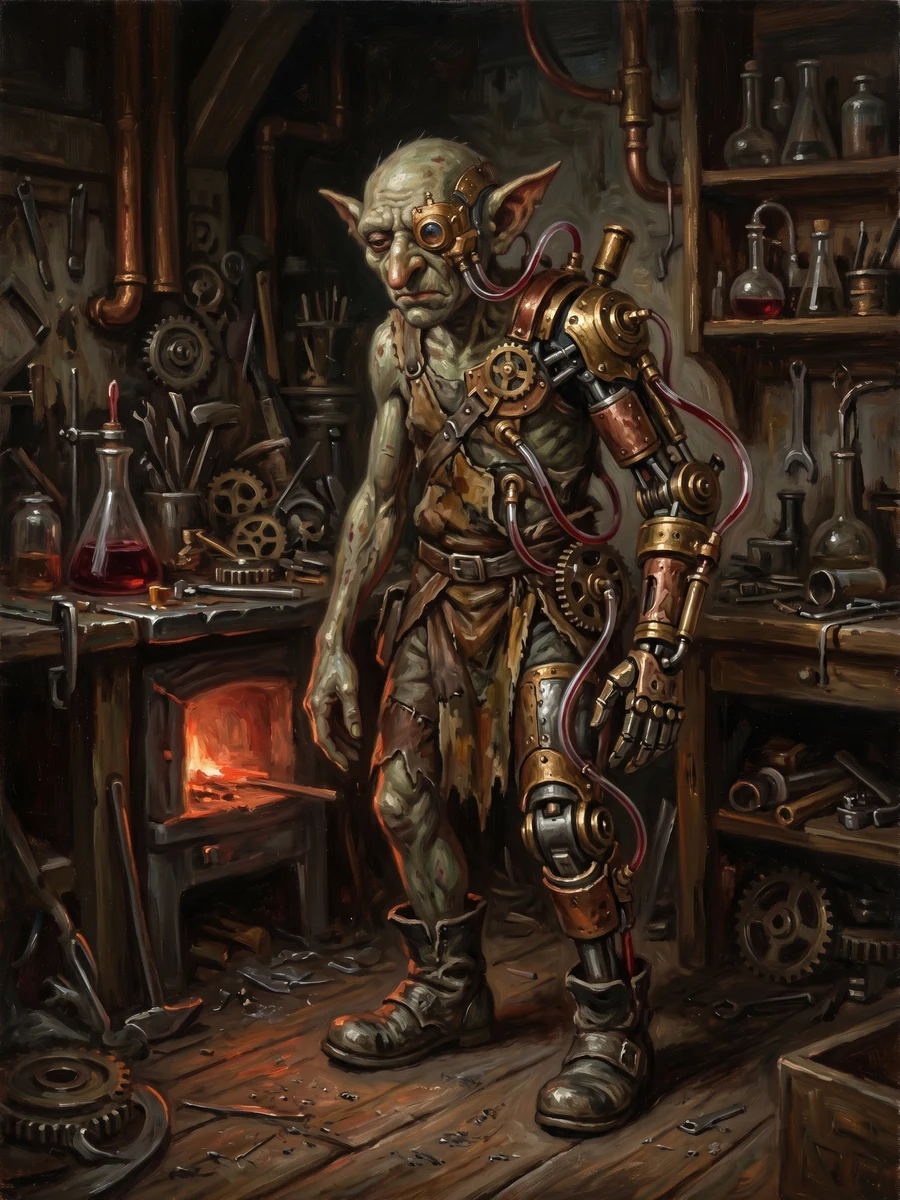
A few peoples stand apart from the three families because of how they began. When the wolf-mother Ulvma, the lion-father Shara Bolasi, and the dragon-father Nagatayora fell in the war against the titan Hykravones, their blood did not waste itself on the ground. It marked mortals. The warriors who drank Ulvma's blood as she died among them became the Ulvsjael, the only one of these lines whose founders chose the gift outright. The mortals struck by Nagatayora's burning blood became the Naga, who carry the dragon-shape in one bloodline that throws three forms and lets none of the parents choose which. The lion's line became the Sharabha. These are not beastmen and not flesh-kin in the ordinary sense; they are what the fall of three great beings left behind, and they hold that inheritance as a trust rather than a tool.
A world too wide to count
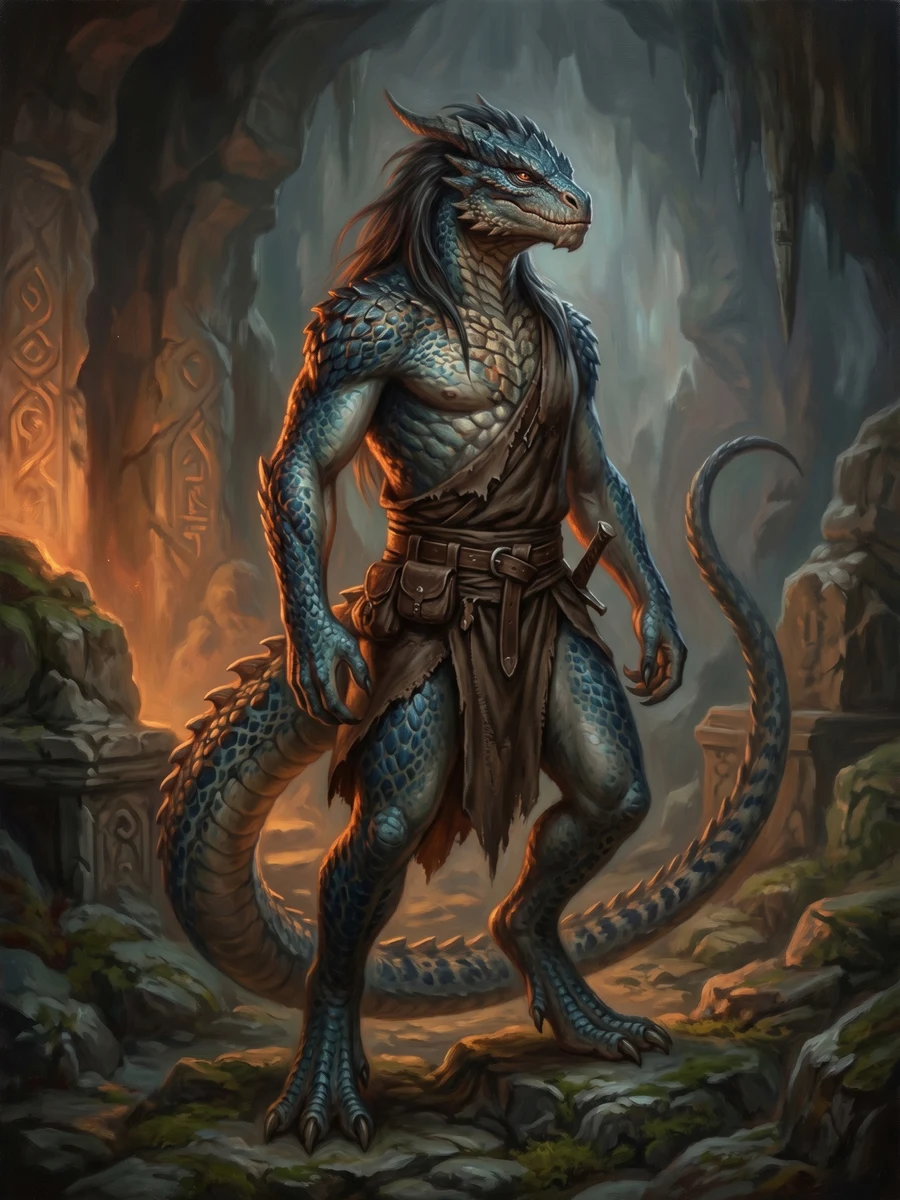
For every people a traveler is likely to meet, a dozen pass their whole lives unrecorded. The Vyanoweir are the scattered last of a civilization that once reshaped reality with spoken words, now reduced to remnants who can barely manage the language their ancestors commanded. The Megélren are born into Naga houses unbidden, read as the old betrayal surfacing, and pushed out toward exile and the killing trades. The Ythari live and die one to a tree, founding no settlement and no nation. Whole peoples persist as a single valley's secret, or a coastal handful, or a name in another people's curses. The world holds far more kinds than any one realm has ever needed a word for, and most of them want nothing from the rest.
What holds two peoples together, when anything does, is the ordinary work of living next to one another: trade, war, a shared coastline, a debt. What keeps them apart goes deeper than any of that. It is the substance each was made from, and the name that fixes each as what it is, and neither of those was ever a mortal's to change.