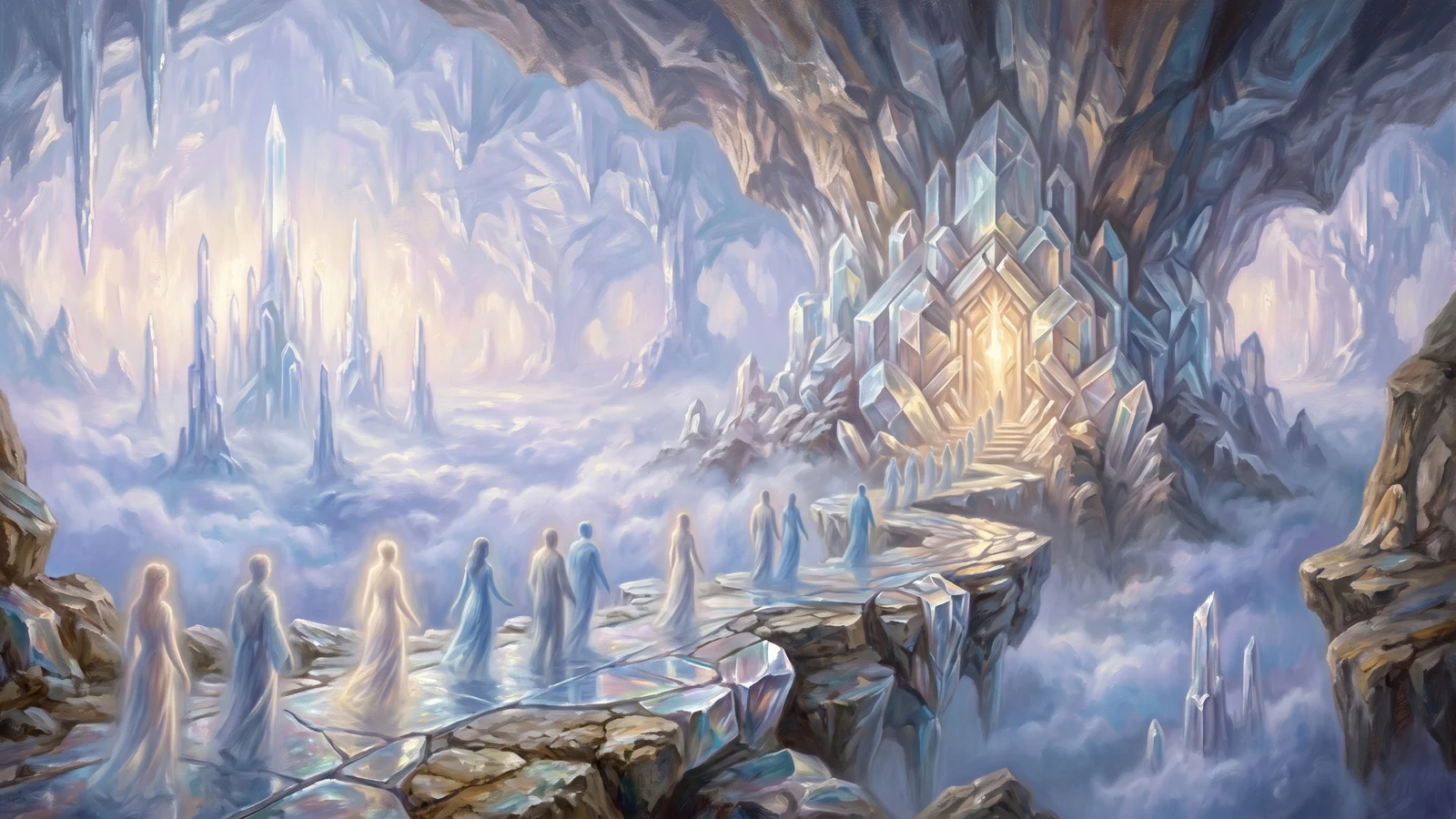
Origin
Celestia's creation required two events separated by 11.5 million years.
During the Lyzaria Era (23.5–18 million years ago), the titan-god Celest poured her essence into a pocket dimension. Her two siblings had already begun dissolving into the forces they embodied — Aurus toward the persistence of souls, Nydus toward the dissolution of shadow. Between those two pulls there was no stable ground for a third being who belonged to neither.
"Celest did not flee a quarrel between siblings. She faced a slower danger: a self caught between the soul-pole and the shadow-pole is overwritten, in time, by one or the other. The seed was no hiding place. It was the only shape in which she could stay herself." — Velorin of Istora
Her sacrifice was preservation, then, not surrender. A titan-god cannot truly die, only transform, and Celest's transformation was unlike her siblings'. Where Aurus and Nydus diffused into impersonal force, she went dormant, folding her selfhood into the seed and sealing it there. What rests in Celestia's core is a genuine identity, ancient and asleep: present without will, able to act on nothing. The Ezz that later filled the plane insulates that core completely. She cannot reach the surface across it, nor transmit the Deoric she was made of.
For its first 11.5 million years the seed sheltered no one. No spirit had yet existed; there was nothing to receive. It was a vessel built before its purpose — bounded, hidden, Deorically patterned, with the form of a sanctuary and nothing inside to keep. Celestia's later reputation as a refuge for the dead is a mortal reading turned backward onto an empty room.
Then came the Ezz Rift (12 million years ago). When Melera's music fractured the Alarian Planar Stack and Ezz poured in, it gathered around Celest's seed, the only Deorically shaped non-corporeal vessel in Alaria. The flood condensed into the one form built to hold it, the way iron filings settle onto a magnet. The old phrase that Ezz resonated with Celest's song names this Deoric attraction; Velorin grants that her dormant presence may emit a faint Deoric field, the "song" mortals later heard. The pocket dimension bloomed into a full plane, peeling away from the Material Plane to become its mirror-image flip side.
This dual origin explains Celestia's strange nature: its core is Celest's dormant self, which is why spirits persist there at all, while its substance is Ezz, which is why it reflects the thoughts and beliefs of the living. The titan-god made the vessel. Melera's music filled it.
Nature
Celestia is the home of daemons. It is a reflection of the world but lacking any of the typical life that exists in the material realm. The plane is shaped by the thoughts and beliefs of the living—the world as mortals understand it, not as it physically is. Where there is thought on the Material Plane, there is a counterpart in Celestia.
Celestia is the Material Plane's mirror flip-side, a reflection across the world's outer edge. This is distinct from Phlethageros, which is the physical underside reached by descending through the slab. Walk far enough in any cardinal direction and you do not fall off the world; you cross the edge into Celestia, arriving at the mirrored counterpart of the place you left (a city on the western rim of the Material Plane has its reflection on the eastern rim of Celestia). The two axes never meet: down through stone leads to Phlethageros and the hells; outward across the horizon leads to the reflected world of the dead and their daemons.
Since the plane is shaped by belief rather than physical law, it cannot be directly altered by those within it. Daemons who seek opulent palaces must encourage their followers to build them in the material realm so their reflections can be enjoyed within Celestia.
Spirits in Celestia
Spirits arrive here upon death, after their soul rises to the Astral Plane and their shadow sinks to Malstaris. Unlike souls and shadows, which cycle through cosmic reservoirs to be renewed, spirits in Celestia face a different fate.
While in Celestia, you have no body—only a spirit—and cannot die by any means except Ezz-forged weapons, which sever your will from your spirit. Survival depends entirely on the prayers of those who knew your true name. Upon death, your spirit fades to Celestia, where it lasts until your true name is forgotten.
When a spirit is forgotten, it does not return to some cosmic source. It simply ends. The spirit—the part of you that was you, your free will and personality—ceases to exist entirely. Souls cycle through Aurus. Shadows cycle through Nydus. But spirits made of Ezz have no such reservoir. The self that made you distinct is gone, irrevocably, forever. This is the true finality of death in Alaria. Soul and shadow separate at the moment of death, but the spirit ends only when it is forgotten.
A few spirits do more than linger. The rare spirit that held generative command of Deoric in life can reach back across the boundary and work upon the material realm. These are the daemons, and they may be worshipped as gods.
The qualification is exact, and it is settled before death. What counts is whether a spirit could compose in Deoric while it lived: build, nest, and scope commands it had never spoken before. A speaker who only recited memorized phrases never crossed that line, however many phrases it had learned and however potent they were. The threshold is categorical, the way ice either is or is not water, and no spirit can earn the crossing once dead. Deoric falls silent in Celestia, so the grammar a daemon holds is whatever it carried through the moment it died, and nothing more. Like any spirit, it then persists only while its true name is remembered and prayed to. Let that worship lapse, and even a daemon ends.
Travel to Celestia
Willingly going to Celestia requires leaving your shadow and soul behind. Unless they are somehow preserved on the material plane, they will never rebind to your spirit, making it impossible to ever return to the material realm.
During the Golden Age (roughly 200,000 to 75,000 years before the Seventh Dawn), some who crossed to Celestia alive did exactly this: they created anchor-vessels on the material side—physical objects or preserved bodies that kept their soul and shadow tethered while their spirit lived in Celestia. These anchors worked because they maintained the material binding that the soul and shadow normally hold through a living body; as long as the anchor persisted, the separation was not permanent. Some kept anchor-vessels for tens of thousands of years, allowing them to return if they chose. The God War (approximately 75,000 years before the Seventh Dawn) destroyed most of these anchors—deliberately, in many cases—trapping the spirits within Celestia permanently. The few who might have returned found their material-side tethers gone. What fragments of anchor-vessels survived are relics of a practice almost entirely lost.
There is one road back that needs no anchor at all, and it is the reason the anchor-craft was ever thought the gentler art. A spirit already fallen to Celestia, its own soul and shadow long since dissolved, cannot be restored to a body of its own—but it can be put into a body taken from someone else. The working is done on the material side: it unwinds the living owner's spirit from the soul and shadow it was born between and ends it, the true death, then draws the waiting spirit down from Celestia into the emptied flesh to bind with the borrowed soul and shadow. A daemon brought across this way comes back a mortal, in a stolen life, with no more reach across the boundary than the person it displaced, and it dies as that person would have. The rite destroys one self to house another, and for that reason the knowledge of it is hidden, hoarded, and in most ages forbidden. The strand-mechanics of the unwinding are described in Life and Death.
Magic in Celestia
Deoric does not function on Celestia. The Ezz that fills the plane disrupts the absolute commands of Deoric speech, so even the most accomplished spirits cannot work a single casting within it. The masters who reside there reach across the boundary instead, acting through their worshippers on the Material Plane. This is how a daemon grants a miracle, and the mechanism is narrower than the word suggests.
A daemon does not hand its worshipper the language. It cannot place the first grammar in an untaught head, and it cannot raise a working out of someone who holds none. The worshipper must already command enough Deoric to begin composing the working in ritual, carrying the structure as far as mortal skill reaches. Only then can the daemon help. Perceiving the half-formed working through the Psywinds, it refines the structure as the worshipper builds, nesting a clause past what mortal skill could reach alone or pulling an over-wide command back to its intended scope. The grammar that lets a mortal begin comes from nowhere in Celestia. It is learned on the Material Plane, from a living teacher who has himself crossed into composing novel Deoric, or from the inert texts that still preserve it: surviving Vyanoweir reconstructions, and the titan inscriptions still legible to those trained to read them. A daemon can sharpen a speaker who already speaks. It cannot make one.