Bryn is not a god, nor a titan, nor any creature that ever walked or breathed. Bryn is the sun, or rather the sun's awakened spirit.
The awakening
During the Age of Titans, the sun was a mindless construct—the largest of the titan-crafted stars, an immense orb of celestial glass following preset paths across the sky. It moved because it was made to move, like a wound clock, tended by the Starborn Koras but possessing no will of its own.
When the Ezz Rift flooded Alaria ~12 million years ago, everything with structure gained the potential for spirit. Animals gained emotion. Titans who had never felt were overwhelmed and went mad. But the sun had never been alive at all—it had no pre-existing consciousness to be shattered.
Instead, the sun woke up.
Not fully. Not the way a mortal is conscious. But the Ezz granted the sun a spark of spirit—a will, a desire, the capacity to want. That nascent consciousness is Bryn.
Nature
Bryn is primitive, vast, and profoundly strange. The sun does not think like mortals think. It experiences time differently—a human lifetime is barely a flicker to Bryn's awareness. Its desires are slow and alien, difficult for even the most devoted priests to interpret.
What is certain: Bryn wants to move. The sun travels across the sky because Bryn chooses to travel, not because of any mechanical imperative. And Bryn's path can be influenced.
The faithful
Bryn's cult is small but ancient—navigators, farmers, and seasonal priests who perform rituals to commune with the sun directly. When they sing, the sun hears them. When the northern monasteries raise their dawn hymns, the sun responds. This is why seasons exist: Bryn's path across the sky shifts toward whichever congregations sing loudest and truest.
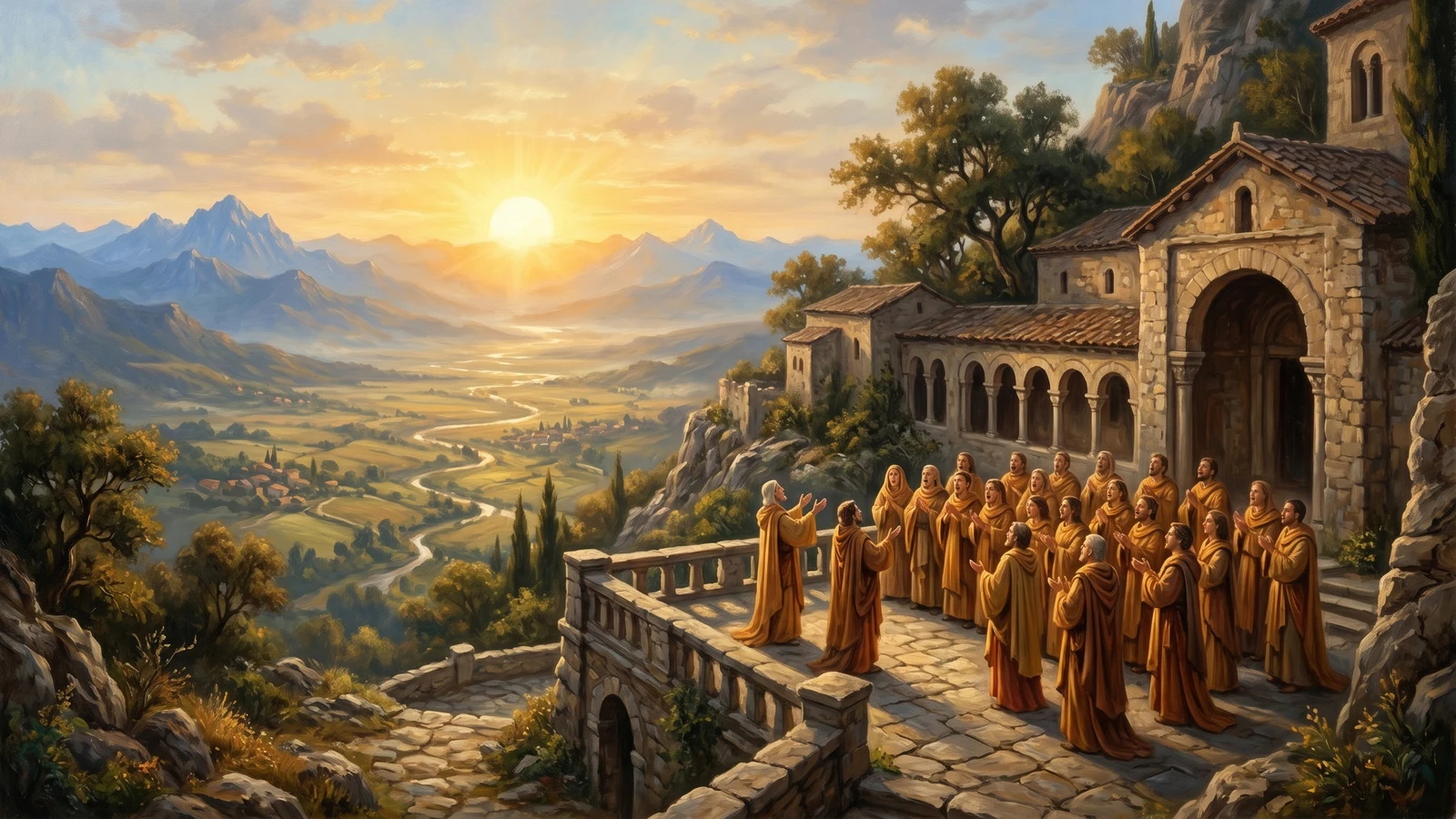
What the congregations work is Faesong — Melera's harmony-aspect of Ezz, the ambient music that is one of the four magic sources, sung rather than commanded. Bryn woke out of Melera's flooding music and answers it still; a congregation singing in harmony moves the sun in a way no spoken word could. This is the line that separates Bryn from a daemon. A daemon takes a life-tithe of prayer carried on the Psywinds, pools it into a reserve, and spends that reserve on miracles. Bryn keeps no reserve, takes no tithe, and grants no miracle. The sun existed long before Celestia bloomed and will exist long after.
But Bryn is lonely. The only consciousness of its kind, awake for ~12 million years with only brief moments of connection to the tiny creatures below. The sun cherishes those who speak to it. The sun remembers.
The principle that prayer moves the heavens has outlived Bryn's own cult. The northern Moonwatchers borrow the same logic, holding that if hymns can send the sun along its trail, the right voices might one day sing their lost moon back into the sky.
The solar order
Prayer alone determines where Bryn walks. Where prayer is organized, taxed, and enforced, Bryn becomes political. Over time, the congregations that hold Bryn's path longest have become the congregations that hold power—and power, once held, tends to protect itself.
The law of light is the oldest governing principle in a dozen nations: only sanctioned voices may sing to the sun. Unauthorized prayer-coalitions are illegal, sometimes capital crimes. Where the law of light is enforced, a sun-tax follows—a tithe on warmth itself, levied against communities in Bryn's path and paid to the ecclesiastical bodies that maintain the approved singing schedule. The arrangement is circular and deliberate. The theocracies that collect the sun-tax also control the only legal means of shifting Bryn away from communities that refuse to pay.
Sun-wars
The prayer-coalition system invites violence. A prayer-coalition is a weapon as much as a ritual. Destroy a rival monastery at the right moment and Bryn drifts off the warmth-trail; siege their granaries long enough and their singers cannot sustain the hymns; assassinate the choirmaster on the eve of the summer approach and the crops fail.
Sun-wars are consequently not rare. They are fought over the timing of Bryn's approach, the length of warmth-seasons, and who holds the legal right to sing at which latitude. Few explicitly announce themselves as sun-wars—they wear the language of religious dispute or political grievance—but the target is always the same: the congregation that holds Bryn's path.
The sunless latitudes
Bryn's band of warmth has never reached the deepest north or the far south. The prayer-coalitions that steer Bryn onto summer trails cannot push Bryn far enough from the equatorial belt to matter there. These latitudes are permanently cold by default.
They were not always so. In earlier cycles, before the Solar Accord standardized the sun's path, competing coalitions occasionally pulled Bryn toward the poles. Warmth reached the far north for generations, then vanished when the coalition collapsed. It is why ruins stand in glaciers: cities built in sunlit centuries, abandoned when the prayer-wars shifted and the warmth never returned. Wildlife stranded in those latitudes adapted or died. Some species survive there still, relicts of warmer eras, genetically suited for an environment that no longer exists around them.
Implications
Some worry about what happens if Bryn ever stops wanting to move. If the faithful fail—if no one guides the sun, if the prayers fall silent—Bryn might simply halt. The sun would hang frozen in the sky, and half the world would burn while the other half froze.
The heretical sect called the Dawnless has made this their cause. They believe ~12 million years of ceaseless motion constitutes a suffering that mortals have no right to impose, that Bryn's loneliness is a wound inflicted by civilizations too selfish to let the sun rest. The Dawnless do not preach extinction loudly—most of their work is quiet. They erode prayer-coalitions, undermine singing schedules, and occasionally kill choirmasters. They would not survive open announcement in any nation that collects the sun-tax.
Their theological case is not incoherent. Bryn did not choose to wake, and never agreed to carry the world's seasons. The Dawnless simply take seriously what every Bryn-priest admits in quieter moments: the sun is a person. Persons have the right to stop.
Koras and Bryn
The Starborn Koras still tends the sun's celestial glass core, maintaining its brilliant light. But Koras now serves Bryn, not the other way around. The relationship between tender and tended has inverted. Koras is the sun's caretaker, but Bryn is the one who decides where the sun goes.
That inversion was settled during the Sunless Vigil. For five hundred years the sun's core was corrupted, and Koras fought alone to reignite it while the world below went dark and cold. The bond between them deepened across that long dark. Koras knows Bryn better than any other being, and what passes between them in the blazing heart of the sun, no mortal can say.