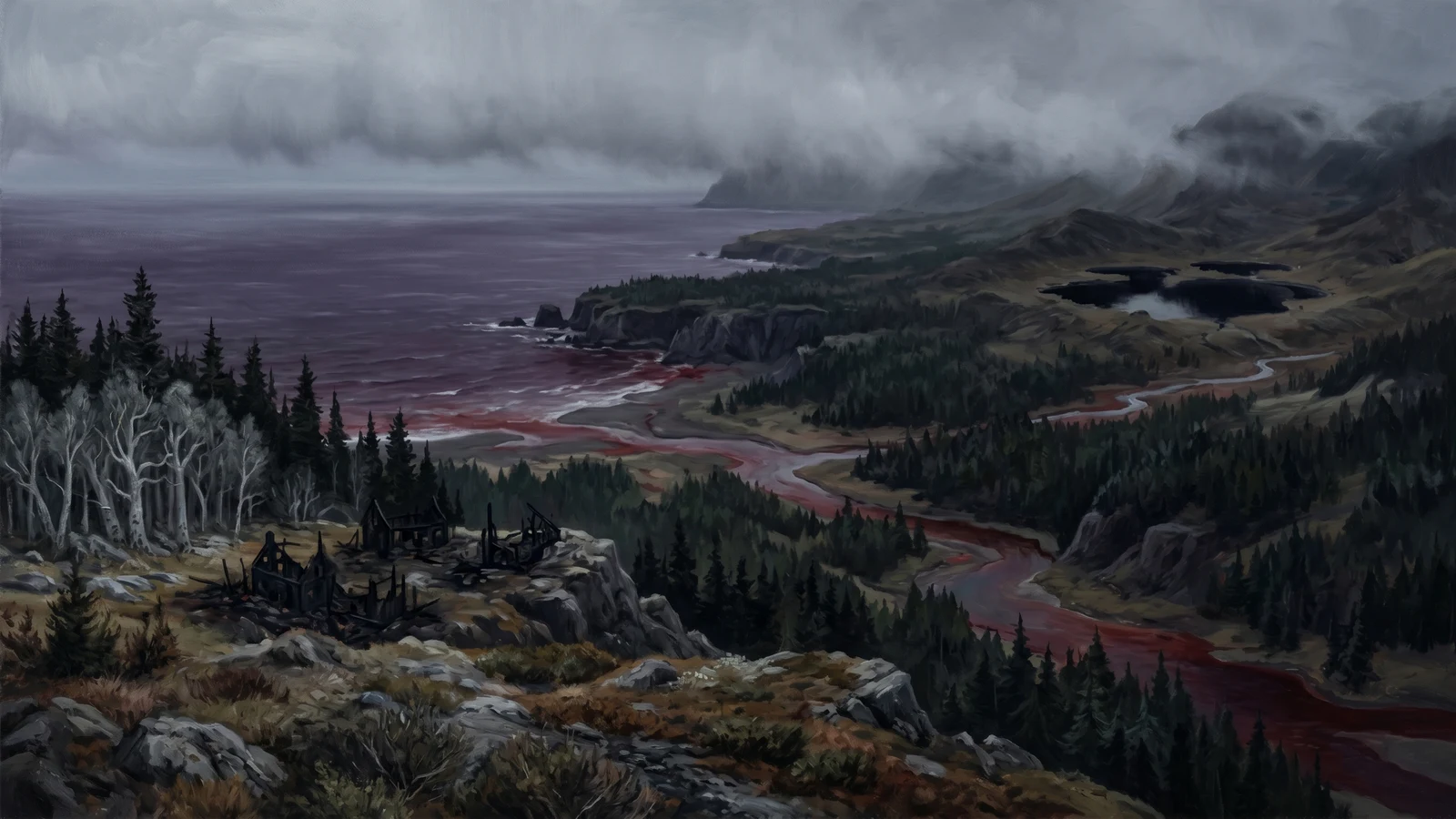
The Crimson Coast earns its name honestly. This is a land stained by centuries of bloodshed—ancient regicides, fractured kingdoms, and the slow grinding violence of elven civil war. South of the Dragon's Spine mountains, three states cling to existence in a region where the very rivers remember old murders and the forests harbor things that predate the elves themselves.
Boundaries and Position
- North: The Dragon's Spine mountains form an impassable barrier, their southern faces dropping into the Hag Hills and the headwaters of the region's rivers
- East: The Dragon's Spine Coast, where Thraken Lake marks the transition to different political realities
- South: The Void—the great purple-dark ocean that bounds all of southern Aboyinzu
- West: The coastline curves around Tangiern's western reaches, past the Pools of Tragedy
The region occupies the southwestern tip of Aboyinzu, isolated from the continent's larger powers by the Dragon's Spine. This geographic isolation has allowed the Crimson Coast's internal conflicts to fester without outside intervention—or resolution.
Terrain
The Crimson Coast is dominated by vast conifer forests broken by river valleys and coastal hills. Moving west to east:
Western Forests: The enormous Fragenstor Mielthøn covers most of Tangiern, a seemingly endless expanse of dark pine and spruce. Hilda's Forest occupies the northwestern corner, older and stranger than its neighbor.
Central Hills: The Suftos Hills run north-south through the region's heart, forming the contested border between Klevnaf and Istora. The Hulry Hills anchor the northwest.
Eastern Woodlands: Whitewood (in Klevnaf) and Winterwood (in Istora) are smaller but no less significant—sacred groves to the Winter Elves who once ruled the entire region.
Waterways: Rivers carve through the landscape in patterns that mirror political divisions. The River of Wights flows from haunted sources in the northwest. Murder Creek divides what remains of the old elven kingdom. The Sova Chyda sustains Istora's settlements. The Rabbit River provides Tangiern's primary trade route to the sea.
Climate
Cold maritime conditions prevail. Winters are long and bitter, with snow lingering in the forests from late autumn through early spring. Summers are brief and cool, with frequent fog rolling in from the Void. The Dragon's Spine creates a rain shadow that makes the eastern reaches slightly drier than the perpetually damp western forests.
Political Climate
The Crimson Coast exists in a state of cold war that periodically turns hot.
The Succession Crisis: When Istor XXVI was murdered, his daughter Lamenrae accused her father's uncle Taoinor of the crime and refused him the throne. Taoinor's supporters—primarily those in the western territories—rejected her authority. The kingdom split along Murder Creek, with each faction claiming to be the true continuation of the Winter Elf realm.
Tangiern's Position: The human kingdom on the western coast pays the elven war very little mind. An old forest-passage toll to the unified crown lapsed when the crown broke, and neither Klevnaf nor Istora has the reach to press a successor to it; Tangiern garrisons the Suftos frontier against raiders and otherwise looks the other way. The Tangier are a seafaring people, and their real concern is the Void at their backs, not the elves dying over a throne in the east.
The Suftos Buffer: The hills between Klevnaf and Istora have become a depopulated no-man's-land. Villages were evacuated or destroyed in the first years of the split. Now it's patrol territory—elven rangers from both sides hunting each other through the rocks and scrub.
What Makes It Interesting
A War With No Good Guys: Lamenrae may be right that Taoinor murdered her father—but Taoinor may be right that a queen is an unacceptable break with tradition. Players can support either claim without being obviously wrong.
Cursed Geography: Murder Creek, the Pools of Tragedy, the River of Wights—the land itself remembers violence. This creates supernatural hazards alongside political ones. Drinking from the wrong stream might show you visions of an ancient assassination.
The Third Player: Tangiern has survived by simply not caring who wins. The kingdom faces seaward, toward the Void and its trade, and treats the eastern war as a border nuisance to be garrisoned rather than a contest to be won. Both elven factions would like Tangier steel or Tangier grain; neither can compel it.
Ancient Secrets: Hilda's Forest and the ruins of Hildaneir predate even the Winter Elves. The Fragenstor Mielthøn hides things that remember when this land had different masters.
What Will Go Wrong
Escalation: The cold war is heating up. Border skirmishes are becoming more frequent. One major incident—an assassination, a massacre, a perceived betrayal—could trigger open warfare.
The Frontier Hardens: The Suftos garrison is a standing expense Halvard would rather not carry, and the longer the elven war grinds on, the more raiders and deserters spill west into Tangier ground. A bad season on that frontier could drag the seaward kingdom into a war it has no interest in fighting.
The Curse Spreads: Murder Creek's waters are spreading their influence. Wells near the creek are going dark. People are having visions they shouldn't have. Something is using the old curse for new purposes.
Dragon's Spine Stirring: The mountains to the north have been quiet for generations. That's changing. Refugees from the Dragon's Spine Coast bring stories of increased activity—and whatever's waking up there will eventually look south.
River of Wights
Flows from the northwestern highlands past the Pools of Tragedy and into the Void. The name is earned—the river's upper reaches are genuinely haunted, and bodies dumped in the river don't always stay down. Fishermen along its lower stretches learn quickly which stretches to avoid after dark.
Pools of Tragedy
A cluster of dark lakes in the northwestern Crimson Coast, fed by the River of Wights. Local legend holds that each pool marks where a great sorrow occurred—a massacre, a suicide, a betrayal. The water is safe to drink but tastes of grief. Travelers who camp near the pools report dreams of losses they've never experienced, mourning people they've never known.
Lake of Rainbows
A surprisingly beautiful lake in western Tangiern, its waters producing prismatic effects in the morning light due to mineral content from surrounding springs. The cheerful name feels incongruous in the Crimson Coast—locals say the lake predates the region's troubles, a remnant of when this land was something other than what it's become.
Thraken Lake
Technically in the Dragon's Spine Coast region to the east, but visible from Istora's highlands. A large mountain lake that marks the boundary between regions. The Istori consider it the edge of their world—beyond Thraken, different powers hold sway.
Suftos Hills
The contested spine of the region, running north-south between Klevnaf and Istora. Rocky, scrub-covered terrain broken by sudden ravines and hidden valleys. Before the split, this was hunting ground for the Winter Elf nobility. Now it's a war zone—depopulated, dangerous, and haunted by the ghosts of the conflict's early casualties.
Fragenstor Mielthøn
The great forest of Tangiern—hundreds of square miles of dark conifer woodland covering most of the kingdom's territory. The name is Old Tangier for "Forest of a Thousand Thoughts," referencing the forest's reputation for inducing strange mental states in those who travel too deep. Most of Tangiern's population lives at its edges or along river clearings; the deep forest remains largely unexplored and is said to contain ruins from before human settlement.
Hilda's Forest
An ancient woodland in the northwest, smaller but older than the Fragenstor Mielthøn. The forest takes its name from a legendary figure—Hilda the Wanderer, who supposedly lived here before the Winter Elves arrived. The ruins of Hildaneir lie within, though what Hildaneir was remains debated. The elves avoided this forest even when they ruled the entire region.
Whitewood
A silver-barked forest in Klevnaf, sacred to the Winter Elves. The trees here are pale as bone, their leaves producing a distinctive rustling that the elves interpret as ancestral voices. Logging is forbidden; the forest is maintained as a shrine to the old ways. Taoinor's faction draws spiritual legitimacy from their control of Whitewood.
Hildaneir
A spiral of cold black stone in Hilda's Forest, older than the elves and built of a dark material that matches no local geology. It was raised to bind something, and the binding is failing now that the one who kept its vigil has been forgotten. The Winter Elves left it alone even when they ruled the whole coast. See Hildaneir.