Geography
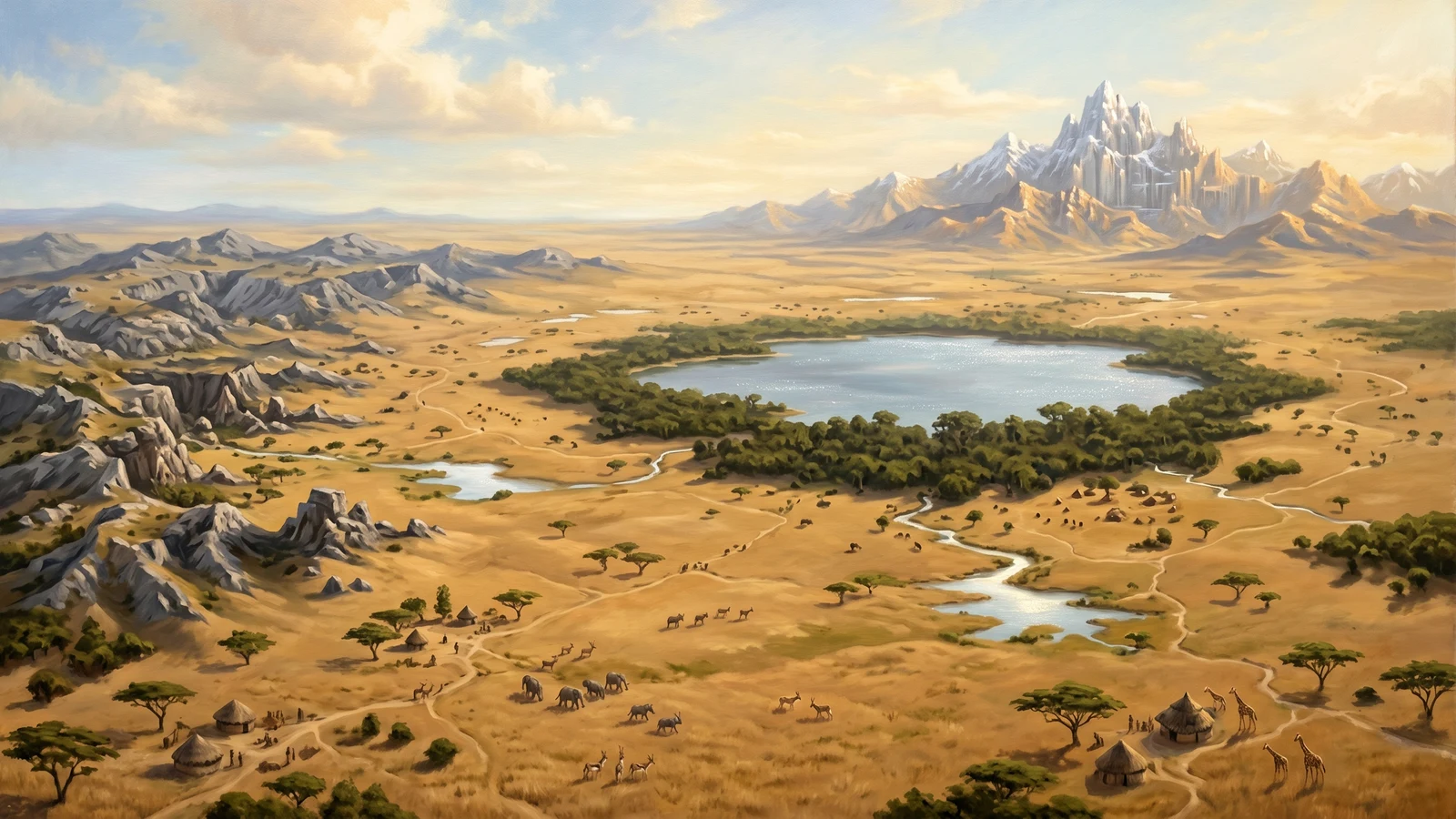
Central Aboyinzu is the vast interior of the continent, a general term encompassing the savanna heartlands, the Deadloop inner sea, and the territories between the major mountain ranges. The terrain is a mix of tan and light green, characteristic of vast savanna and dry grassland. Think of the African Serengeti: endless golden grass beneath wide skies, punctuated by scattered trees and watering holes.
Boundaries and Position
- North: Terrenia and the states of Chaal Nazaerox, Grustos, and Quintas
- East: The Elderwilds peninsula and South Sea
- South: The Morygun Mountains and Dragon's Spine range
- West: Korgül forest, the Mumbling Forest, and largely uncharted wilderness of grassland and forest
The Crystal Mountains
A major mountain range running southwest to northeast across central Aboyinzu. At their southwestern point, they connect to the Morygun Mountains. At their northeastern extent, they overlap with the mountains of Grustos. Chaal Nazaerox lies to their north.
The Morygun Mountains
Running northwest to southeast, these mountains connect the southern tip of the Crystal Mountains to the northwestern edge of Dragon's Spine. West of the Morygun Mountains lies uncharted wilderness—grasslands, forests, and the Korgül region (home to satyr).
States and Territories
- Chaal Nazaerox: The massive northern state (shared with Terrenia)
- Grustos & Quintas: Eastern states near the Crystal Mountains
- Kadroka: Southern territory
- Chechol: Eastern territory, south of the Deadloop and northwest of Dalizi
- Korgül: Western forest region, home to satyr
Political Climate
TODO
What Makes It Interesting
TODO
What Will Go Wrong
TODO
Frogsong River
Inhabited by extremely poisonous frogs.
Cowardly Mountains
A sub-range of the Crystal Mountains, curving southwest from the main spine to form Luendrokrül's northwestern boundary. The name is old, possibly older than the common tongue version suggests, and no one agrees on its origin. What everyone agrees on is that things live here that live nowhere else, and most of them came from somewhere else.
Geography
The Cowardly Mountains are lower and more broken than the Crystal Mountains proper. Where the main range presents sheer faces and defined peaks, the Cowardly Mountains are a jumble of ridges, box canyons, hidden valleys, and cave systems that honeycomb the stone. The terrain is defensive by nature—easy to hide in, hard to search, impossible to hold against someone who knows it better than you.
The western slopes drop into the foothills above the Minas River. The eastern faces overlook Luendrokrül's canopy, offering views that would be spectacular if anyone wanted to look at that forest for long. The Safeway Passage cuts through the range's narrowest point, the only reliable route between the western territories and the lands beyond.
The Refuge
The Cowardly Mountains earned their name, or perhaps always had it, because things flee here. Animals seeking territory, but also people. Creatures. Things that needed to disappear.
Refugees from Chaal Nazzerox's expansion found their way here generations ago, the living who escaped before Xynoth's conquest was complete. Their descendants still inhabit hidden valleys, speaking old Terrenian dialects and practicing customs that died everywhere else. They don't welcome outsiders, but they don't attack them either. They've learned that staying hidden is safer than staying hostile.
Other things came later. Deserters from a dozen armies. Criminals whose crimes were severe enough to warrant real pursuit. Cultists whose worship drew too much attention. Monsters intelligent enough to know when they were being hunted. The mountains don't judge. They just provide cover.
Not everything here fled from something. Some things fled to something. The forest below, Luendrokrül, draws certain minds the way a wound draws flies. Pilgrims who believe something waits in the ruins. Scholars obsessed with the vanished civilization. Madmen who heard voices promising answers. They pass through the Cowardly Mountains on their way down, and the mountain-dwellers let them go. Anyone that determined to enter Luendrokrül won't be stopped by warnings.
The Inhabitants
No census exists of who or what lives in the Cowardly Mountains. The terrain makes surveying impossible and the inhabitants make it inadvisable. What's known comes from occasional contact at the Safeway Passage, rare trading encounters, and the testimony of the few who've traveled deeper and returned.
The Old Terrenians: Descendants of refugees, clustered in three or four hidden valleys. They raise goats, grow what the thin soil allows, and maintain traditions from a country that no longer exists. Suspicious of outsiders but not automatically violent. Will trade for metal goods and news from the wider world.
The Unaffiliated: A catchall term for everyone else—bandits, hermits, exiles, and stranger things. No organization, no common cause, just people and creatures who needed to be somewhere no one would look. Mostly avoid each other as much as they avoid outsiders.
The Listeners: A name used by the Old Terrenians for something else in the mountains, neither human nor quite animal, seen only at the edges of vision. They don't attack, don't communicate, don't seem to want anything. They just watch. The Old Terrenians leave offerings at certain stones and don't speak of them to outsiders.
Why "Cowardly"
Theories abound. The mountains shelter cowards and refugees. The stone is geologically unstable, "cowardly" rock that crumbles under stress. An old legend claims the mountains themselves fled here during some primordial cataclysm, cowering at the edge of the world.
The Old Terrenians have their own explanation, which they don't share with outsiders. When traders at the Safeway Passage have asked, the answer is always the same: "The mountains know what's in the forest. So do we. Wouldn't you hide too?"
Melekas the Stillbound
Melekas is an ancient dragon who rules the state of Kadroka from the capital city of Ponoigari, though "rules" understates the complexity of the situation. For nearly eight hundred years, Melekas has been paralyzed from the neck down, fused with the bedrock beneath the city, unable to fly, walk, or leave the spot where the dragon landed after a catastrophic encounter with the Agony Stones.
The Stillbinding
Around 800 years ago, Melekas flew to investigate the Agony Stones—a vast region of strange, contorted rock formations in the southern reaches of what is now Tythikerys. The dragon landed on the largest formation to examine it more closely. That was a mistake.
The stone reached back.
Petrification raced up the dragon's legs before Melekas could tear free. The dragon barely managed to take flight, but the curse, or infection, or sympathy-bond, no one is certain which, had already spread through most of the body. Melekas made it back to the settlement that would become Ponoigari and has been rooted there ever since.
Present State
Melekas's body is fused with the bedrock beneath the capital. The dragon's immense form, several hundred feet from tail to snout, now serves as the foundation for the palace complex and surrounding government district. Only the head, neck, and one foreleg retain mobility. The scales have taken on a grey-stone cast that wasn't there before, and the line where living tissue meets petrified flesh creeps imperceptibly higher each decade.
The dragon can still breathe fire. Still think. Still speak in a voice that rattles windows across the city. But Melekas cannot fly, cannot walk, cannot project physical power beyond the reach of neck and flame.
The petrification continues to spread. Slowly, a few inches per decade, but inexorably. Melekas has perhaps four or five centuries before the head goes still. The dragon knows this. Everyone in Kadroka knows this.
The Palace of the Stillbound
The royal palace is built around and upon the dragon's immobile body. Petitioners approach the living head while standing on the dragon's petrified flank. Audience chambers are carved into the spaces between frozen limbs. The dragon's one mobile foreleg occasionally gestures during conversation, a reminder that this is a living ruler trapped in stone, not a statue.
The architecture has evolved over centuries to accommodate both the dragon's needs and the practical requirements of governance. Heating systems draw from the dragon's body heat. Drainage channels redirect the occasional gout of flame. The throne room is simply the space before Melekas's face, with the dragon's eye, each larger than a wagon wheel, providing illumination and, by repute, lie detection.
Personality and Rule
Eight centuries of forced immobility have transformed Melekas from a creature of physical dominance into one of pure political cunning. The dragon who once ruled through terror and flight now rules through manipulation, information networks, and the careful cultivation of loyal agents. Melekas has become the ultimate stationary power—all of Kadroka must come to the dragon, never the reverse.
The dragon is patient in ways that shorter-lived beings cannot comprehend. Melekas plans in decades, thinks in centuries, and nurses grudges that span generations. The Tytheri orcs who now raid Kadrokan settlements with impunity? Melekas remembers when their ancestors were scattered tribes easily burned from the sky. The Agony Stones that trapped the dragon? Melekas has spent eight hundred years researching them, interviewing survivors who approached them, and sending agents to study them from safe distances.
The dragon desperately wants two things: a cure for the stillbinding, and revenge on whatever the Agony Stones actually are. These goals may be connected. Melekas suspects that understanding the Dying One, truly understanding it, might provide a way to reverse the petrification. But that would require someone to go into the Stones. Deep into them. And everyone who has tried that has either died or joined the Dying One's slow agony.
Relationship with Kadroka
The people of Kadroka have a complicated relationship with their immobile ruler. On one hand, Melekas provides genuine protection—the dragon's fire can reach well beyond the city walls, and any army foolish enough to assault Ponoigari directly would face an enemy that cannot be flanked, cannot retreat, and has nothing to lose.
On the other hand, Melekas is still a dragon. Taxation is heavy. Dissent is noted and remembered. The dragon's network of informants (humans, naga, and others who serve the Stillbound) ensures that very little happens in Kadroka without Melekas eventually learning of it.
The naga population, in particular, has thrived under draconic rule. Dragons and naga share ancient connections, and many naga serve in Melekas's inner circle as advisors, spies, and interpreters of the dragon's will. Human Kadrokans sometimes resent this, creating ongoing tension within the realm.
The Tytheri Problem
Melekas's paralysis has emboldened the Tytheri blood orcs to the southwest. They know the dragon cannot hunt them. They know Kadroka's military, without aerial support, struggles to project power into the rough terrain of Tythikerys. They raid with increasing boldness, and Melekas can do nothing but watch and scheme.
The dragon's hatred for the Tytheri is matched only by hatred for the Agony Stones that crippled Melekas in the first place—and the orcs' connection to those Stones, their harvesting of the Dying One's ichor, makes them doubly offensive. Melekas would give almost anything for a way to destroy both the orcs and the Stones that sustain them.
Almost anything.
Mikisapi Forest
An ancient forest covering Mikisapi Island, the landmass at the center of Deadloop. Unlike the hostile Dragonsong forests to the east, Mikisapi is inhabited, but on the forest's terms.
Geography
Mikisapi Island is roughly thirty miles long and fifteen miles wide, entirely covered by old-growth forest except for the city of Tenches at its heart. The coastline is rocky and difficult to land on; most visitors arrive at one of three maintained harbors that connect to roads leading inland.
The forest floor is surprisingly navigable in most areas—the canopy blocks enough light that undergrowth stays sparse. But the paths shift. Trails that were clear last season may be overgrown this season, while new routes open through previously impassable sections. Locals claim the forest guides travelers toward Tenches if they're peaceful, and away from it if they're not.
Character
Mikisapi is old, but not malevolent. The trees grow tall and close together, their canopy forming a continuous roof that turns daylight into perpetual green twilight below. Sound carries strangely—conversations seem muffled while distant birdsong rings clear. The air smells of loam, moss, and something faintly sweet that no one has ever identified.
The forest tolerates habitation. Woodcutters work its edges, hunters range through its depths, and hermits build cabins in isolated clearings. But tolerance isn't welcome. People who take too much find their luck turning: tools break, game vanishes, paths lead in circles. People who give back, planting seedlings, clearing deadfall, leaving offerings at the old stones, find the forest generous in return.
The Inhabitants
Tenches occupies the forest's heart, built around a clearing the trees have never reclaimed. The city-state has existed for centuries, maintaining a careful balance with the forest around it.
Beyond Tenches, the forest holds:
- Woodcutters and hunters who've learned to read the forest's moods
- Hermits and exiles seeking solitude or hiding from something
- Spirits and fae that never come to the city—older presences that tolerate Tenches but don't acknowledge it
- Things without names in the deepest groves, neither hostile nor friendly, simply ancient
Resources
Mikisapi timber is prized throughout Aboyinzu. The wood is dense, rot-resistant, and takes enchantment unusually well—shipbuilders, wandmakers, and artificers pay premium prices for quality cuts. Tenches controls all timber exports through the Grove Council, and cutting without permission is punished by exile at best.
The forest also yields medicinal herbs, rare fungi, and occasionally stranger things—artifacts from older times, exposed by shifting roots or revealed in storm-toppled trees.
What It Looks Like
Massive trunks rising like columns in a cathedral, their bark rough and dark, hung with pale lichen. The canopy above is so thick that rain arrives as a delayed drizzle, filtered through layers of leaves. The ground is carpeted with fallen needles and decomposing leaves, soft underfoot and nearly silent to walk on.
Shafts of green-gold light break through gaps in the canopy, illuminating clearings where wildflowers grow in brief, brilliant displays. Streams wind between the trees, their water cold and clear. Birdsong is constant but distant, as if the birds are always somewhere else.
At night, the forest is utterly dark. No moonlight penetrates the canopy. Travelers without light don't travel at all—they stop, wait for dawn, and hope nothing finds them.