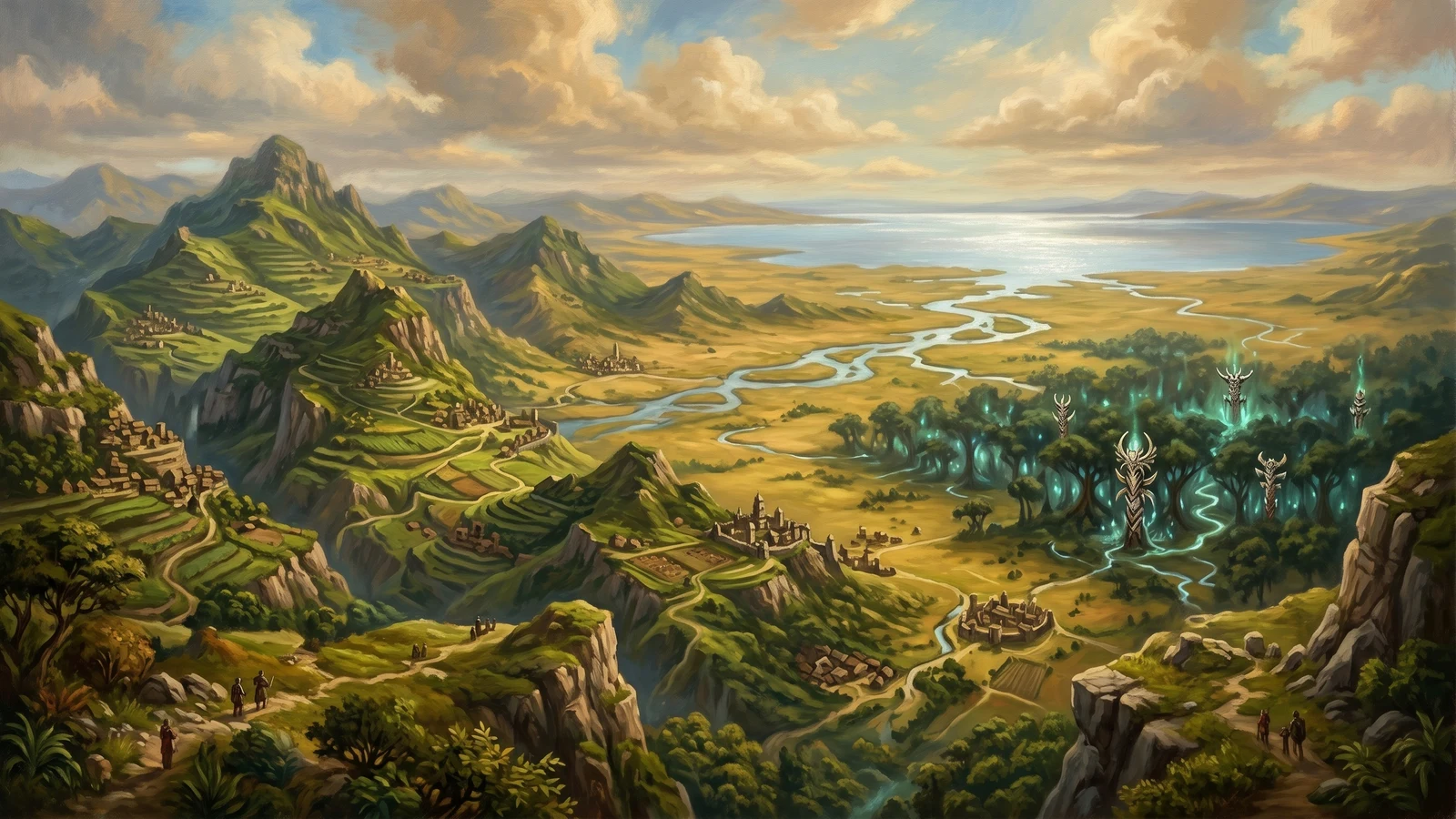
The Dalizi Confederation spans the territory northwest and west of Lake Tonactlet Chipe, encompassing forty-four member states from the Dalizi Highlands in the northeast to the plains and river-states of the south and west. It is one of the largest political bodies in Aboyinzu, a coalition bound by shared treaty and mutual interest rather than an empire.
Governance
The confederation operates through the Mwali, an assembly of state delegates that convenes annually at a rotating host city. Each member state sends one delegate regardless of size, and binding decisions require a two-thirds majority. In practice, the largest and oldest members—including the highlands bloc and the prominent southern states—carry disproportionate influence through debt, alliance, and the weight of long tradition.
There is no permanent capital. The Mwali's rotating seat means that political prestige follows the host cycle, and states compete for the honor. Smaller states sometimes trade their hosting rights to larger ones in exchange for economic concessions, a practice called kusafirisha kiti, "passing the seat."
Money
The confederation keeps no coin. It mints no metal, and the iron-reckoned standard of the Middle Sea and the weighed silver of the southern sea both stop at its border. Dalizi reckons its wealth in cattle. A head of cattle, ng'ombe, is the unit every debt is named in, and like a banker's iron piece it is mostly notional — the cattle named in a contract rarely walk anywhere. Settlement happens in bars of lake salt and stamped lengths of cloth, issued by the member states and valued against the cattle reckoning.
What makes the arrangement live is who sets the rate. Each year the Mwali fixes the salt-to-cattle and cloth-to-cattle rates at whatever city holds the rotating seat, which hands the confederation's money to whoever is hosting, and the host shades the rate toward its own salt and its own cloth every time. The shading is as old as kusafirisha kiti and about as provable as a herd count. Because the whole reckoning rests on cattle, a hard season of raiding moves the money all at once: a bloc that loses its herds watches its salt and cloth inflate against a unit it can no longer field, while the raiders who took the cattle find their own goods worth more. The seat-cycle and the money-cycle are the same cycle, and the two grievances feed each other.
The cattle reckoning barely crosses the confederation's edge. A trader carrying goods down to the lake ports converts there into southern silver marks, at a rate that runs, in the end, back to the Adron banks across the sea.
Key Sub-Regions
The Dalizi Highlands occupy the elevated terrain north and northeast of the lake: a zone of peaks, passes, and deep valleys bounded on the north by the Thundering Mountains, beyond which lies the Wanderlands. Within the Highlands sits the Dalizi Wildlands, an ancient forest of concentrated leylines and deep magical heritage. The Pool to Infinity and the forest of Nykotheryx Amberylika, where bone-and-silver totems hold the lingering spirits of ancient dark-elf leaders, are its most significant features.
The western and southern states occupy the savanna and lowland plains. These states—among them Dhabisa, Nikpato, Misanda Mulu, and Taulo Magi—form the agricultural and trade backbone of the confederation. The southern frontier runs against Emblydium and the foothills of the Dragon's Spine.
Political Tensions
The confederation's primary fault line runs between the highland states and the lowland majority. Highland delegates argue their terrain provides a defensive buffer for the whole confederation and demand greater resource-sharing in return; lowland states counter that the highlands produce little tradeable surplus.
The Mwali has no enforcement mechanism beyond expulsion—a sanction no large state has ever faced. Three member states maintain standing armies exceeding confederation treaty limits, which smaller members view with suspicion but lack the votes to formally censure.