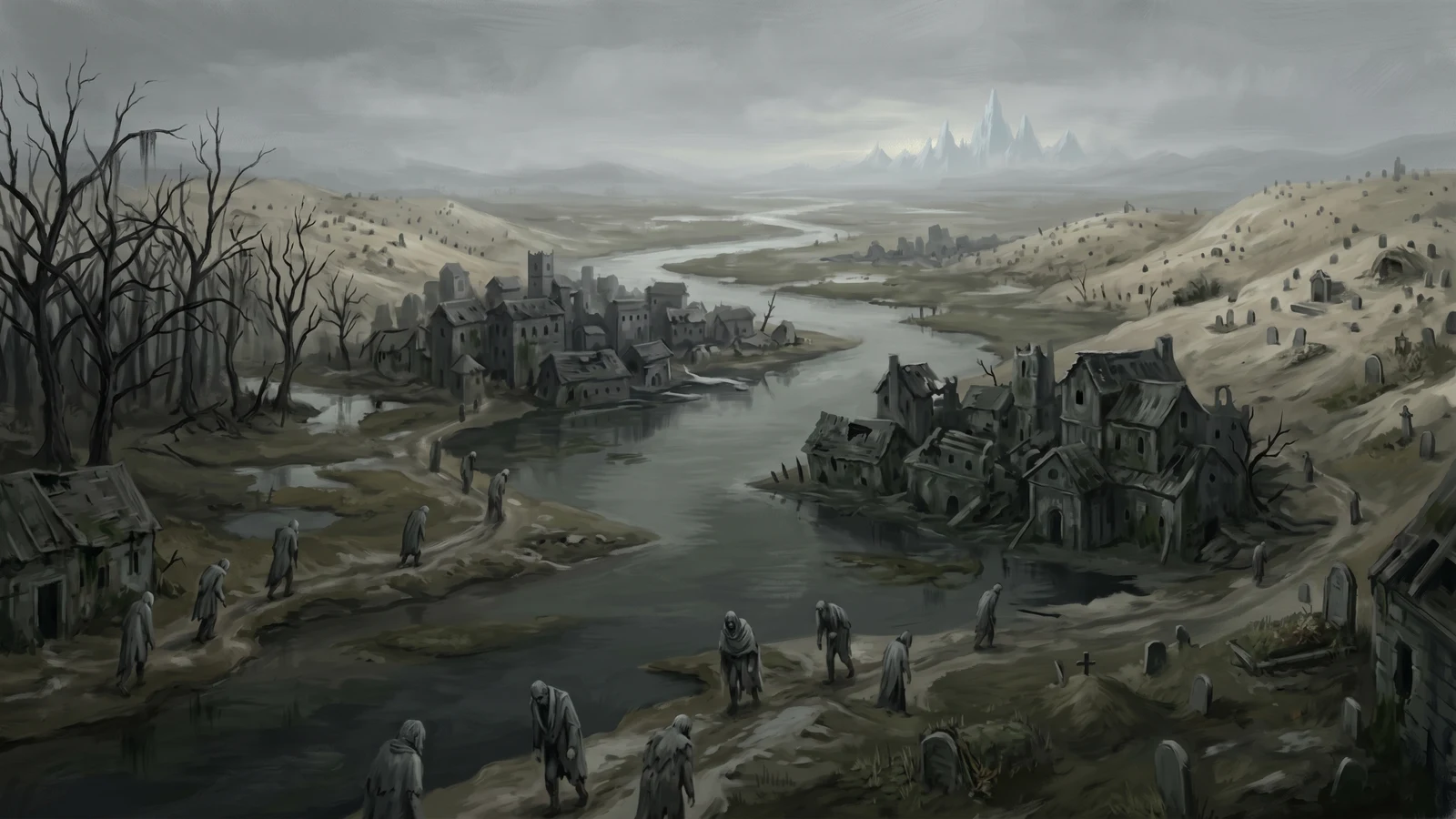
The largest state in Terrenia and one of its greatest horrors, an undead empire stretching from the western coast to the Crystal Mountains, ruled by the lich king Xynoth Azkonor. What was once a prosperous agricultural heartland is now a land of shambling dead, rotting cities, and the desperate living who serve or hide from their immortal master.
The empire is bounded by natural barriers on all sides: the sea to the west, the Crystal Mountains to the south, the Smokey Hills and their Firesworn defenders to the east, and the still-living states of northern Terrenia to the north. These barriers have contained the undead, for now. Xynoth's armies probe constantly for weakness, and his living servants work to build the navy that will let him break free.
Travel in Chaal Nazzerox is almost exclusively by river. The ground is soft, waterlogged, and refuses to hold roads. This has shaped the empire's geography. Cities cluster along riverbanks, and whoever controls the waterways controls movement. The dead don't tire, but they're slow on soft ground. Barges are faster.
The land itself seems sick. Forests weep or frown. Hills are named for graves and bones. Lakes hold the drowned. Even the geography has absorbed the empire's nature, or perhaps it was always this way, and that's why Xynoth chose it.
Prowling Hills
Southern highlands near the Crystal Mountains, where something hunts. Travelers report being stalked through the rocky terrain, not by undead, who are too clumsy for this landscape, but by something faster and more deliberate.
The most common theory is mountain predators descended from the Crystal ranges: cats, wolves, or something worse that found easy prey in the refugees trying to cross south. Others believe living resistance fighters use the Prowling Hills as a base, preying on empire supply convoys. A few whisper about older things, creatures that lived in these hills before humans came and resent all intruders equally.
Whatever prowls here, the undead armies have trouble in this terrain. Their shambling gait catches on loose rock, and they lack the awareness to spot ambushes until it's too late. The Prowling Hills remain unconquered, not because anyone defends them but because the cost of conquest exceeds the value.
The Rivers
The empire's highways. With no roads and soft ground, all significant travel and transport moves by water.
Melkron River: The largest river, running roughly north-south through the heart of the empire. Controls access between the capital region and the southern territories. Heavily patrolled by undead barges.
Yephrenzi River: Northwestern river flowing out of Aal Salma territory. One of the few routes refugees use to escape north, dangerous but faster than overland.
Tozzelak River: Northeastern river through Brevldorf Hills. Tribute barges use this route; so do slave transports.
Matorkey River: Eastern river flowing toward the coast. Less traveled, as it leads to more heavily controlled territory.
Rojek River: Northeastern tributary, connecting several highland settlements to the main river network.
Caarl River: Central river serving the agricultural regions, what agriculture remains. Grain barges still move on the Caarl, feeding the living population.
Caarline River: Southern tributary of the Caarl, running through the Prowling Hills region. Dangerous; convoys require heavy escort.
Berrisund River: South-central river connecting interior settlements. Subject to frequent raiding, whether by living resistance or something else is unclear.
Pabacine River: Southwestern river flowing toward Lutuya Sound. Used primarily by the hags and those foolish enough to trade with them.
Segos River: East-central river serving the Frowning Forest region. Notoriously difficult to navigate; the forest seems to move the riverbanks.
Towns and Villages
The empire's smaller settlements, what remains of them. Most were thriving communities before Xynoth's rise; now they're labor camps, tribute stations, or empty ruins. The living population in these places exists to serve the empire's needs, nothing more.
Zornos: A northeastern town in the Brevldorf Hills, serving as a collection point for tribute from surrounding villages. The living elite here are tax collectors backed by undead enforcers.
Myavis Kaalthox: An eastern town near the Frowning Forest, known before the empire for its woodworkers. Now produces coffins and siege equipment. The irony is not lost on the remaining craftsmen.
Sharyakax: A town east of the Hills of Deoria, uncomfortably close to the Melthrayn holdout. A forward observation post, watching for activity from the city-state. The garrison here is more alert than most.
Nomos: A central town on the Caarl River, once a market hub. Now processes agricultural goods from the surrounding slave farms. The granaries here feed the living population of several cities.
Lepox Naan: A south-central town that processes slaves arriving from the north before distribution to work sites. The holding pens are larger than the living quarters.
Myrth: A southern town near the Prowling Hills, perpetually on edge. Whatever hunts in those hills sometimes ranges this far north. The undead garrison here has unusually high turnover.
Moartos: A southwestern town, a waypoint between Pyaal Faras and the interior. Travelers bound for hag territory pass through here, if they're foolish enough to go.
Iagyax: A southern agricultural town where slave labor works the last productive farmland before the Crystal Mountains. The fields here haven't failed yet, which makes Iagyax valuable.
Kuyakov: A southwestern town on the Pabacine River, marking the edge of hag-influenced territory. Residents here have learned to leave offerings at the forest's edge. It seems to help.
Esaavos: A southern town that once served as a rest stop for travelers crossing to the Crystal Mountains. Now it's a military supply depot for the endless southern campaigns.
Housan: A small town in the agricultural south, unremarkable except for its survival. The living here keep their heads down and meet their quotas. That's all anyone can do.
Hasaag: A southeastern town near Eyovlix, housing support personnel for the mountain campaigns. Smiths, leatherworkers, healers, the trades an army needs that the dead can't perform.
Kaffyak: A southwestern village near the coast, half-abandoned. Those who remain fish the coastal waters and try not to attract attention from Hagswood.
Soryla Navys: A southern village in the foothills, named for a river that dried up generations ago. The population dwindles each year as quotas claim more than births replace.
Toffertine: A coastal village on Lutuya Sound, caught between the empire's shipbuilding ambitions and the hags who sabotage them. Residents have learned to be useful to both sides, a precarious balance.
What Will Go Wrong
Chaal Nazzerox is contained but not defeated. The empire will eventually:
- Break out through the Crystal Mountains: The passes are defended, but undead don't tire. Eventually, numbers will tell.
- Build a navy: Whether through Lutuya Sound, captured ships, or some other method, Xynoth will reach the sea.
- Consume the holdouts: The Gray Citadel and Melthrayn cannot resist forever. Every siege weakens them; every fallen defender becomes an enemy.
- Find new sources of shadow: The empire runs on animated corpses, and corpses run out. Xynoth needs fresh bodies from somewhere.
- Fragment further: Xynoth is a lich, and his spirit fractures with each death and rebirth. Eventually, what remains may not be sane enough to rule.