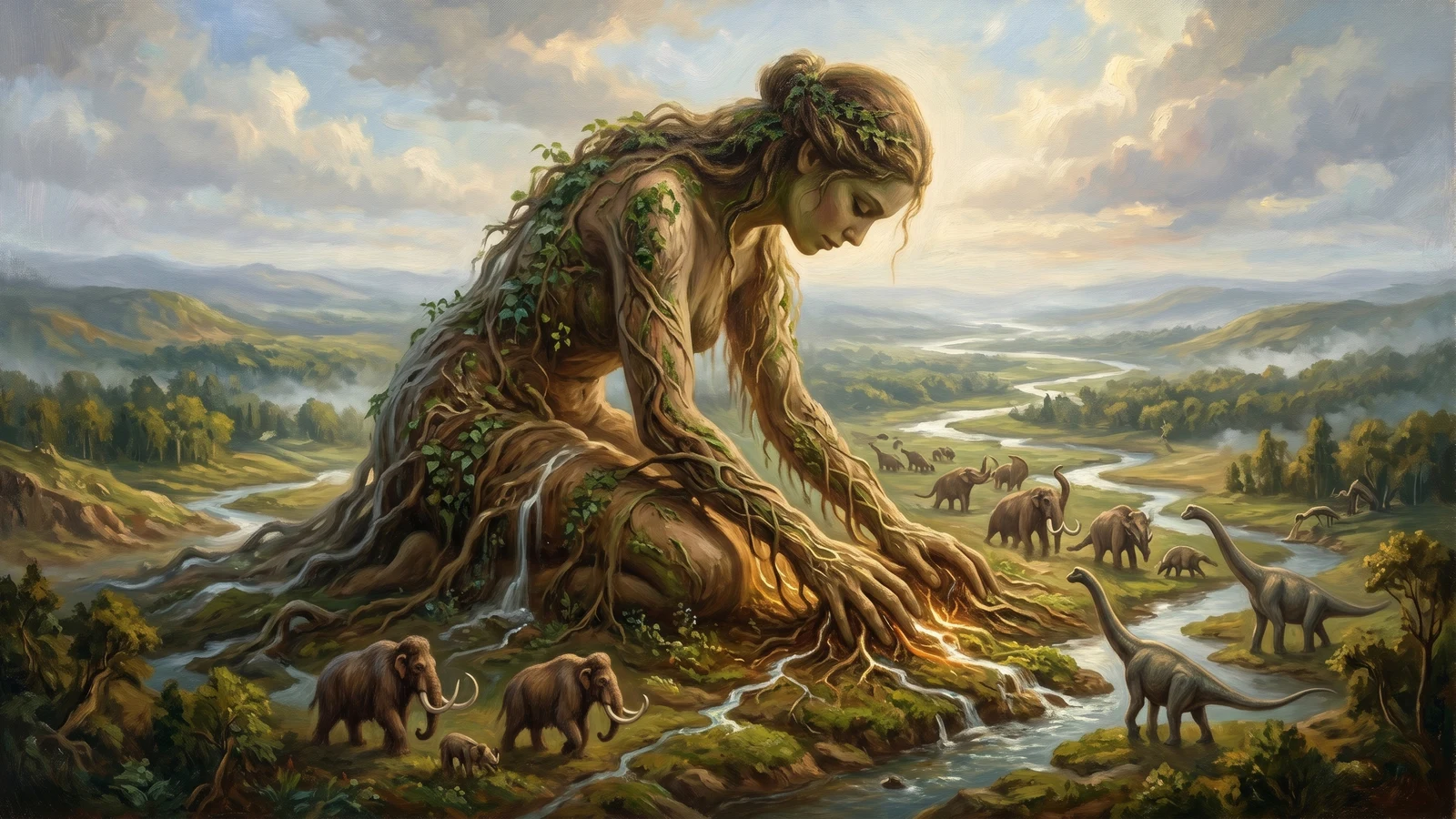
Gaea rose alongside the Ezz Rift, born from the flood of psyic energy that transformed Alaria roughly 12 million years ago. She was not made by the titans. She emerged from the material realm itself — the world's own answer to the emotional substrate the Ezz had become. From the first she was strongest here, in the material plane, though not bound to it; her presence spread across Alaria's full geography, but she was most fully herself with her hands, figuratively and otherwise, in the ground.
Nature
Gaea's power is Kethic, the language she named and shaped. Where Deoric is the titans' command tongue that reshapes reality at the cost of life, Kethic channels the caster's own psyic energy through Alaria's leylines and into the Elemental Planes, a bridge of raw emotion structured outward. Casting Kethic draws on the caster's own psyic reserve. At mortal scale that reserve replenishes naturally — a practitioner who works Kethic for an afternoon is not measurably diminished by it. At cosmological scale and duration the arithmetic is different: psyic energy poured through the leylines disperses into the broader Ezz via the Psywinds faster than it returns, and what disperses at that rate does not come back. A mortal never approaches that threshold. Gaea, pouring herself through Kethic into every creature she made across millions of years, did, cumulatively and totally.
The flesh life of Alaria
In the aeons following the Ezz Rift, Gaea filled Alaria with creatures. Mammoths, rocs, scorpions, the great dinosaurs — a terrestrial ecology assembled through Kethic, each creature a shaped expression of psyic energy given physical form. This is the flesh family: beings made from Gaea's substance, defined by it, sharing a common origin in the material world she inhabited.
Later she made the beastmen, minor animal-children, scattered and varied, and finally humans, around 500,000 years ago. Giants and trolls come from the same root.
The flesh family shares more than a creator. Humans, beastmen, giants, and trolls can interbreed. Half-giants are documented in recorded history; trollkin exist in every city with a troll quarter. The shared origin is the mechanism: Kethic-made bodies recognize each other at the level of substance. Druid-crafted races (elves, shaped from wood and stone and river-mud) do not share this origin and cannot cross with the flesh family.
The sacred three
Among all her creations, three stand apart. Nagatayora, the First Dragon. Ulvma, the First Wolf. Shara Bolasi, the First Lion. These were not minor animal-children. They were Gaea's sons, shaped with full intent and given something close to her own depth of feeling. Their descendants are the Naga, the Ulvsjael, and the Sharabha. No other beastmen hold this status.
The three are not interchangeable. Nagatayora descended into rage at Hykravones; Ulvma stayed with the armies and died among them; Shara Bolasi stood alone and fell. Each inheritance is different, and the cultures that grew from each bear the mark of that difference. What all three share is the scale of what Gaea put into them.
Diffusion
Gaea is far less active in the current age. She has dispersed rather than departed.
The Kethic she spent over 12 million years of creation diffused into the Ezz via the Psywinds and did not come back. At that scale and duration, the global Ezz substrate could not refill what she poured out. She thinned herself into her own creations. When Eyachria challenged her roughly 600,000 years ago, she had already spent most of what she was; the aeons of making had cost her the reserve to match it.
She did not diminish because she lost worshippers to a rival power. She diminished because Kethic spent at the scale and duration of world-making does not return; used without restraint across deep time, it drew more from the Ezz than could ever refill.
Gaea is still present. She is not a daemon waiting on prayers; she is an Earth Mother dispersed through the world she built. The ground over which Kethic flows still carries her pattern. Those who listen carefully enough describe her as a song in the ground rather than a voice: ambient, sourceless, everywhere.