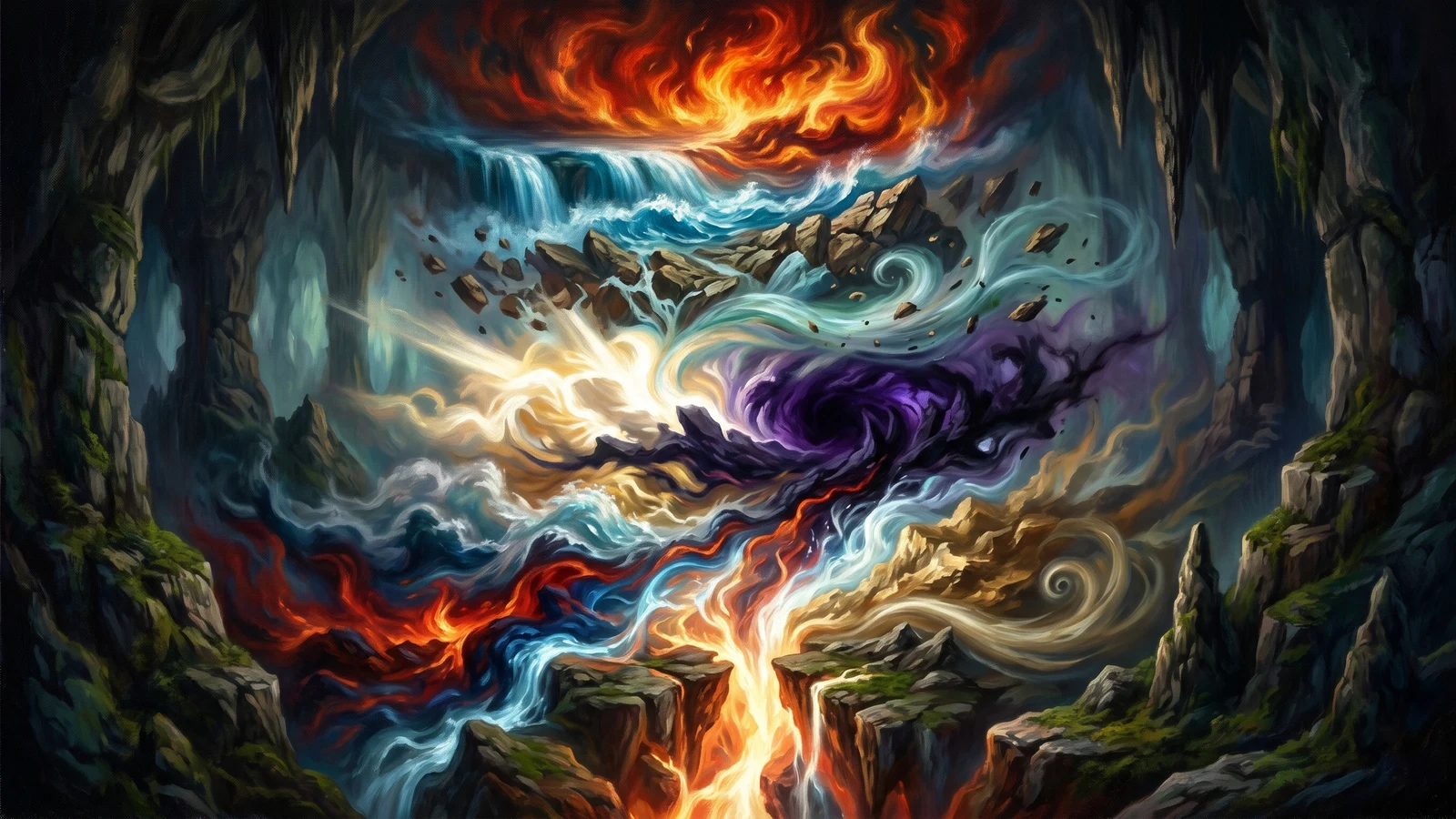
The Elemental Planes are a separate adjacent planar stack, not part of the six-plane structure of Alaria (the four true planes plus two overlays). They cannot be reached by conventional planar travel; the only connections are leylines, fissures where an elemental plane presses close enough to the Material Plane that its power bleeds through. This is why Kethic elementalism feels like borrowed power: the caster does not draw on a native substrate but channels energy through leyline conduits into a stack they cannot properly enter.
The stack is primordial. It belongs to Azus's original planar architecture, ordered and in place from Alaria's formation in the Age of Titans, long before Gaea and long before the Ezz Rift gave the world emotion. For most of that history it was inert and untappable, an adjacent order of fire and stone and the rest with no way in. What changed was not the planes but the access. After the Rift, Gaea found and shaped the leyline bridge, the technique called Kethic. Kethic is how the stack is reached, not why it exists. The elements were always there.
A leyline is better understood as the whole contact between the two stacks than as a rare doorway. The elemental stack presses faintly against the entire Material Plane, everywhere, a thin and uniform field that bleeds a little of all nine planes into the world at all times. A named leyline is where that contact concentrates, a seam where one or more planes press abnormally close. So elemental magic performed on leylines is always more powerful, precisely because those points are where the elemental stack draws physically close to the material world rather than remaining at its usual remove. The faint background field is only the floor.
Seams anchor to the deep structure of the stack, which makes them stable across human history but not eternal. A great cataclysm can open a new seam, shift one, or close one, and over geological time they drift. Where several planes converge in one place, each is amplified and the elements interact: compatible planes reinforce one another and allow rare combined workings, while incompatible ones grind against each other and make the seam unstable and hazardous. The richest leylines in the world are also the most dangerous, and these convergences are why.
Those elemental layers are:
- Yolus (Fire)
- Sulus (Air)
- Golus (Earth)
- Pelus (Water)
- Vulus (Darkness)
- Kunus (Light)
- Nilus (Void)
- Izzus (Time)
- Dynus (Force)
Dynus, the ninth, is the element of motive force itself—momentum, pressure, the kinetic push that moves a thing once the other elements have given it shape. It is not the psychic substrate of the world (that is Ezz, the medium of thought and emotion in which the true planes hang); Dynus is a material element like the other eight, a layer of the leyline-reached stack, and the force a Kethic caster channels through it is the plain physical force of the moving world, not anything of mind.