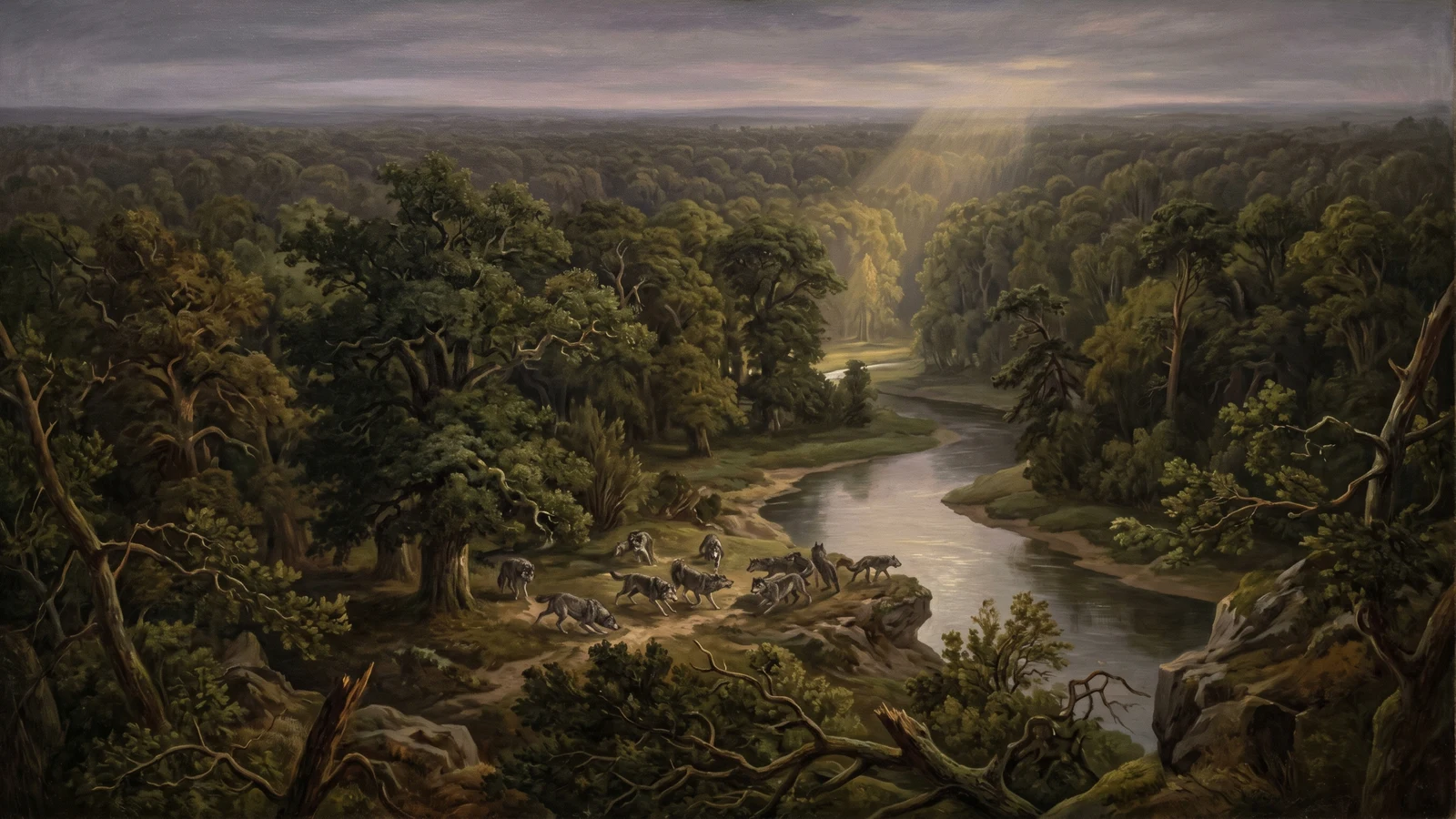
One of Alaria's largest continuous forests, Fylvrae Sylvrym blankets the western half of Wycendeula—a sea of ancient trees stretching roughly 700 miles north to south and 600 miles from the Bay of Wolves to the Kilbyurn Mountains. The forest has no roads, no settlements, no safe paths. It belongs entirely to the ulvsjael.
The Forest Itself
Fylvrae Sylvrym is old growth throughout. Trees here measure their ages in millennia; some of the heartwood oaks predate the God War. The canopy is dense enough to create perpetual twilight at ground level, broken only by rivers and the occasional clearing where something massive has fallen.
The undergrowth is surprisingly navigable in most areas—centuries of shade have prevented the explosive ground-level growth found in younger forests. What grows instead are fungi, moss carpets, and shade-tolerant ferns. The smell is rich decay and wet earth, punctuated by the sharp green scent of crushed fern where something large has passed.
Wildlife is abundant but wary. Deer, boar, and smaller game populate the forest in numbers, but they've learned caution. Anything that moves casually through Fylvrae Sylvrym doesn't survive long.
The Ulvsjael
Nearly a dozen nomadic packs roam Fylvrae Sylvrym—the largest concentration of ulvsjael anywhere in the world. These are not the cursed werewolves of northern Alaria, transformed by magic and trapped between forms. The ulvsjael are true-born wolf-kin, descended from Ulvma, Gaea's wolf son. They were born this way. Their parents were born this way. Their line stretches back millions of years.
The ulvsjael spend most of their existence in wolf form, massive creatures that hunt in coordinated silence. Only in times of extreme circumstance do councils convene in human form—and even then, the gatherings are brief. Human shape feels wrong to them, a costume worn for necessity.
The packs range in size from thirty to over a hundred individuals. Territory boundaries shift constantly through skirmish and negotiation. Some packs are relatively peaceful, content with their hunting grounds. Others are aggressive, expanding whenever opportunity presents. The balance of power reshuffles every generation.
Rumors persist that some packs have interbred with cursed werewolves from the north, incorporating transformation magic into bloodlines that never needed it. The purpose—if true—would be to expand their power, perhaps to produce offspring capable of infiltrating human society. No one has confirmed this. No one who could confirm it has survived to report.
Hidden Wealth
Beneath the forest floor lie hundreds of skystones—astral fragments that drifted down during some ancient cataclysm and were buried by millennia of leaf fall and root growth. A single skystone can fetch enough gold to buy a merchant ship. The forest floor is a fortune waiting to be claimed.
No one claims it.
The ulvsjael don't use skystones, don't trade them, and don't seem to care about them. But they care very much about their territory. Treasure hunters who enter the forest occasionally emerge with stones. Far more often, they simply vanish. The packs don't distinguish between innocent travelers and would-be thieves. All intruders are prey.
Navigation and Rivers
The only reliable features for navigation are the rivers, which thread through the forest like veins. The Twilight River is the largest, flowing west toward the Bay of Wolves. The Lilsau drains the southern reaches near the Eceraen foothills. Smaller tributaries are too numerous to name, and most lack names anyway—the satyr who might have named them don't enter, and the ulvsjael don't share their terms.
The rivers are also the primary hunting corridors for the packs. Prey must drink; the ulvsjael know this. Traveling along a riverbank is faster than pushing through the undergrowth but significantly more dangerous.
The Edges
The forest's margins are slightly less deadly. Along the Bay of Wolves coast, the trees thin into marshland and scrub. Near the Eceraen Mountains, altitude and rocky soil create gaps in the canopy. Around the Kilbyurn foothills, the transition to mountain terrain provides some defensible positions.
The Balduahr dwarves occasionally patrol the eastern forest edge, more to confirm the boundary than to enter. Satyr from the plains sometimes venture in from the east during lean seasons, though they rarely go deep. Along the western coast, the occasional shipwreck survivor has made it out alive—but only by moving fast and avoiding the interior entirely.
For practical purposes, Fylvrae Sylvrym is impassable. The only routes through Wycendeula go around it: the coastal passage along the Bay of Wolves, the mountain passes through the Kilbyurns, or the long eastern route across the satyr plains. Any path through the forest leads through ulvsjael territory, and the ulvsjael don't negotiate passage.
Seasonal Patterns
The forest has two notable seasonal shifts:
Deep Winter: Snow falls heavily in Fylvrae Sylvrym, muffling sound and obscuring trails. The packs are more active in winter—the cold doesn't bother them, but it slows their prey. This is when territorial conflicts peak, as packs push boundaries while rivals are hunting elsewhere.
Faesummer: When the Faesummer phenomenon intensifies light magic across Alaria, Fylvrae Sylvrym experiences peculiar effects. The canopy seems to thin despite no physical change, allowing shafts of intense light to pierce the gloom. The ulvsjael retreat to the deepest shade during these periods, hunting only at dawn and dusk. Some scholars speculate this vulnerability is why they avoid the eastern plains, which offer no cover from the light.
For Travelers
Don't.
If circumstances absolutely require passage through the forest, stay near water but not on the banks. Move during transitions—dawn and dusk—when pack activity is lowest. Travel light and fast; supplies attract attention. If you hear wolves, you're already surrounded—they don't vocalize until the hunt is decided. Pray to whatever powers you honor that they're not hungry.
Most importantly: don't take skystones. The packs may let a small party pass if they seem transient and unthreatening. They never let thieves leave. Whatever you dig up isn't worth what follows you out.