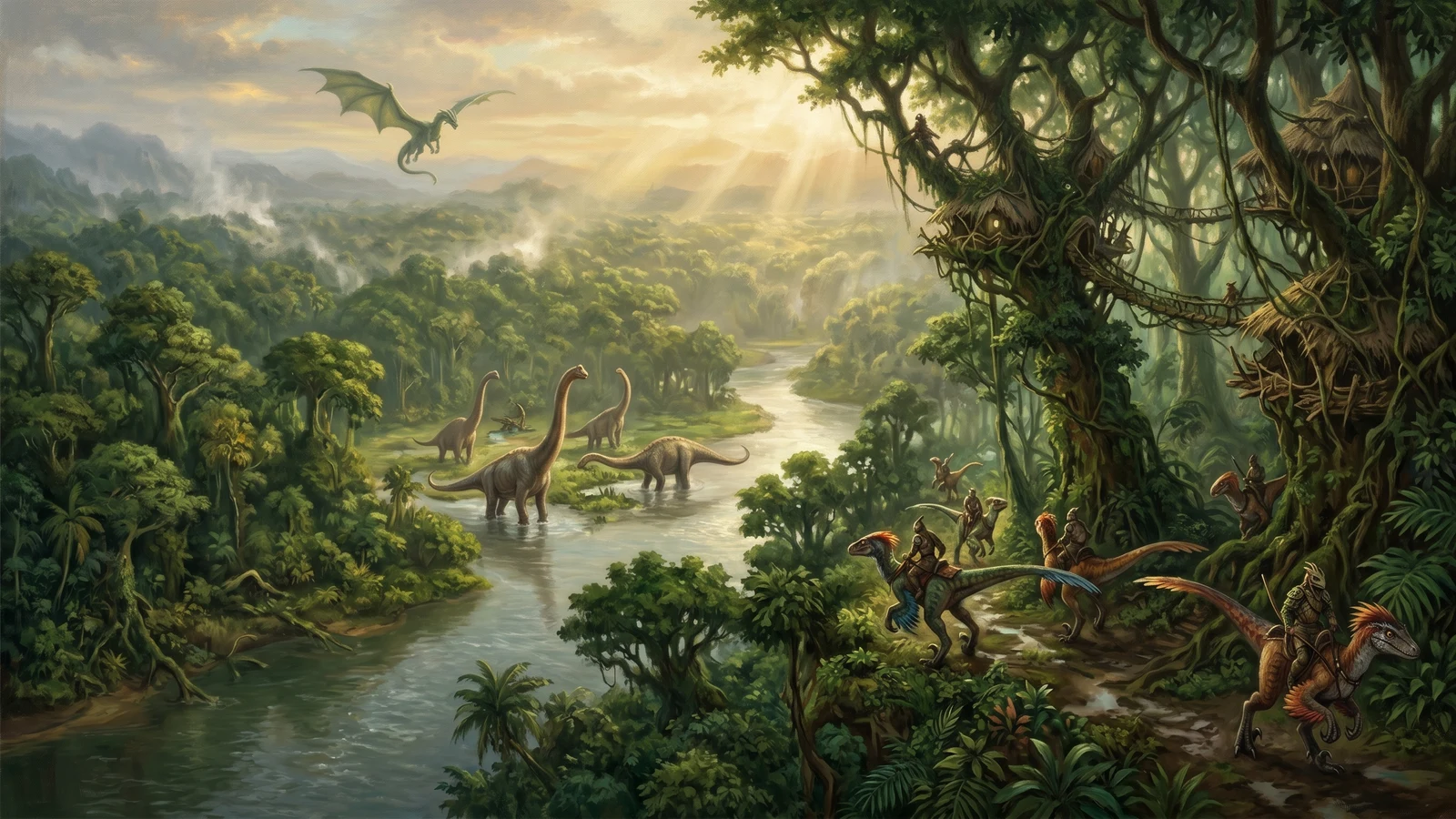
The Dygon Beastlands sprawl across the entire southern end of Ve, a primordial wilderness roughly four hundred miles north to south and six hundred miles east to west. This is the largest continuous jungle on the continent, and one of the most dangerous regions in all of Alaria. Dinosaurs rule here. The jungle itself seems hostile to civilization. And two green dragons have claimed territories that together encompass most of the interior.
The Beastlands are not unexplored. The Ix'Meglyakuk, raptor-riding lizardfolk who have lived here since before human memory, know every trail, every hunting ground, every danger zone. But they don't share that knowledge freely, and the jungle they navigate would kill most outsiders within days.
Why Civilization Fails
Every major power on Ve has attempted to establish footholds in the Dygon Beastlands. Chimea has tried three times. Shyona mounted expeditions during its expansionist periods. Even the Krell, before they became what they are now, attempted to push westward into the jungle.
All failed, worn down by accumulation rather than any single catastrophe.
The jungle reclaims. Roads cut through vegetation regrow within weeks. Cleared fields sprout new growth overnight. Buildings left unattended for a season vanish under vines and roots. The rate of growth here exceeds anything natural, and the Beastlands may sit on an earth leyline that accelerates plant life, though no one has mapped leylines this far into the interior.
The predators adapt. Every permanent settlement attracts attention. First the scavengers, then the mid-sized hunters, then the apex predators. A village of fifty might hold off jungle cats and terror birds. It cannot hold off a pack of hunting allosaurs that have learned where the easy prey gathers.
The Ix'Meglyakuk don't want you here. They're not uniformly hostile. Some tribes trade at the margins, and a few have served as guides for expeditions. But they consider the Beastlands their homeland, and they've perfected the art of making outsiders unwelcome without open warfare. Trails that lead in circles. Warnings that come too late. Game that's been driven away from your hunting parties. Most colonial attempts fail to attrition rather than violence, supplies running out faster than expected, until the survivors retreat to the coast.
The Ix'Meglyakuk
The raptor-riders are the only sapient species to successfully inhabit the Beastlands interior. Their population is unknown. Estimates range from twenty thousand to over a hundred thousand, scattered across dozens of tribal territories.
They live in semi-permanent villages built in the canopy, structures of woven vines and shaped branches that can be abandoned and rebuilt as hunting grounds shift. Young Ix'Meglyakuk bond with utahraptor hatchlings in ceremonies that mark the beginning of adulthood; the partnership lasts until death, and losing a bonded mount leaves permanent psychological scars.
Tribal Organization: The Ix'Meglyakuk have no central government. Each tribe, typically two to five hundred individuals, controls a hunting territory and governs itself through councils of senior riders. Inter-tribal relations range from alliance to open warfare depending on recent history, resource competition, and the personalities of tribal leaders.
Relationship to Dragons: The Ix'Meglyakuk acknowledge both Pyaganos and Draphilir as powers to be respected but not worshipped. They avoid the dragons' core territories, offer tribute when demanded, and otherwise maintain careful distance. The dragons, in turn, rarely hunt Ix'Meglyakuk directly, since the raptors make the lizardfolk too mobile to be worth the effort.
Outsider Contact: A few tribes near the coast and the Phriorys hills maintain trading relationships with Chimea and the nations to the north. They exchange jungle products such as rare woods, medicinal plants, and dinosaur parts for metal tools and weapons they cannot manufacture themselves. These trading tribes are looked down upon by interior groups, who consider contact with outsiders a contamination.
Geography
The Beastlands divide into several distinct zones, each with its own character and dangers.
The Coastal Margins: A strip of lighter jungle and mangrove swamp along the southern and western coasts, extending roughly twenty miles inland. This is the "accessible" Beastlands, still dangerous but survivable for prepared expeditions. Most outsider contact happens here.
The Deep Jungle: The interior, where the canopy blocks most sunlight and the understory is a maze of roots, vines, and deadfall. Navigation is nearly impossible without Ix'Meglyakuk guidance. The megafauna here, brachiosaurs and tyrannosaurs and creatures that dwarf anything in the northern lands, move through clearings and river corridors.
The Dragon Territories: Pyaganos claims the Phriorys hills and surrounding jungle in the northwest. Draphilir holds Blyss in the east. Between them lies contested ground where neither dragon hunts regularly, and where the most dangerous predators gather, freed from draconic predation.
Phriorys
The hilly region in the northwest, where the jungle gives way to scattered groves and grassland. Home to the dragon Pyaganos. See Phriorys for details.
Blyss
The eastern jungle, denser and darker than the rest of the Beastlands. Territory of the dragon Draphilir. See Blyss for details.
Blackpits
A swamp in the north-central Beastlands, where dark water pools beneath the canopy. See Blackpits for details.
Creatures
The Beastlands host the greatest concentration of dinosaurs in Alaria. Species that went extinct elsewhere millennia ago thrive here, alongside creatures found nowhere else.
Megafauna:
- Tyrannosaurs — apex predators in the deep jungle, hunting in mated pairs or small family groups
- Allosaurs — pack hunters, more dangerous than tyrannosaurs due to coordination and numbers
- Brachiosaurs and diplodocids — massive herbivores that reshape the jungle as they move
- Ceratopsians — herd animals that can trample a village when panicked
- Utahraptors — the bonded mounts of the Ix'Meglyakuk, intelligent and loyal to their riders
Other Threats:
- Terror birds — flightless predators that hunt the margins and clearings
- Giant crocodilians — in every river and swamp, some exceeding fifty feet
- Jungle cats — including species with venomous bites, chameleon-like camouflage, or pack-hunting intelligence
- Insects — clouds of biting, stinging, disease-carrying swarms in the wet season
The Dragons
Two green dragons divide the Beastlands between them: Pyaganos in the northwest and Draphilir in the east. Their relationship is complicated. They are clutch-siblings, hatched from the same nest over eight centuries ago, and they have spent those centuries alternating between alliance and rivalry.
Currently, they maintain an uneasy truce. Each claims their territory as sovereign, each avoids the other's domain, and the space between them is a buffer zone where neither hunts. This arrangement has lasted forty years. Previous truces have lasted anywhere from a decade to a century before collapsing into open conflict.
When the dragons fight, the Beastlands suffer. Their last war, from 3,201 to 3,219 SD, killed thousands of Ix'Meglyakuk caught between their territories and drove entire tribes from their traditional grounds. The lizardfolk pray the current peace holds.
See Pyaganos and Draphilir for details on each dragon.
For Players
Expedition into the Interior: Someone wants something from the deep Beastlands: a rare plant, a dinosaur specimen, a ruin from pre-Ix'Meglyakuk civilizations. Reaching it requires Ix'Meglyakuk guides, which means earning tribal trust or paying prices measured in more than gold.
The Dragon Truce: After forty years of peace, signs suggest another war is coming. Draphilir has been seen hunting closer to the buffer zone. Pyaganos has demanded increased tribute from nearby tribes. An outside party might be hired to mediate, to sabotage one dragon's position, or simply to evacuate vulnerable communities before the fighting starts.
Fort Vaylen's Crisis: The Chimean trading post is in trouble. A new tribal leader has repudiated the old treaties, demanding renegotiation. The Chimeans need someone to broker new terms before the jungle closes in. The Ix'Meglyakuk need someone who can explain what Chimea will actually accept. Both sides might be lying about their intentions.
The Howler Mystery: Something is organizing the howlers of the Bay of Monkeys. The attacks are becoming more sophisticated, the swarms larger. Someone or something has taken control of the colonies, and their goals, beyond theft and harassment, are unclear.
The Sleeping God: Ix'Meglyakuk mythology speaks of a primordial entity beneath the Beastlands, the lizard-god whose body became the land. Recent earthquakes near Lizard's Maw have the tribes worried. Some believe the god is stirring. Others believe something is trying to wake it.