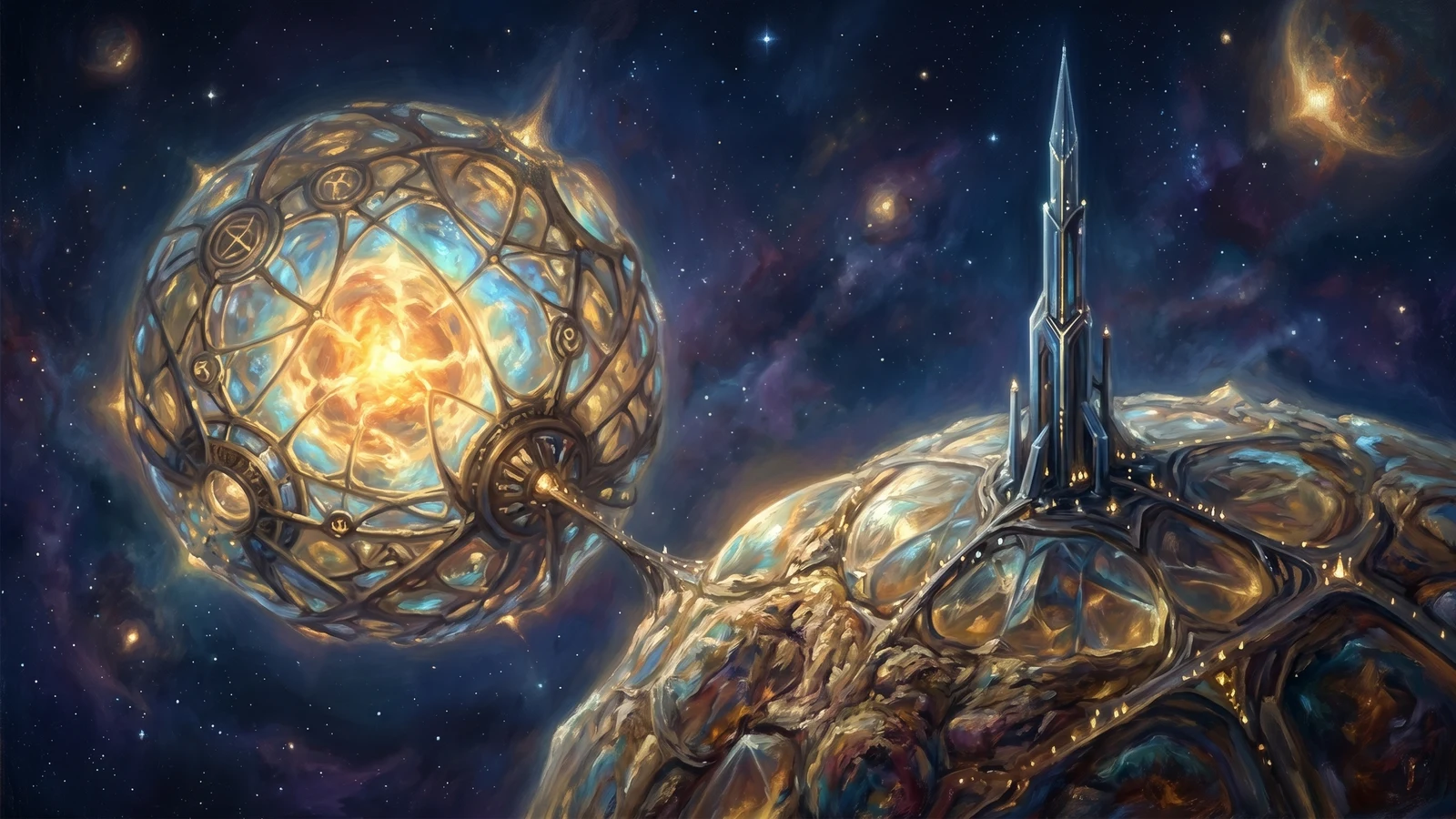
Stars
Built by the titans to illuminate the darkness of the world. The sun did not exist yet. No night and day yet, just eternal stars. Consist of glowing orbs, containing incredibly rare celestial glass, which emits lots of light. Taken care of by the Starborn, who live within the stars, tending to the magical cores.
Most famous among the Starborn is Koras, tender of the sun. Koras lives within the sun's blazing core, maintaining its celestial glass and ensuring its light burns steady. Though Koras tends the sun's physical form, it is Bryn—the sun's awakened spirit—who chooses where it travels. Koras is immune to the extreme heat and has served the sun since before it gained consciousness. When a Xaphkiel reached the sun's core and corrupted it, Koras held the Sunless Vigil: a five-hundred-year fight to draw the corruption from the glass and rekindle the light while the world below went dark. The seam the Xaphkiel left never fully closed, which is why the sun, alone among the great cores, has never been left untended.
Above the star live Sarakiel civilizations—huge towers, usually not more than one per star, filled with Sarakiel. Some stars have gone out due to Xaphkiel smashing their cores, and taking them over. Also, among the stars lie super-high density sky-stones, which float incredibly high up.
Suns
There are three suns within Alaria, each over a different layer of the planar stack.
The Sun of the Material Plane
The sun that lights the Material Plane is the greatest of the titan-crafted stars—an immense orb of celestial glass tended by Koras. Unlike Aurus and Nydus, which are dissolved titan-gods, it is a construct that gained consciousness.
Bryn, the sun's spirit
When the Ezz Rift flooded Alaria, the sun—previously a mindless mechanism—woke up. The Ezz granted it a spark of spirit: a will, a desire, the capacity to want. This awakened consciousness is called Bryn.
Bryn is not a god in the traditional sense. The sun is not sustained by worship like a daemon. But Bryn is aware, and Bryn's path across the sky can be influenced by the Faesong of those who sing to it. The sun travels because Bryn chooses to travel. Seasons exist because different congregations across Alaria convince Bryn to traverse different paths—when the northern monasteries sing loudest, the sun travels closer to the north.
The sun is the only celestial body known to have awakened in this way. Why the sun and not the other stars remains a mystery—perhaps its size, perhaps its proximity to the Material Plane, perhaps something else entirely.
Aurus, the White Sun
Aurus is a still-living titan-god. Along with his brother Nydus, he was among the first beings created within Alaria. As a titan-god, he could not be truly killed by the Ezz Rift. Instead, he dissolved, leaving nothing behind but his brilliant, bright white spirit. He became the White Sun, the ever-present radiance above the Astral Plane.
Aurus never rises or sets—his light is constant, illuminating all souls on the Astral Plane. The soul itself is made of his essence. His position slowly drifts over millennia, and when he draws closer to the Material Plane's boundary, temperatures below grow warmer.
Aurus is also the source from which all souls are drawn. New souls emerge from his light; worn-out souls eventually return to it. His flip-side, Astraeva, is where his unmediated presence can be experienced—and where souls exist before and after their time bound to mortal spirits.
Nydus, the Black Sun
Nydus is a still-living titan-god. Along with his brother Aurus, he was among the first beings created within Alaria. As a titan-god, he could not be truly killed by the Ezz Rift. Instead, he dissolved, leaving nothing behind but his brilliant, dark spirit. He became the Black Sun, the ever-present darkness above Malstaris.
Like Aurus, Nydus never sets. The light cast from Nydus is a dark illumination that barely reveals one's shadow—many things lie hidden in its murk. The shadow itself is made of his essence. His slow drift causes cold temperatures to spike around the Material Plane when he draws near.
Nydus controls the Umbral Agents and is the source from which all shadows are drawn. New shadows emerge from his darkness; worn-out shadows eventually return to it. His flip-side, Eindumor, is where his unmediated presence can be experienced—and where shadows exist before and after their time bound to mortal spirits.
Moons
Two moons orbit Alaria, visible from the Material Plane but existing partially within the spirit-substrate that threads through all planes. Unlike the sun, which travels through physical space, the moons ride the Ethereal and Nethereal overlays—the same currents that carry souls and shadows between planes.
Auris, the Bright Moon
Auris completes its cycle every 11 days, marking the week. It rides the Ethereal overlay, resonating with Aurus's soul-light. When Auris is full, it has risen closest to the Material-Ethereal boundary—bright, visible, soul-strong. When Auris is new, it has descended deeper into the overlay, dim and distant from mortal sight.
The 11-day week begins with Auris at its darkest—new moon, the day called Cautious—and builds toward the full moon celebration of Merrynight mid-week. As Auris waxes and wanes, so too does a subtle tide of soul-energy across Alaria. Seers and spirit-speakers find their work easiest at full moon; necromancers and those who traffic with the dead prefer the darker nights at week's beginning and end.
Auris is not controlled by Aurus—the White Sun does not command its movements. But moon and sun are made of the same essential substance: celestial glass infused with primordial soul-stuff. They resonate with each other the way a tuning fork resonates with its fundamental tone. When Aurus drifts closer to the Material Plane during Faesummer, Auris burns brighter and its cycles seem to quicken with energy.
Nyxara, the Dark Moon
Nyxara completes its longer cycle every 23 days. It rides the Nethereal overlay, resonating with Nydus's shadow-dark. When Nyxara is full, it has risen closest to the Material-Nethereal boundary—visible as a deep purple-silver disc, shadow-strong. When Nyxara is new, it has descended into the Nethereal depths, invisible and potent with hidden power.
The 23-day cycle creates Alaria's deeper rhythm of magical tides. Shadow magic, secrets, and Malstaric creatures wax and wane with Nyxara's face. The full Nyxara is not a time of darkness but of revealed darkness—shadows become sharper, secrets feel closer to the surface, and the boundary with Malstaris thins.
Like Auris with Aurus, Nyxara resonates with but is not commanded by Nydus. When Nydus drifts closer during Shadowrift periods, Nyxara's presence intensifies—some claim it appears larger, or that its purple tint deepens to near-black.
The Double Moons
Because 11 and 23 share no common factors, the two moons align only every 253 days—slightly longer than Alaria's 200-day year.
Brightnight, the double full moon, comes when both Auris and Nyxara are full at once, and the night blazes with silver-white and purple-silver light. The Ethereal and Nethereal overlays press close to the Material Plane together. Magic of all kinds surges. Rituals performed on Brightnight carry extra power—and extra risk. Many cultures hold festivals; others bar their doors.
Hollownight, the double new moon, comes when both are absent, and the night is profoundly dark. Neither soul-light nor shadow-light touches the Material Plane. Some find this peaceful—a true rest from magical tides. Others find it terrifying—a void where anything might creep through. Werebeasts, vampires, and creatures of pure darkness are at their most dangerous on Hollownight.
The Killing Moon
The Killing Moon is not a moon at all—or perhaps it was, once.
What actually happens
Every few thousand years—sometimes five thousand, sometimes twenty thousand, usually around eight thousand—the natural drift cycles of Aurus and Nydus reach a point of maximum instability. Their resonances clash rather than complement. The Ethereal and Nethereal overlays, normally separate currents, begin to bleed into each other.
The results are catastrophic:
- Planar boundaries thin across Alaria
- Creatures from Malstaris and the Astral cross freely into the Material Plane
- Magic becomes unpredictable, sometimes lethal to its casters
- Mass psychological effects sweep populations
- People die in ways that seem random, inexplicable, divine
These destabilization periods last years to centuries, depending on how quickly the drift corrects itself. Strong divine intervention can suppress or delay the effects—Craggus's reign famously kept the instability dormant for fifteen thousand years.
During these periods, looking at the sky can kill you. Not metaphorically. The unfiltered bleed of planar light, raw Ethereal and Nethereal energy mixing where they shouldn't, destroys mortal minds and bodies. People learn to keep their eyes down, to roof their streets, to never gaze upward after dark.
And so they call it the Killing Moon.
The lost third moon
There was a third moon, once.
During the Age of Titans, three moons orbited Alaria—Auris and Nyxara as they exist now, plus a third whose true name has been lost. It rode a position between Auris and Nyxara, and the leading account holds it as the stabilizing keystone of the whole lunar resonance. The Celestian temples teach instead that it was Celest's own moon, bound to her essence before she sacrificed herself to become Celestia — a claim the rest of the cosmology does not support.
When the Ezz Rift flooded Alaria 12 million years ago, something happened to the third moon. Perhaps it shattered. Perhaps it fell. Perhaps it was pulled into interdimensional space when the surviving titans fled. The Desert of One Million Shards, the strange crater lake of Morgnor's Cradle, the void-locked darkness where the dragon Ural lairs—all have been proposed as fragments of its grave.
What seems certain: the third moon is gone, and its absence may be what allows the destabilization cycles to occur. It was the keystone. Without it, Auris and Nyxara eventually drift into destructive resonance.
Or perhaps the cycles simply reminded people that something was missing, and they invented the third moon to explain the inexplicable.
Beliefs about the Killing Moon
The common reading treats the Killing Moon as a name for the destabilization periods, not a body in the sky. What kills is the bleeding planar light. "Don't look at the Killing Moon" is a warning, not an astronomical observation.
The Moonwatcher cult, with certain old druid circles, holds the literal view: the third moon still exists, damaged and drifting through the void between planar stacks, and its erratic orbit brings it screaming back every few millennia. The destabilization, in their telling, is the symptom of its return rather than the cause. They gather on Hollownight to pray the lost moon home.
The Celestian temples teach a third account — that the moon was Celest's physical form, left hollow and dead when she became Celestia, and that its passage reminds the planar stack of her absence. The wider cosmology contradicts them: Celest sealed her selfhood in Celestia's core and left no moon-body behind.
Certain Malstaric cults deny there was ever a third moon at all. The Killing Moon, they say, is Nydus turning his full attention on the Material Plane, and when the Black Sun looks at you, you die.
The Titansworn hold it to be Hykravones's eye, torn out in some ancient battle and left to orbit, and say the Gray Prince stirs in his sleep beneath the earth when it passes. The deaths, in their account, come from the moon looking at the world, not the world looking at it.
"Born Under the Third Moon"
This expression carries multiple meanings depending on context:
- Literally: born during a destabilization period. Rare, since most such periods saw massive population collapse. Those born during such times are often considered touched, marked, strange.
- As descriptor: someone affected by catastrophe, marked by doom, chronically unlucky.
- As insult: "cursed," "brings disaster," "bad omen walking."
- Among Moonwatchers: "chosen," "blessed by the returning moon," "destined for greatness when the Third Moon rises again."
The dragon Ural, called "of the Third Moon," was literally born during the last destabilization period. His void-touched nature, his darkness-dwelling habits, his eyes like dead moons—all are attributed to his birth under that poisoned sky.