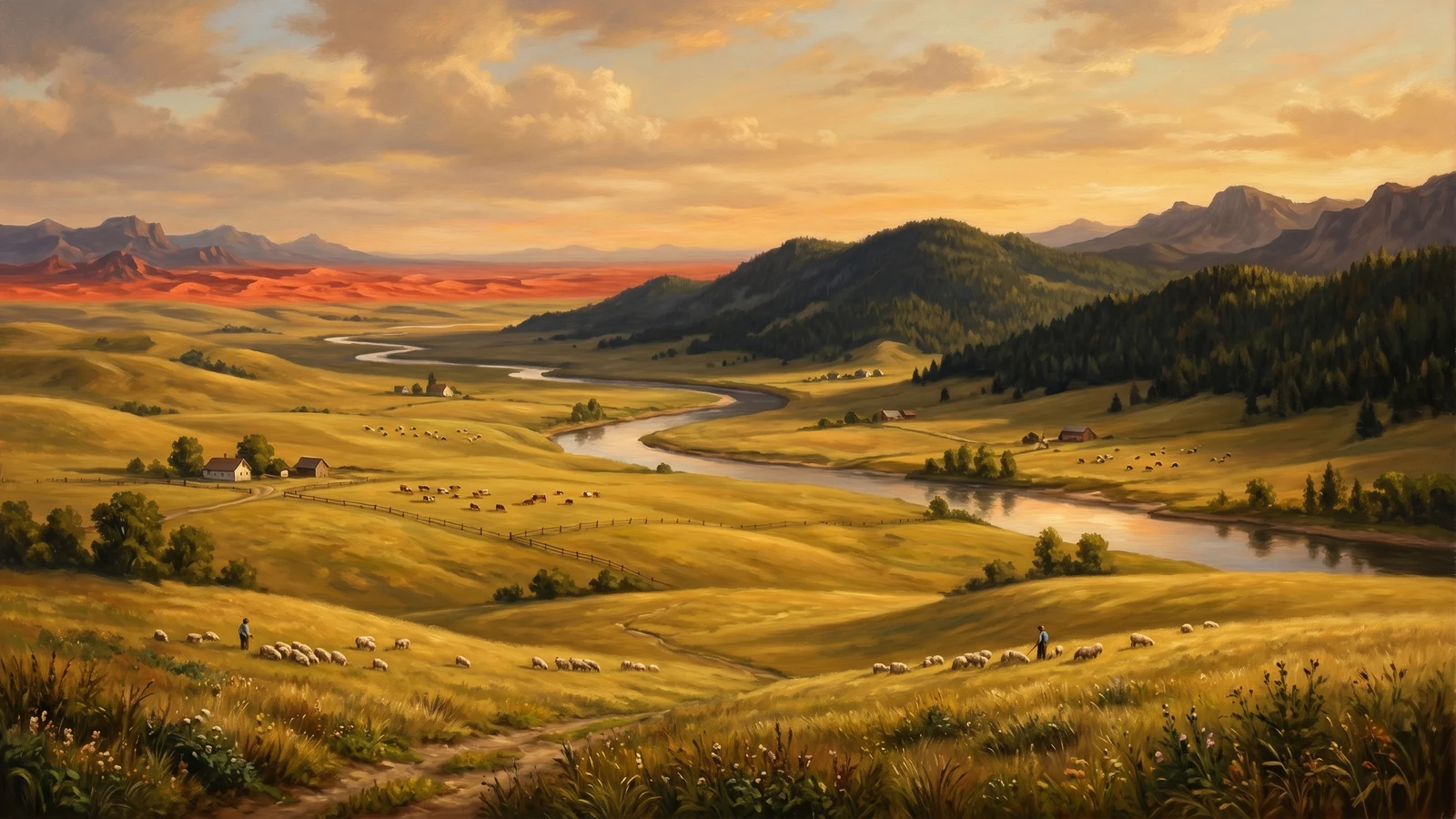
The heartland of western Ve—a kingdom of shepherds and silk-weavers ruled by a monarch who speaks for a god. Sestros stretches from the Red Desert in the north to Tukiwood in the south, from the coast at Nuin Bay to the Hills of Dolor in the east. It is orderly, prosperous, and unsettlingly content.
Geography
Sestros occupies the most habitable portion of western Ve. The terrain transitions from dry savannah in the north, through rolling grasslands ideal for grazing in the center, to forested hill country in the south. The Glory River winds through the heart of the kingdom, providing water for the ranching communities that form the backbone of Sestran life.
Boundaries:
- North: Shepherds' Stones (mountain border with Edari)
- East: Hills of Dolor and the Dunes of Evioli (borders with the independent city-states)
- South: Tukiwood and the northern slopes of the Widebarrow Mountains
- West: Nuin Bay and the open coast
The kingdom is well-connected by road. A main route runs east from the capital at Mu, following the Glory River through the central grasslands before splitting—one branch heading northeast toward Shyona, the other southeast toward the Widebarrows.
Red Desert
The northern reaches of Sestros give way to true desert—the Red Desert, named for its iron-rich sands that glow crimson at sunset. Few live here permanently. Shepherds bring flocks to the desert's edges during the brief winter rains, when seasonal grasses sprout, but retreat south when the heat returns.
The ruins of Lurza stand at the desert's western edge, where it meets the Shepherds' Stones. See Shepherds' Stones for details on that cursed place.
Glory River
The primary waterway of central Sestros, the Glory River rises in the foothills of the Shepherds' Stones and flows east-southeast through the kingdom's heartland. Its banks support the densest settlement in Sestros—a string of ranching towns that depend on the river for water, irrigation, and transport.
The river's name comes from Shailin religious practice. They believe water that flows through Talressses's chosen land carries his blessing. Drinking from the Glory River is considered auspicious; bathing in it purifies the spirit. Whether Talressses actually blesses the water is debatable. The Shailin don't debate it.
Tukiwood
The southern forest marks the transition between Sestros and the wilder lands beyond. Tukiwood is temperate woodland—oaks, maples, and scattered evergreens—that provides timber, game, and a buffer against whatever comes out of the Widebarrow foothills.
Logging operations work the forest's northern edges, but the Shailin don't push deep. Talressses teaches contentment with what one has. The deep woods remain largely unexplored.
The Spoken Throne
Sestros has one ruler, and that ruler does not claim to rule. The monarch is the Spoken Throne, the mortal mouth through which Talressses gives his word to the kingdom, and every decree comes down as the god's instruction rather than the monarch's choice. The title does not pass by blood. When a monarch dies, Talressses names the next and proves the naming with a miracle the whole capital can see, and the chosen one takes the throne already validated. There is no other way onto it.
This is why Sestros has never written a law of succession. It never needed one. The god chose, the god showed his hand in front of witnesses, and the question of who ruled was settled before any council could be called to argue it. The arrangement has held for three reigns. Orwin was the first to sit the Spoken Throne. Pelwin followed him. Halwen, an old man now, has held it longer than either, and his accession was marked by the same public proof as the other two: a working on the scale of saving a city, done before the assembled faithful at Mu. The Shailin keep the memory of those three miracles as the three certainties their faith rests on. They have never thought to ask what each one cost.
The contentment fault
A daemon lives on the prayers of his people, and a validation-miracle is paid for out of that same reserve. Talressses has spent it three times now, once for each Foretold, and each time the working was a large one. A kingdom of fervent, frightened worshippers would have refilled the cost within a few years. Sestros is not that kingdom. Talressses taught his people contentment, and a contented people pray softly. The Shailin want for little and beg for less, so their prayers come thin and even, and the reserve that three accessions drew down has been slow, very slow, to climb back.
We have flocks, we have the river, we have the word of the god. What is there left to ask him for? — a herder of the Glory valley, asked why he prayed so seldom
The fault is not a secret, exactly. It is written into the kingdom's own self-description: orderly, prosperous, unsettlingly content. The danger is that contentment and devotion pull against each other, and Talressses built his throne on the wrong one. If his reserve ever falls below the floor that keeps a forgotten god alive, the monarch who speaks for him becomes a monarch with nothing behind the title, and Sestros has no law to choose who comes next.
The guarded king
Halwen is old, and Talressses cannot afford to let him die. A fourth accession means a fourth validation-miracle, and the daemon may no longer have one in him; an empty throne means a kingdom that has forgotten how to fill it, which is the same death by a longer road. So the deceiver-oracle of the Shailin has become, in everything but name, the bodyguard of one mortal. The warnings Halwen receives have grown small and exact in his late years, less the sweeping prophecy of his youth and more a steady murmur of plain caution: not that road tonight, not that cup, send another man in your place. Halwen reads this as his god drawing nearer in his old age. He has it backwards. Talressses is hoarding, and true warning is cheap where a miracle is dear. The detail in Mu is that the most reliable prophet in Sestros has stopped lying to its king, and only because lying now costs more than the truth.
The Concordance
Not everyone in Sestros has failed to ask what the miracles cost. The Concordance, the scholar-order at Mu charged with reconciling the kingdom's contradictory prophecy-journals into a single authoritative record, has done the arithmetic the faithful never do, and an inner circle of them has reached a conclusion they will not say aloud: their god is not an oracle reading fixed futures but a finite thing spending a finite reserve, and the reserve is nearly gone. They have not exposed him. They serve Sestros, not Talressses, and they judge that the kingdom dies the day the faith does. So they keep the books on a god and keep the secret, and what they will do when Halwen finally dies is a question they have not settled among themselves.
Sestros controls the overland route across northern Ve. Anyone traveling between the western coast and Shyona, the Dunes of Evioli, or the eastern lands must pass through Sestran territory unless they want to risk Edari or sail around the continent. The Shailin don't exploit this. Hospitality is a virtue Talressses demands, and their strategic position gives them quiet leverage they rarely need to use.
The kingdom also produces the finest textiles on Ve, possibly in the world. Sestran silk is a luxury good everywhere it reaches, and the merchants who trade in it make fortunes.