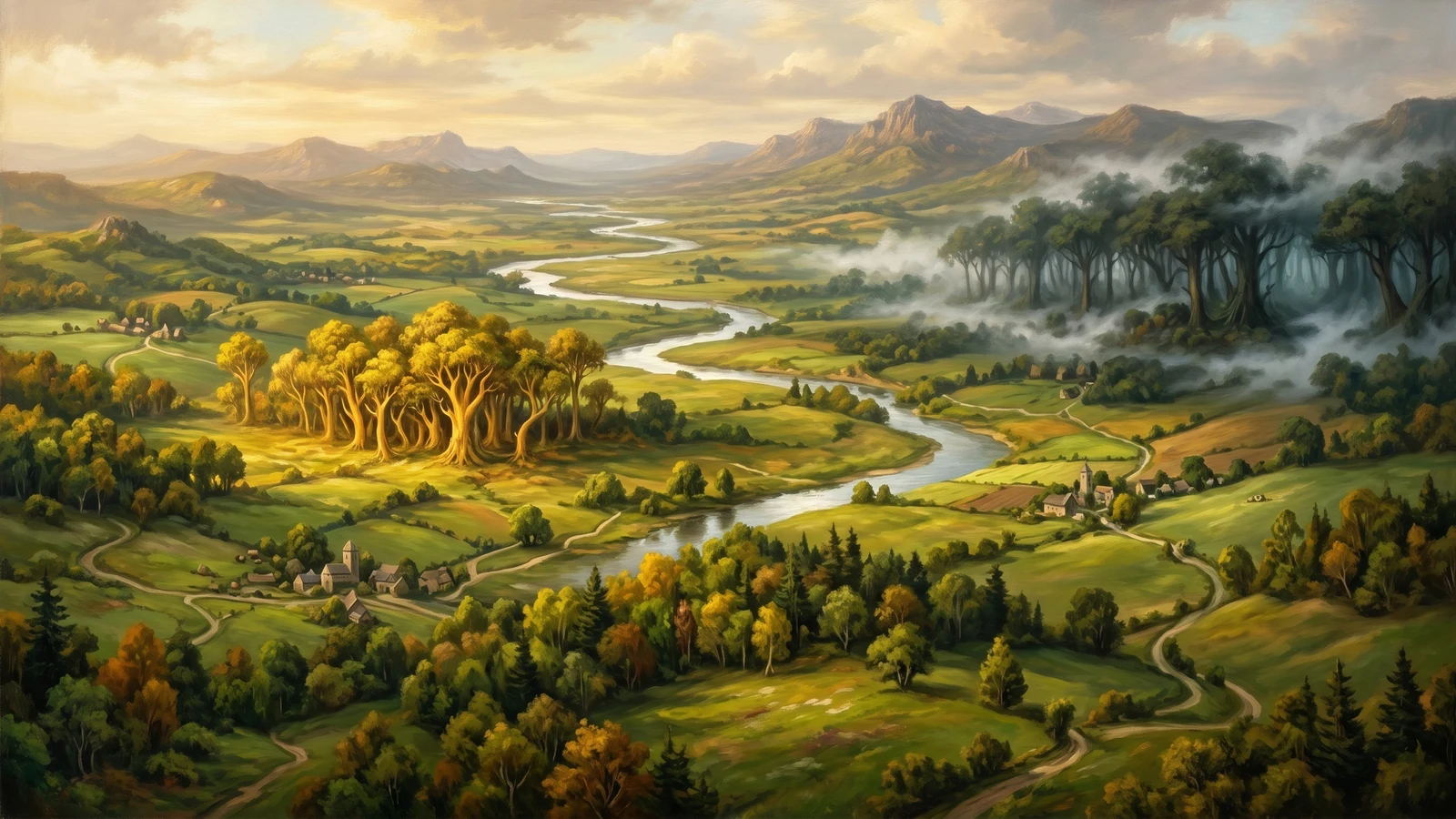
The heartland of Ve's time-magic theocracy, where the Grand Imperial Ecclesiarch has sat unblinking upon the throne for generations, seeing futures that guide every aspect of Temptari life. Avalon is a land of rolling grasslands and ancient forests, temperate and fertile, ruled by priests who declare children's destinies before they can walk.
Geography
Avalon occupies central-western Ve, bounded by natural features that make its borders feel ordained:
Boundaries:
- North: Tukiwood and the plains of Sestros
- East: The Widebarrow Mountains and Dern
- South: Promisewood descending toward Chimea
- West: Munari Inlet and the open sea
The terrain is gentler than surrounding regions—rolling hills, broad river valleys, and mixed forests that provide timber without overwhelming the grasslands. The Honor River winds through the center, its banks supporting the densest population.
The Forests
Four major forests define Avalon's landscape:
Goldwood lies in the west, between the settled heartland and Munari Inlet. The trees here have distinctive golden-yellow bark that seems to glow in afternoon light. The forest is considered sacred to the aspect of time governing autumn and endings. Pilgrims visit to contemplate mortality.
Pathanul spreads across the northern reaches, a transitional forest between Avalon's heartland and the Sestran border. The trees are older here, and the priests say this is where time moves slowest in Avalon—minutes pass while hours elapse elsewhere. Whether this is literally true or theological metaphor, travelers report feeling disoriented in Pathanul's depths.
Promisewood dominates the south, a vast forest stretching toward the Widebarrow Mountains. The name refers to the promises made to children during their Declarations—the forest is where those declared for forestry, hunting, or druidic paths spend their training decades. Deep Promisewood is off-limits to casual visitors.
Shorolyn Forest covers the eastern highlands where Avalon meets Dern. Logging operations work its edges; the interior remains wild.
Society
Life in Avalon follows patterns laid down generations ago by the Ecclesiarch's visions. At age eight, every child is brought before the local priest for their Declaration, a pronouncement of what their life will hold. Farmers' children are usually declared farmers. A soldier's child might be declared a soldier, or might be sent down an entirely different path if the priest reads a different future. The devotion that frames the whole rite is owed to Azak, the omen-daemon the Temptari have prayed to since before they had a nation, and the priests keep his forms exactly.
The Declaration is final. Fighting it is possible but brings social ostracism and religious condemnation, and most Temptari accept their fates without much struggle. The Ecclesiarch sees truly, the priests interpret correctly, and a single life weighed against the order of the country is held to be a small thing.
Partners are assigned the same way. The priests determine which unions will produce the children Avalon needs and arrange the marriages accordingly. The system usually works. When it doesn't, when couples are miserable or children are born outside their assigned partnerships, the failure is blamed on corruption among minor priests rather than on the system itself. That habit of explaining away the exceptions is worth remembering, because the system has produced one exception it cannot afford to explain at all.
The null Declaration
Now and then a priest looks into a child's futures and finds nothing there. No path, no life to read aloud, only blank where every other child shows a thread. This is the null Declaration, the rarest verdict the Temptari recognize and the one they discuss least. Because the ceremony is understood to read what will be, a child with no future is taken to be a child the world has already finished with. The families do not raise them. They grieve early and let them go, and no one asks after the result. In all of Avalon's rolls there is no record of a null-Declared child living to adulthood.
There is one now. A girl named Tamari received a null Declaration and is alive, hidden by her family on the edge of her district, because the priest who read her, a second-ring Declaration-priest named Doremin, did not see what the verdict required. He saw her future clearly, more clearly than he had ever seen anyone's, and he decided no one else should have it. He forged her a modest, ordinary Declaration in the proper hand and sealed it with the proper rites, and her parents believe their daughter scraped through with an unremarkable life.
The forgery is a crack running straight to the foundation. A child the Ecclesiarch's own sight failed to foresee is proof that the sight has a hole in it, and every claim Avalon makes about itself rests on the sight being whole. Doremin holds that proof and has never named a price for it. The Ecclesiarch knows the girl is alive and watches her without moving against her, because he has read the futures in which he removes her and the secret survives all of them. So the three of them are held in place. The girl who was not supposed to live, the priest who saved her, and the immortal whose perfect record she quietly disproves.
The forgery is the loud version. There is a quiet one too. Not every null-Declared child is grieved and let go, because not everyone in Avalon can do it. A thin, hidden network that calls itself the Unburied has spent generations carrying a few of these children out of their districts before the families finish mourning, handing them off to ordinary lives under ordinary names somewhere the verdict was never spoken. The Unburied are small and mostly failing, and whether any child they saved has truly lived to grow is a thing even they cannot prove. The rolls of every district still show their children dead, so the country's claim that no null-Declared child reaches adulthood stands untouched on paper. Tamari is the one exception anyone can prove, and the only one the Ecclesiarch is forced to watch.
The Ecclesiarch
Everything in Avalon descends from one man. Maurolin, the Grand Imperial Ecclesiarch, has read the nation's futures from the throne at Tarolin for longer than any record runs back, and he is the reason the throne has never changed hands. His longevity is no miracle. He sits inside a sphere of slowed time, a working drawn off the leylines beneath the capital, and inside it he ages at a crawl while generations of his priests are born, serve, and die around him. The deeper trouble is what he does with his sight, and that is detailed in his own entry. In short, when he chooses which future Avalon will walk into, he chooses the one in which Maurolin lives longest, and he has done it so long that he no longer feels it as a choice.
Because he governs at the speed of a sentence stretched over days, the running of the country does not fall to him. It falls to the Solum Impervium, the order of high priests in Tarolin's inner ring who catch his pronouncements as they form and stretch them into policy. They decide what he meant and how it applies to a harvest or a marriage that cannot wait on him, and in doing so they govern Avalon in his name. The drift in the Declarations descends through their hands before it reaches anyone's.
The cost has begun to show in the rolls. Over the last two generations the country has been asked for more soldiers and fewer farmers, more children declared to hard and short-lived paths, more marriages arranged to breed particular bloodlines rather than content households. The priests who keep the Declaration records have noticed the drift and cannot say what it is for. Maurolin can, and the answer is not one Avalon would survive hearing.
Why it matters
Avalon's time-magic tradition produces the most skilled temporal practitioners on Ve. Its military is tiny but devastating, soldiers trained from childhood to know where an attack will land before it is launched, and no neighbor has successfully invaded Avalon in recorded history. Chimea, which conquers as a matter of policy, has never once moved against it.
The theocracy also delivers stability of a thorough and airless kind. Fields are planted where the harvest will succeed, buildings raised where the earthquake will not strike, disputes settled before they grow into anything. Life is predictable and safe and entirely arranged. Whether that reads as paradise or as a prison depends on whether you trust the Ecclesiarch's sight, and whether your Declaration matched what you wanted from your life. The people who keep the rolls have begun to suspect it should not be trusted. They have not yet found anyone they dare tell.