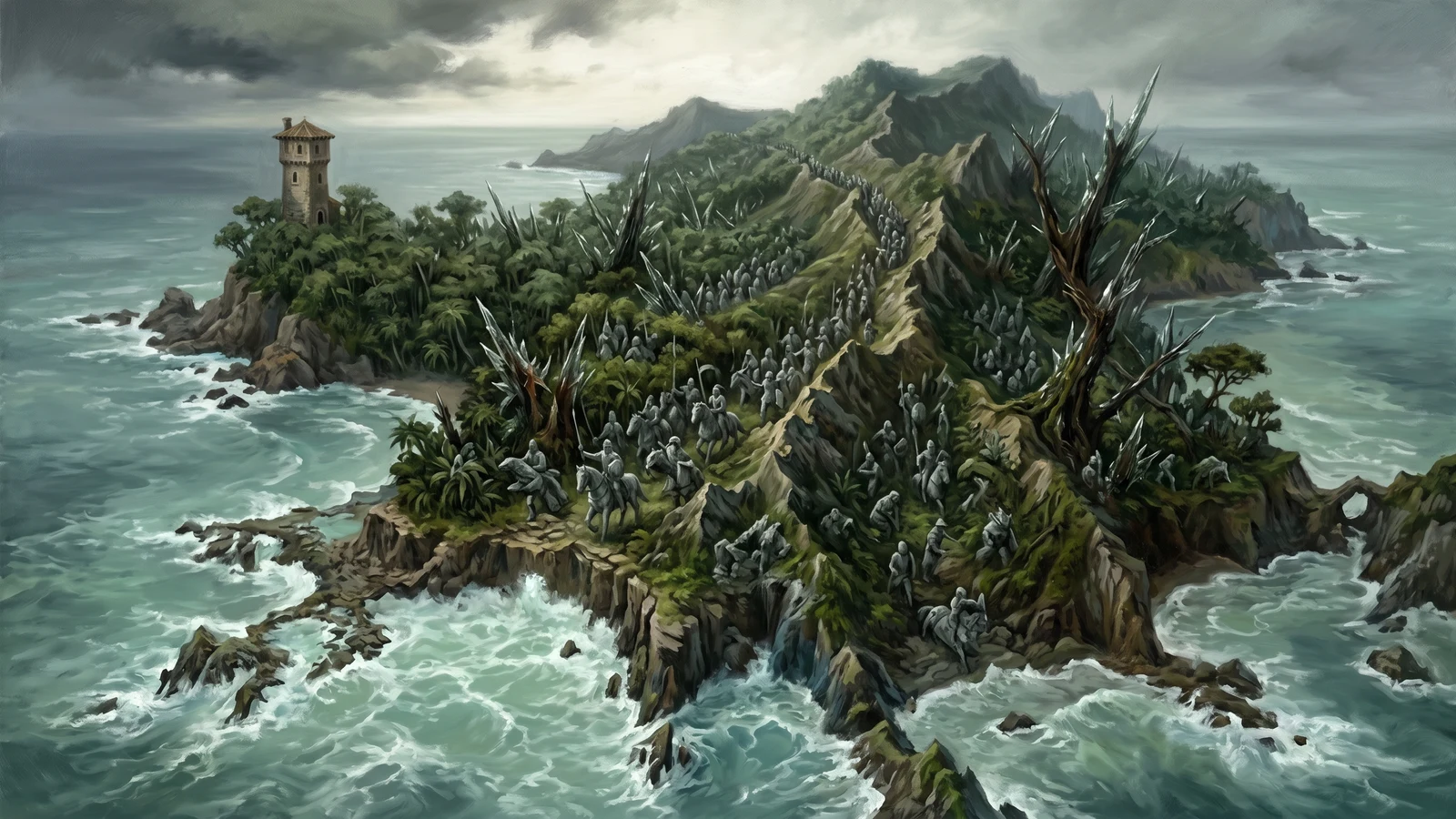
A jungle island in southeastern Ve, separated from the mainland by the treacherous Disaster Passage. Phyr Island bears the scars of an ancient magical catastrophe: the land itself transformed by a curse that turned an army to stone and warped the jungle into something hostile to all life.
The island is roughly eighty miles east-to-west and sixty miles north-to-south. Dense jungle covers nearly every surface, broken only by the ridge of the Statue Hills running through the eastern interior. A single village, Attla, clings to the eastern shore.
Ships avoid Phyr Island. Those that must approach come through Further Sound to the east, anchoring in Safety Bay on the northern coast, the only approach that doesn't require navigating cursed waters or landing in cursed jungle.
The Reign of Queen Haegstra
Phyr Island was not always cursed. Three centuries ago, it was home to a modest population of fisherfolk and jungle foragers who lived in scattered villages across the island. Then came Haegstra.
The histories disagree on what Haegstra was before she came to power. Some accounts call her a Chimean exile, a noblewoman cast out for practicing forbidden magic. Others claim she was native to Phyr, a village witch who grew too powerful. A few darker texts suggest she was never human at all, that she crawled up from something buried deep beneath the island.
What the histories agree on: Haegstra could turn living things to stone with a touch, a word, or, at the height of her power, simply by willing it. She consolidated control over the island's villages through terror. Those who resisted became statues in her garden.
She ruled for forty-three years. The islanders learned to obey.
The Invasion and the Curse
In 3,041 SD, the expanding power of Chimea sent a military expedition to claim Phyr Island. Three thousand soldiers landed on the western shore and marched inland toward Haegstra's tower.
They never reached it.
Haegstra met the army in the island's central highlands. The details of what followed are unclear: there were no survivors among the invaders, and the islanders who witnessed it from a distance speak only of a sound like breaking glass and a light that turned the sky gray.
When the light faded, three thousand soldiers stood frozen in stone. Horses, pack animals, war dogs, all petrified mid-stride. An entire army transformed into a forest of statues stretching across the hills.
But Haegstra had overreached. The magical energy released in that single act was catastrophic. The curse did not stop with the soldiers.
The jungle began to change. Trees hardened, their bark crystallizing into glass-like spines. Animals developed strange afflictions: partial petrification, stone growths, the ability to petrify prey. The waters around the western shore became deadly, filled with petrified reefs and creatures warped by the curse's residue.
And Haegstra herself was consumed. Her tower still stands in the northwestern jungle, but what remains of the queen is unknown. Some say she turned to stone like her victims. Others say she became something worse: neither alive nor dead, neither flesh nor stone, still waiting in the ruins for someone to wake her.
The surviving islanders fled east, beyond the Statue Hills, to the shores of Further Sound. Their descendants founded Attla and learned to live in the shadow of the curse.
Disaster Passage
The strait separating Phyr Island from the Dygon Beastlands mainland, running roughly north-south along the island's western edge. The passage earns its name.
The waters are treacherous for multiple reasons:
- Petrified reefs lurk just below the surface, razor-sharp stone formations that can hull a ship before the lookout spots them
- Unpredictable currents twist through the strait, the result of the curse warping the water's flow in ways that defy navigation
- Curse-touched creatures hunt the passage, things that were once normal sea life, now partially petrified and predatory in ways their ancestors never were
Ships that must pass between Phyr and the mainland typically sail far to the south, around the island entirely, adding days to their journey rather than risk the passage.
Attla
A fishing village on Phyr Island's eastern coast, home to approximately three hundred permanent residents. Attla is the only surviving settlement on the island, home to the descendants of those who fled east when the curse transformed their home.
The village occupies a sheltered cove facing Further Sound, with the Statue Hills rising to the west. The location was chosen deliberately: the hills block the worst of the curse's effects, and the eastern waters remain safe for fishing. Three centuries of isolation have made Attla self-sufficient by necessity.
The People of Attla: The villagers are ethnically similar to the peoples of Chimea and the Dygon Beastlands; their ancestors came from the same stock. But three centuries of isolation have given them distinct traditions.
They know the curse intimately. Every child learns to recognize spine sickness, to prepare the poultices that slow it, to perform the rituals that can halt it entirely if caught early. They know which paths through the hills are safer, which seasons see the curse wax stronger, which signs indicate that something has stirred in the western jungle.
They are not hostile to outsiders, but neither are they welcoming. Visitors bring disruption, and on Phyr Island, disruption can be fatal. Traders who deal fairly and follow local guidance are tolerated. Those who ignore warnings or express interest in the tower are encouraged to leave.
Trade: Attla trades with the occasional ship from Further Sound. They offer:
- Preserved fish and other seafood from the uncursed eastern waters
- Curse remedies: the poultices and preparations that treat spine sickness, valuable to anyone planning to explore the island's interior
- Carefully harvested artifacts from the Statue Hills, selected for low curse contamination and sold only to buyers who understand the risks
- Information about the island, its dangers, and its history, for a price
They seek:
- Metal tools and weapons (the island has no smithing tradition)
- Cloth and textiles
- Salt (essential for their preservation methods and their curse treatments)
- News from the mainland
The Village Council: Attla is governed by a council of elders who make decisions by consensus. The council's primary concern is the village's survival, which means maintaining the careful balance between isolation and trade, between safety and opportunity.
The council controls access to the Statue Hills. No one harvests from the hills without council permission, and the council decides which artifacts can be sold and which must remain buried. They are not sentimental about the soldiers (the invasion was three centuries ago, and the petrified army tried to conquer their ancestors), but they are practical about the curse.
For Players
Phyr Island offers several hooks for adventuring parties:
The Treasure of the Statue Hills: Three thousand soldiers' worth of military equipment, untouched for three centuries. Ancient weapons, armor, coins, and personal effects, enough to make a party wealthy. But the curse makes looting dangerous. A party would need to work with Attla's council, learn the safe methods, and still accept significant risk.
The Tower Expedition: The Petros Shard sits beneath the tower, still granting power to anyone willing to bond with it. A wealthy patron in Chimea wants it recovered, or destroyed. A scholar in Shyona wants to study it. A cult that worships earth elementals considers it a holy relic. Someone will pay for access. The party would need to traverse the Jungle of Spines at its worst and deal with Haegstra's concentrated attention at the curse's source.
The Cure: The shard grants petrification abilities. It might also hold the key to reversing them. Someone afflicted with late-stage spine sickness, or someone who loves them, might pay anything for the chance to touch the shard and bargain with whatever intelligence guides it. The elders of Attla know this is possible. They also know it's never worked; the shard takes more than it gives.
Racing the Clock: Haegstra is reassembling. The Attla elders have tracked the pattern for generations. Thirty years ago, the shared dreams came once a decade; now they come several times a year. Within another generation, she'll be coherent enough to direct the curse intentionally. Someone needs to stop this before the island becomes actively hostile. The options: destroy the shard (risking catastrophic magical release), find a way to further fragment Haegstra's consciousness, or evacuate Attla before it's too late.
Chimea's Unfinished Business: The army that Haegstra petrified was Chimean. Three centuries later, some in Chimea consider the soldiers' recovery a matter of national honor, and the treasure they carried a matter of national interest. A Chimean expedition with military backing might arrive, expecting to succeed where their ancestors failed. They won't listen to warnings from a fishing village. They'll make everything worse.