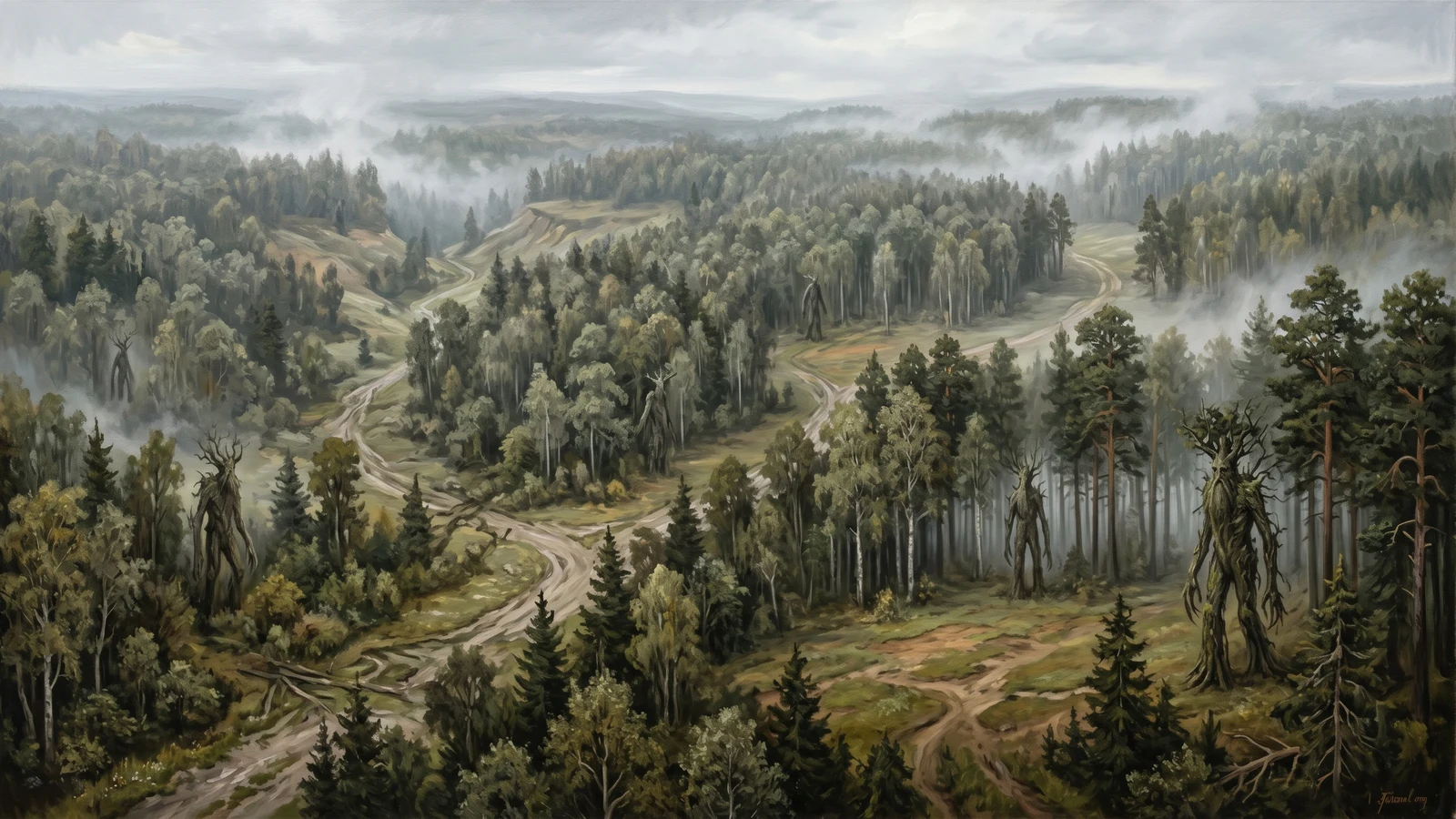
A vast woodland south of the Tenekee Woods and east of the Everwood, the Walking Forest is named for its most unsettling quality: it moves. Over seasons and years, the forest migrates, too slowly for the eye to catch. Entire groves relocate. Landmarks shift. Paths that existed last decade are now dense woodland, and clearings appear where none existed before.
Cartographers have learned not to bother mapping it.
The Movement
No one knows why the Walking Forest moves. One theory holds it follows underground water sources. Others think it tracks ley lines, or responds to seasonal changes in ways too complex to model. A few suggest the forest is semi-sentient, migrating according to preferences no mortal can fathom.
The movement is slow, perhaps a mile per year in the most active sections, but relentless. A village built in a clearing might find itself surrounded by encroaching trees within a generation. Roads laid through the forest become impassable as the woods close behind travelers. The forest doesn't seem malicious, exactly. It simply doesn't acknowledge that anything should stay in one place.
The Grayls
The Walking Forest is home to the largest population of Grayls in the world, wooden humanoids born from sacred groves, melancholic and ancient, who find the sounds of civilization physically painful.
The Grayls gather here because the Walking Forest solves their deepest sorrow. A Grayl bonds with trees (specific trees, individual trees) over decades or centuries of patient communion. In a normal forest, those trees eventually die, or the Grayl is forced to move and abandon them. The loss is devastating, repeated across immortal lifetimes.
But in the Walking Forest, the trees come with them. A Grayl can bond with an oak and know that oak will never be left behind. When the forest moves, their companions move too. The Walking Forest is not the Grayls' creation, but it has become their sanctuary.
When the Grayls mobilize, when many of them move at once for whatever slow reasons drive them, the forest seems to move faster. Whether this is cause or correlation, no one knows.
Sound and Silence
The Walking Forest is quiet in ways other forests aren't: not supernaturally silent like Quiet Mountain, but naturally hushed. No roads bring wagons. No villages echo with voices. No axes ring against wood. The only sounds are wind, rain, the creak of slow movement, and the occasional low groan of trees adjusting their positions.
This silence is why the Grayls can tolerate it here. They find mortal voices painful. Something about the pitch, the speed, the sheer volume of humanoid speech causes them distress. In the Walking Forest, they can exist without suffering.
Visitors who wish to pass through peacefully learn to communicate in whispers, gestures, and writing. Those who shout or sing will find the forest suddenly more difficult to navigate, paths closing, landmarks shifting, the Grayls' patient attention turning unfriendly.
Lacire
On the Springs of Vyowehr, within Ierya, stands Lacire, a city-state of perhaps fifteen thousand people, the only significant permanent settlement in the Walking Forest. See separate entry.