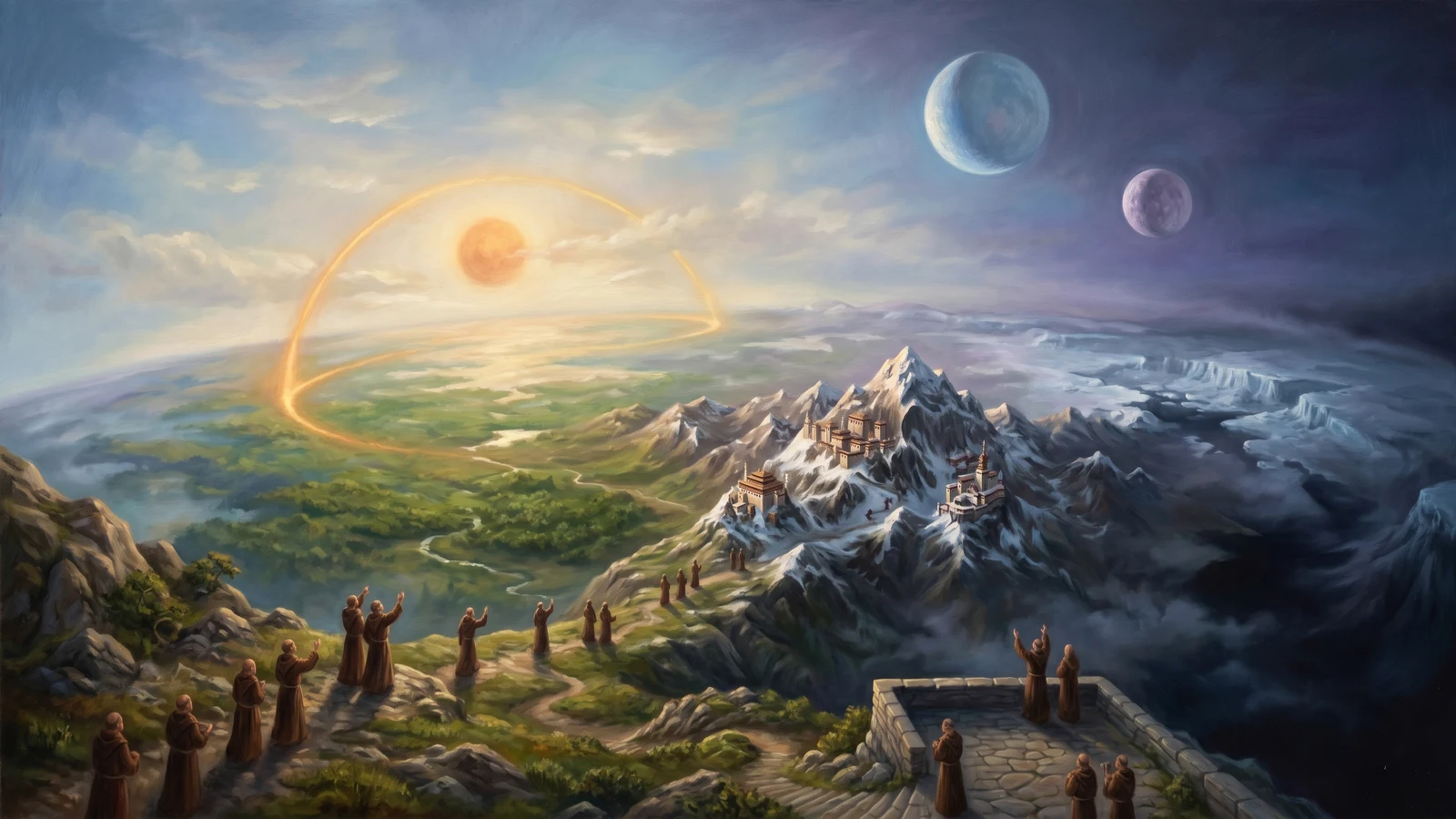
The sun passes around the center strip of the sky every day, all year. Alaria has no axial tilt. The poles are cold because Bryn's band of warmth never nears them. Seasonal geometry has nothing to do with it; no prayer-coalition has ever held the sun that far from the equatorial belt for long.
Two moons — Auris and Nyxara — pass over at various times throughout their cycles. A third moon once existed but was lost; its absence is remembered in the name "Killing Moon," given to the catastrophic destabilization periods that occur every several thousand years.
Seasons come and go when followers convince Bryn to traverse a different trail across Alaria. When the northern monasteries sing loudest, summer comes to the north; when the southern congregations raise their voices, warmth travels south.
Stars are viewports for the gods. Daemons can look down through them upon their subjects. Stars are usually located above places of importance to the daemon who claims them.
The calendar
Moon cycles: Auris has an 11-day cycle that marks the week, beginning at new moon and reaching full moon mid-week. Nyxara has a 23-day cycle. Because 11 and 23 share no common factor, the two faces coincide only every 253 days, a little less than once a civil year: both full (Brightnight) or both new (Hollownight), the two falling about half a cycle apart. Both are important holidays.
The civil year: 200 days, split into eight 25-day quarters. This is not physics. The 200-day year is the product of the Solar Accord, a political treaty among the major prayer-coalitions that partitioned Bryn's annual path into a standardized cycle. Before the Accord, seasons lasted as long as the prevailing coalition could hold the sun on a given trail — sometimes ninety days, sometimes forty, depending on the strength of the singers and whether their monasteries survived the season. The civil year begins on the date the Accord designated as new year. That date is a political convention, not an astronomical one; there are no solstices on a world with no axial tilt.
The Great Cycle: the slow drift of Aurus and Nydus toward and away from the Material boundary turns a wheel 25,300 years long (~14,000 Earth years), and the lunar alignments mark its key positions. When an alignment coincides with the calendar's new year, it signals the beginning of a new age. Smaller ages turn every 11, 23, and 253 years, when lunar alignments fall on significant dates.
Great Cycle position: the wheel's dial is read from 0 to 25,300 and back down again — a cyclical position, not a running historical count. F indicates the ascending half of the Great Cycle; B indicates the descending half. At position 0, Hollownight falls on new year's day. At position 25,300, Brightnight falls on new year. Each marks the beginning of a new age. The dial is read, never used to date events — that work belongs to SD/BSD alone.
The eight quarters
The Accord's year turns through eight named quarters, four warm and four cool, tracing Bryn's standardized path from the year's warm opening down into the cold and back up. The warm quarters are Kindling, Greenreach, Highsun, and Goldreap; the cool are Greysky, Lowlight, Deepcold, and Stillturn. Kindling opens the year as the warmth returns and planting begins. Highsun is the peak. Goldreap is the harvest, the warmth already ebbing out of it. Then Greysky brings the first cold as Bryn is drawn off the belt, Lowlight deepens it, Deepcold is the trough, and Stillturn is where the cold breaks and the sun starts back toward Kindling. The names describe the agreed civil season, not a guarantee. A coalition that defects can leave Highsun cold or hold Goldreap warm a quarter past its turn.
Four solar holidays fall on the cardinal turns. Newlight is the first day of Kindling and of the year — the warmth's return, which is also the Accord's new year. The Crown is the heart of Highsun, midsummer, the warmth at its strongest. The Last Sheaf closes Goldreap in its final week, the harvest in. The Hearthhold sits at the heart of Deepcold, midwinter, and is kept hardest of the four: cheer held against the cold and the dark, lamps in every window, the year at its lowest and the singers straining to turn Bryn back. Farmers and commonfolk keep these; the magic-centered cultures keep the lunar holidays instead, though most households mark both.
A full civil date names the weekday, the day of the quarter, and the year — Marketday, the 14th of Highsun, 3376 SD. The week runs on Auris and the quarter runs on the sun, so the two cycles drift against each other and a given weekday falls two or three times within one quarter; the day-count fixes which. The Time Puzzle is dated to Fireday, the 9th of Lowlight, 312 SD, and the war that closed the Dark Ages is recorded ending on Patrons' Day, the 2nd of Stillturn, 231 SD. The campaign present is conventionally reckoned at the turn into Greenreach, 3376 SD.
Reckoning and eras
SD/BSD is the calendar for history. "Seventh Dawn" marks the current age; the present is 3376 SD. The reckoning counts forward from calendar zero (0 SD), the epoch the surviving calendars fixed just after the World Fire of approximately 10 BSD. BSD counts backward from that same threshold.
The Great Cycle is not a historical timeline. It marks where the world currently sits on the 25,300-year wheel of Aurus and Nydus's drift, and the lunar alignment that drift produces — a cyclical position, not a running year-count. Observatories use F/B notation to record that position (F for the ascending half of the wheel, B for the descending), but this describes a place on the dial, not a point in history. Two eras separated by 25,300 years would share the same Great Cycle position. Dates are always SD/BSD.
Seasons and the Accord
The Solar Accord standardized the civil year's shape. It did not change how Bryn works. Seasons are variable in practice — a coalition that defects from the rotation, collapses, or loses a sun-war extends or cuts short a quarter without warning. The 200-day calendar is the plan.
The Sun-Forsaken North and the Sun-Forsaken South lie permanently beyond any coalition's reach. Bryn's warmth-band cannot be steered that far from the equatorial belt regardless of how organized the prayer effort is. But those latitudes were not always cold. Before the Accord constrained the path, competing coalitions occasionally pulled Bryn toward the poles. Warmth reached the deep north for generations, then vanished when the coalition holding it collapsed. The ruins standing in those glaciers are cities built during those sunlit centuries. The relict wildlife stranded there is evidence of an environment that no longer exists around it.
Sun-wars were fought over precisely this: who held the right to steer Bryn, at which latitudes, for how long. The solar theocracy, the law of light, and the sun-tax all emerged from that history. See person-bryn and event-solar-accord for the political and ecclesiastical architecture.
A sect called the Dawnless holds that twelve million years of ceaseless motion constitutes an imposition Bryn never agreed to, and that the faithful should let the sun rest. Their theological case is not incoherent. Bryn did not choose to wake. In any nation that collects the sun-tax, announcing this position is a capital crime.
Lunar and solar celebrations
The moons aligning represents the cycle of magic; the calendar's turn represents the cycle of nature.
Lunar cultures: moon elves and other peoples who center life around magic generally celebrate lunar holidays — every 253 days on Brightnight, the monthly rhythms of Nyxara, and the weekly tide of Auris.
Solar cultures: seasons are more celebrated by commonfolk, less attached to magic and more connected to nature. The four cardinal celebrations are Newlight at the year's warm opening, the Crown at midsummer, the Last Sheaf at harvest's close, and the Hearthhold at midwinter. The Hearthhold is kept hardest — cheer held against the cold and dark.
Both sets of holidays are observed by most cultures, though the emphasis varies.
The 11-day week
The week follows Auris's cycle, beginning at new moon:
- Cautious (new moon): stay indoors after dark. The week's most dangerous night.
- Wakeday (waxing crescent): made it through Cautious. Safe to emerge.
- Patrons' Day: give thanks to your daemon.
- Moil: a day of work.
- Marketday: trading and commerce.
- Merrynight (full moon): Auris at its brightest. Stay up late, celebrate.
- Brightlove: the glow continues. A day for joy and connection.
- Lazyday: rest.
- Farewell: travelers depart to reach home before Cautious.
- Gather: prepare supplies and close up for the dark nights ahead.
- Fireday (waning crescent): burn candles through the night. The last light before darkness.