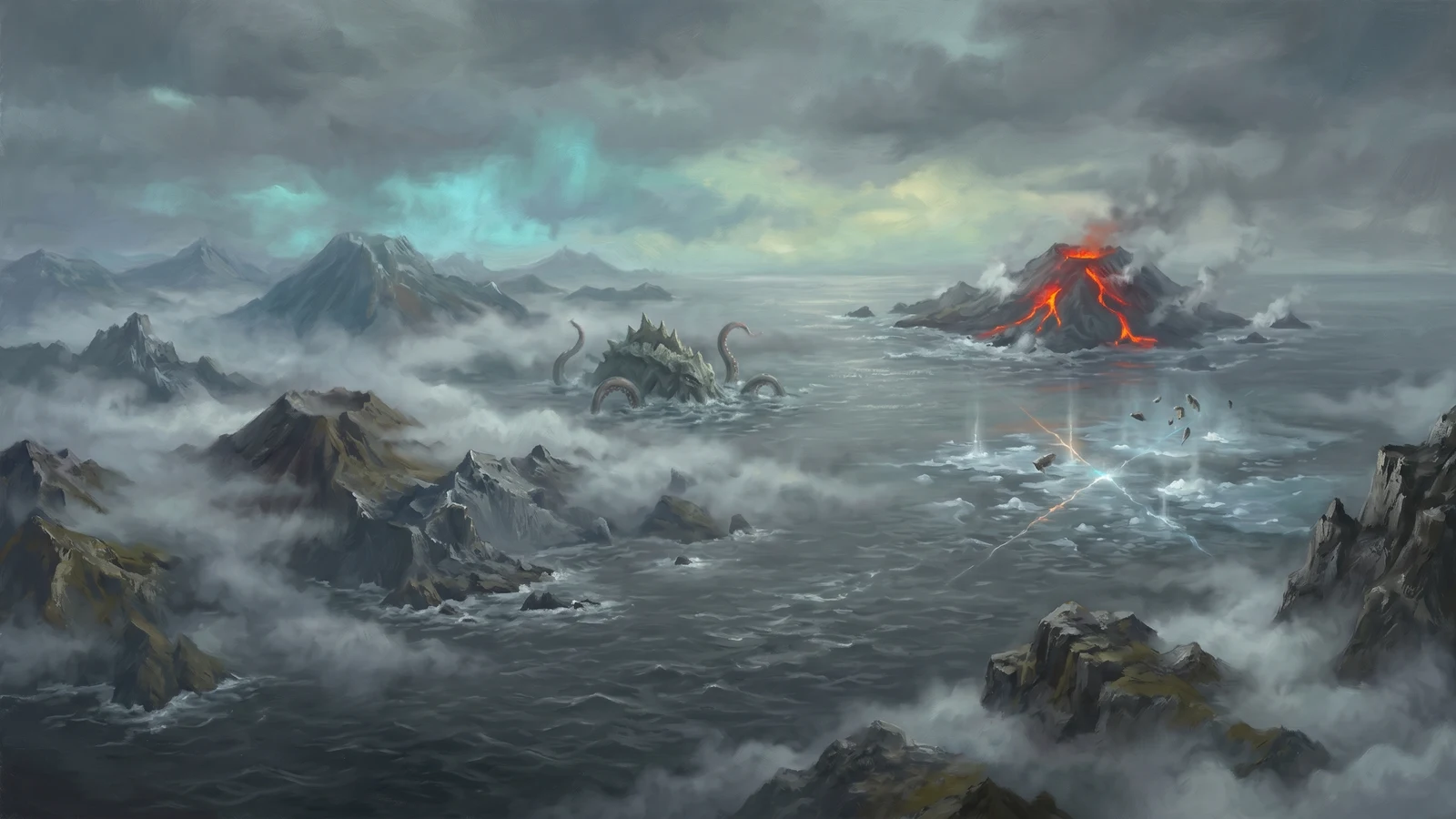
A sprawling archipelago stretching roughly 800 miles east-to-west and 500 miles north-to-south off the Dragon's Spine Coast, where the mountain range fragments into the sea and eventually dissolves into the Abyssal Ocean. The Pindolins are cold, misty, dragon-haunted, and almost entirely uninhabited by anything that wants to stay that way.
Geography
The islands are the drowned peaks of the Dragon's Spine—the same volcanic mountain range that dominates southern Aboyinzu, here broken apart by ancient seismic activity and scattered across hundreds of miles of ocean. Individual islands range from massive (some over a hundred miles long) to barely-rocks poking above the waves.
The Western Pindolins: Larger islands, closer to the mainland, connected by relatively navigable straits. This is where the few human settlements attempted to establish themselves before the dragons made that impractical.
The Central Pindolins: The densest cluster, a maze of channels, hidden coves, and fog-shrouded passages. Three leylines converge here—Water, Force, and the combined Earth-Fire line that runs south. Navigation is treacherous even without the dragons.
The Eastern Pindolins (Nazish): The far reaches, where islands become sparse and the Abyssal shelf drops away into true oceanic depth. Local sailors call this region "Nazish"—an old word meaning roughly "where the map ends." Few return from deep exploration here.
Climate
Cold and wet. The Pindolins sit in a permanent collision zone between the warm Abyssal currents and the cold air masses that sweep down from the Dragon's Spine. The result is fog—thick, persistent fog that can reduce visibility to arm's length for days at a time.
The fog isn't always natural. Near leyline convergences, it thickens into something almost solid, resistant to wind, occasionally dense enough to suffocate. Locals call these patches "choke-banks" and navigate around them by sound and instinct. Visitors blunder in and sometimes don't blunder out.
Rain is constant but rarely heavy—a perpetual drizzle that soaks everything without the drama of actual storms. When real storms do hit, they're violent enough to reshape coastlines. The islands are riddled with sea-caves carved by millennia of wave action.
The Three Dragons
The Pindolins are claimed by three dragons who mostly ignore each other's existence:
Findra, the Glassy Eyed, holds the northeastern islands, near where the Force leyline runs strongest. A blind dragon who sees through crystalline resonance spheres, perceiving motion and vibration rather than light. She's been here three centuries and considers the region her laboratory for sensory experimentation.
Oboros, the Cunning, lairs in the central islands along the Water leyline. A blue-scaled dragon associated with currents, depths, and the manipulation of liquid. He's the oldest of the three, the most patient, and the most likely to bargain rather than attack—though his bargains tend to favor him significantly.
Elebria claims the southwestern islands where the Earth and Fire leylines intersect—a region of volcanic activity, thermal vents, and lava that occasionally reaches the surface. She's a lava dragon, her scales shifting between black stone and molten orange depending on her temperature. The most territorial of the three; entering her claimed waters is effectively suicide.
The dragons have established an informal truce through mutual disinterest. Their territories don't overlap meaningfully, their hunting grounds are distinct, and none of them wants what the others have. This could change if circumstances shifted—a new dragon arriving, a leyline moving, or external pressure forcing cooperation or conflict.
The Leylines
Three elemental leylines cross the Pindolins:
The Force Leyline enters from the Dragon's Spine mainland and runs through the northeastern islands before dissipating into the Abyssal Ocean. Effects include gravitational anomalies (objects weighing more or less than they should), kinetic storage (things that should fall staying suspended), and occasional spontaneous acceleration of loose objects.
The Water Leyline runs roughly north-south through the central islands. Effects include current manipulation (water moving against wind and tide), temperature instability (freezing patches in warm water, boiling spots in cold), and the enhancement of water-based magic. Oboros has learned to ride this leyline like a highway.
The Earth-Fire Convergence enters from the south and intensifies as the two leylines approach intersection in Elebria's territory. Effects include volcanic activity, thermal vents, occasional lava flows, and the creation of obsite—a glass-like volcanic stone that holds heat indefinitely.
Where leylines cross or approach each other, effects compound unpredictably. The central Pindolins contain at least three major convergence zones, all of which are considered impassable by sane navigators.
Creatures
The Pindolins host an ecosystem adapted to cold, fog, and magical instability:
Fog-Stalkers: Colonial organisms that exist as distributed awareness through fog banks. They're not intelligent individually, but a sufficiently large fog-stalker colony can coordinate hunting behavior across miles of mist. Prey enters the fog; the fog notices; tendrils of denser vapor guide the prey toward the colony's digestive core. Most victims never see what kills them.
Kraken-Spawn: The Abyssal Ocean hosts kraken-matriarchs in its deepest trenches. Their offspring, smaller and stupider but still building-sized, drift into Pindolin waters following warm currents. A kraken-spawn can capsize a ship by accident; they can destroy one deliberately when hungry or territorial.
Thermoclaws: Crustaceans adapted to the volcanic southern islands, ranging from crab-sized to horse-sized. Their shells incorporate obsite, retaining heat from thermal vents. A large thermoclaw can crack steel with its pincers and survives being submerged in freezing water by simply radiating stored heat until the water around it boils.
Glass Eels: Found near Force leyline concentrations, these transparent eels are effectively invisible in water. They hunt by kinetic sense, detecting the vibrations of swimming prey. A school can strip a whale to bones in minutes. Findra considers them pests and kills them when she notices them, which isn't often enough.
Silt-Singers: Bottom-dwelling creatures in the deeper channels that produce low-frequency sounds as part of their mating displays. The sounds travel through water and stone, sometimes resonating with leyline energies to produce hallucinations in surface-dwellers. Sailors who hear silt-singers for too long report seeing phantom ships, lost loved ones, or "the thing that waits below."
Why Anyone Comes Here
The Pindolins are not a destination. They're a place people end up through desperation, greed, or terrible navigation:
Hiding: The islands are effectively lawless and nearly impossible to search systematically. Fugitives, pirates, and people fleeing worse fates than dragons occasionally establish temporary camps. Most don't survive long, but some do, and the Pindolins don't ask questions.
Hunting: The three dragons represent enormous bounties to anyone capable of claiming them. Dragon-hunters occasionally mount expeditions, usually funded by mainland lords with more money than sense. Success rate is approximately zero.
Harvesting: The islands produce rare materials unavailable anywhere else. Force-crystallized obsidian from Findra's territory. Obsite from the volcanic south. Kraken-bone from spawn that wash up dead. Fog-stalker cores, if you can kill one without being digested. The profit margins are extraordinary for anyone who survives.
Consulting Korvo: Tidewatcher's Perch holds a man with perfect navigational knowledge of every sea in Alaria. Reaching him requires surviving the journey. Getting information requires resisting the urge to sit down.
Navigation
The Pindolins are not charted in any meaningful sense. The fog makes visual navigation impossible for days at a time. Currents shift with leyline fluctuations. Islands occasionally sink or rise as volcanic activity reshapes the seabed.
Successful navigation requires:
- Local knowledge: Guides who've survived the islands long enough to learn their patterns (rare and expensive)
- Magical assistance: Water mages can read currents; Force mages can sense the leyline; anyone with fog-penetrating senses has an advantage
- Luck: Honestly, mostly luck
The safest approach is to skirt the edges—the western islands are survivable with caution. Going deep into the archipelago is a commitment. Going into Nazish is a death wish unless you have a very specific reason and the means to survive it.
Nazish (The Eastern Reaches)
The far eastern Pindolins, where islands become scattered and the Abyssal shelf drops away into true oceanic depth. Local sailors named it "Nazish"—an archaic term for the edge of the known world.
Nazish is where the Pindolins stop pretending to be survivable:
The Abyssal Shelf: The ocean floor drops from hundreds of feet to thousands over the span of a few miles. Things live in that depth that don't come up to the shallows. When they do come up, it's rarely good.
The Fog Wall: A permanent bank of fog marks the approximate boundary of Nazish, possibly a fog-stalker super-colony or a leyline effect no one has successfully studied. Ships that enter don't always emerge.
The Empty Islands: Nazish contains islands. Some are large enough to support ecosystems. All of them are uninhabited by anything visible. Expeditions that land report finding signs of habitation—fire pits, cleared paths, structures—but never occupants. Where the builders went is unclear. That they left quickly is obvious.
History
The Pindolins have been continuously dangerous for as long as anyone has tried to settle them:
The Vaelish Expansion (~600 years ago): When Vael controlled the Dragon's Spine passes, they attempted to establish trading posts in the western Pindolins. Most failed within a decade. The survivors fled when Kanzekill began her rampage on the mainland.
The Dragon Settlement (~300-500 years ago): Elebria was first, claiming the volcanic south. Oboros arrived perhaps a century later, taking the central waters. Findra is the newest, establishing herself after whatever blinded her drove her to these shores.
The Present: The Pindolins exist in a stable state of danger. No nations claim them. No powers contest them. The dragons ignore each other, the creatures hunt what they can, and the islands wait for anyone foolish enough to visit.