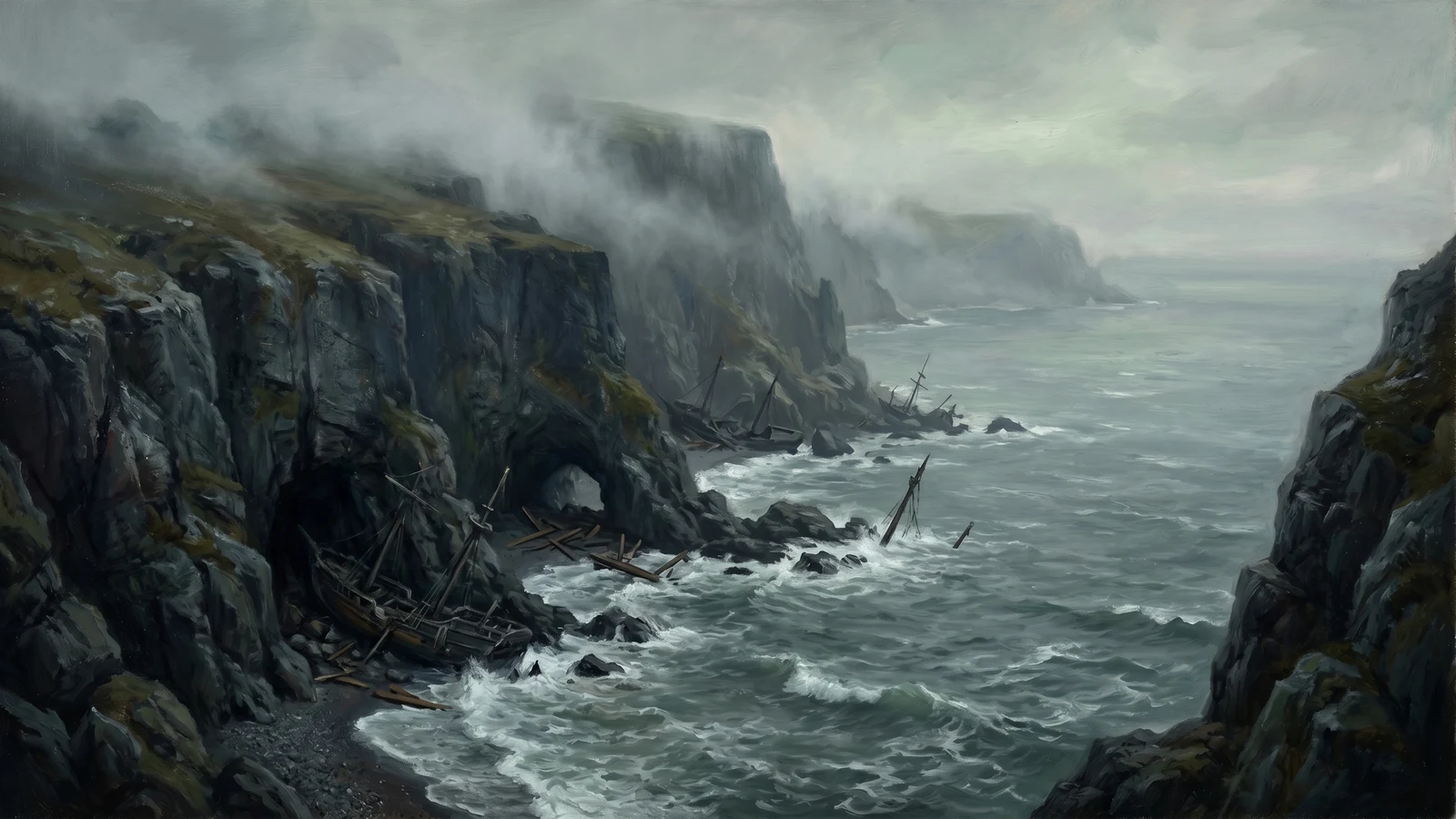
The Shipwreck Coast stretches nearly three hundred miles along the eastern margin of the Dalizi Highlands, from the Misty Valley in the north to the coastal plains south of the Elder Mountains. No permanent settlements exist along its length. No ports. No fishing villages. The coast earns its name honestly—the seafloor here is a graveyard of broken hulls, and the cliffs are studded with the rusted remnants of vessels that never made landing.
Geography
The coast presents an almost uniformly hostile face to the sea. Sheer cliffs rise two hundred to four hundred feet directly from the water along most of the northern and central stretches, carved by millennia of wave action into overhangs, sea caves, and treacherous undercuts. Where the cliffs relent—primarily in the south near the Elder Mountains—the beaches are narrow strips of dark volcanic sand backed by unstable scree slopes.
The continental shelf drops away sharply within a mile of shore, creating a zone where deep-water swells suddenly encounter shallow rock. Combined with unpredictable currents that sweep down from the northern Wanderlands waters, this produces wave patterns that can swamp even experienced sailors. The waters remain cold year-round, fed by currents from the cursed Donclik Sound to the north.
Why Ships Die Here
Three factors combine to make the Shipwreck Coast lethal:
The Fog Bank. The Foggy Mountains to the west earn their name from constant moisture-laden air that spills down their eastern slopes. This fog blankets the coast most mornings and many evenings, reducing visibility to ship-lengths. Vessels often don't see the cliffs until they hear the waves breaking against them.
The Undertow. Currents along this coast run parallel to shore in complex, shifting patterns. A ship fighting to stay off the rocks may find itself pulled inexorably sideways toward a headland it thought was safely to port. Local sailors—the few who exist, working out of distant ports—call this phenomenon "the gathering."
No Safe Harbor. Even if a vessel successfully navigates the fog and currents, there is simply nowhere to land. The few coves that exist are choked with rocks, their entrances too narrow for anything larger than a rowboat. Ships in distress have no refuge.
The Wrecks
Centuries of maritime traffic between the southern Aboyinzu coast and the Elder Wilds have left their mark. Merchant vessels, exploratory expeditions, refugee flotillas, and the occasional warship—all have contributed to the underwater detritus. Local legend claims you can walk from one wreck to the next without touching natural stone for miles in certain stretches.
Salvage operations are technically possible but rarely profitable. The cliffs make overland access to the wrecks nearly impossible, while the same currents that killed the ships make diving treacherous. A few determined salvagers work the southern stretches where beach access exists, but they speak of the work in terms of survival rather than profit.
Some wrecks are visible from the cliff tops—masts protruding from the water, hulls wedged into sea caves, the occasional vessel impaled on rocks close enough to shore that its decay can be watched over years. The Dalizi have names for the most prominent ones, passed down through generations of shepherds who graze the Banesnap Hills above.
Why It Remains Empty
The Dalizi Confederation's eastern frontier ends at the Cerulean Crests and Jackal Mountains. No state claims the highlands beyond, and none claim the coast. This isn't oversight—it's policy born of hard experience.
The coast offers nothing. No arable land backs the cliffs. No timber worth harvesting survives the salt spray. The fishing would require establishing communities in an area with no fresh water and no safe anchorage. Every generation or so, some enterprising merchant proposes establishing a lighthouse or rescue station; every generation, the proposal dies when the cost becomes clear.
The highlands above the coast are monster territory—Moon Goblins, ogres, and worse. Any coastal settlement would need to be supplied entirely by sea, through waters that kill ships, while simultaneously defending against raids from above.
The Dalizi have a saying: "The sea takes what comes, and the mountains take what stays."
Navigation Warnings
Sailors with business in eastern Aboyinzu waters know to stay well offshore when passing the Shipwreck Coast—twenty miles minimum in clear weather, more in fog. The currents extend far from shore, and the fog can roll out unexpectedly. Ships that must approach do so only in full daylight, during the brief window between morning fog and evening fog, with crew watching the water constantly for the telltale color change that indicates shallowing.
There are no reliable charts of the underwater hazards. The seafloor here is a maze of rocks, wrecks, and sudden depth changes. Attempts to map it have added to the wreck count.
Related Locations
- Misty Valley — Northern terminus, where the coast briefly becomes accessible
- Banesnap Hills — Coastal hills overlooking the central stretch
- Elder Mountains — The southern highlands above the coast
- Foggy Mountains — Source of the perpetual fog bank