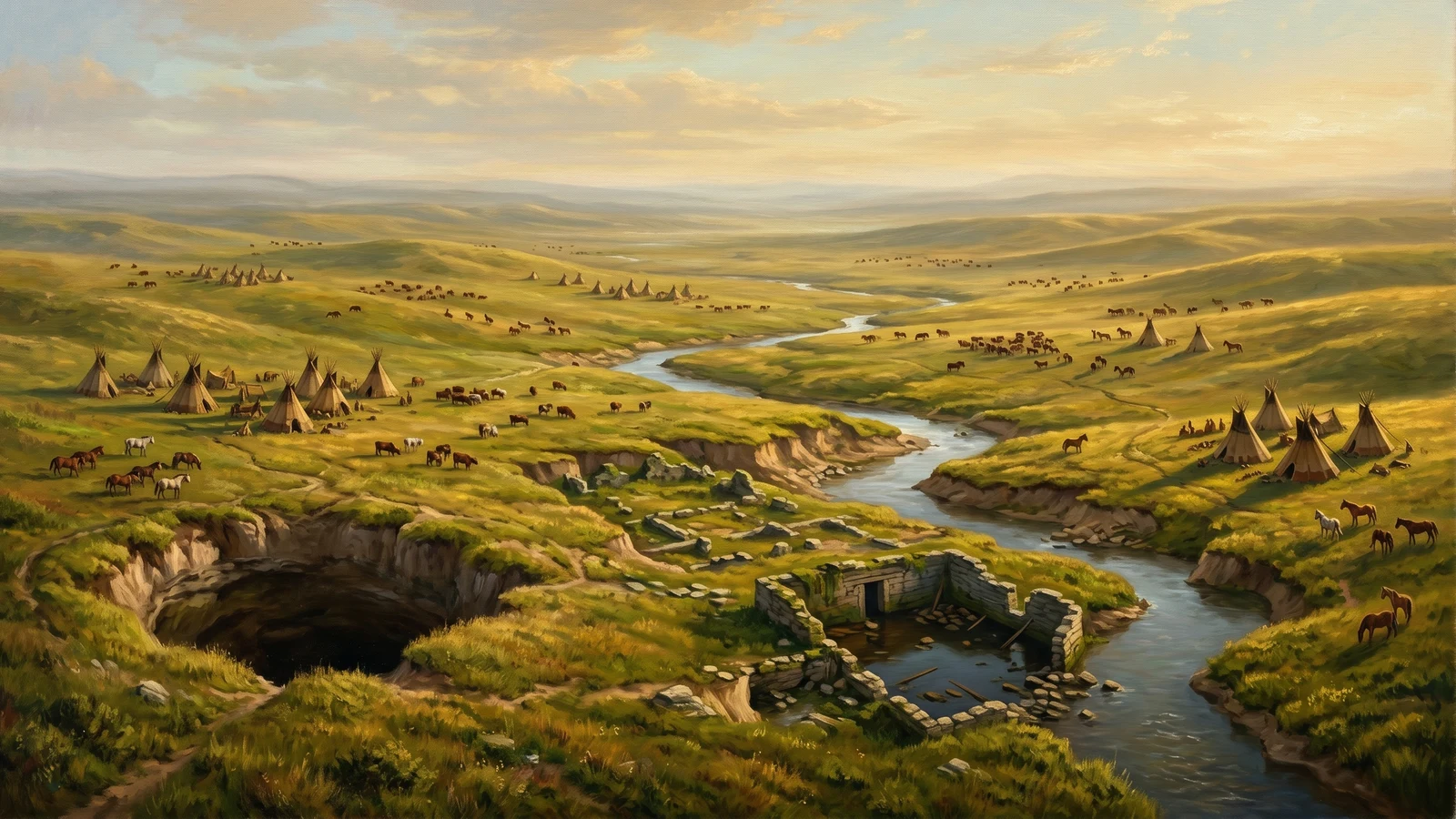
A vast grassland stretching across eastern Wycendeula, from the Kilbyurn Mountains in the west to the shores of God's Bathtub in the east. The plains are fertile, well-watered by several river systems, and completely overrun with satyrs.
The Satyr Occupation
The plains hold perhaps a hundred thousand satyrs scattered across thousands of temporary camps. Buffalo hide tents dot the landscape; herds of wild cattle and horses provide sustenance. The satyr follow the herds, moving with the seasons, leaving little permanent mark on the land.
Despite the fertile soil, no farming exists. The satyr lack the social organization to establish agriculture—or perhaps they simply don't want to. Attempts by outsiders to settle the plains have universally failed, overwhelmed by sheer numbers before any fortification could be completed.
Despite having no formal government, rumors of a self-proclaimed king of the satyr have begun to spread. A satyr of dark and mysterious origins, with ambitions to unite all of the satyr. These rumors terrify Balduahr, the smaller dwarven kingdom in the southwest, which would have no hopes of defending itself if all of the satyr across Wycendeula united.
What Lies Beneath
The satyr are not the first inhabitants of these plains.
Beneath the grass and topsoil lie the remains of a human civilization that flourished here in the distant past—cities, roads, temples, and farms, now buried under centuries of accumulated earth. The satyr ignore these ruins; they have no interest in the past and no use for stone buildings. But the ruins are there, waiting.
Evidence of the old civilization surfaces regularly: foundation stones exposed by erosion, metal objects turned up by burrowing animals, carved fragments in riverbanks where floods cut through the soil. The architecture suggests a prosperous, organized society—nothing like the nomadic camps that occupy the surface today.
What happened to them remains unclear. The satyr arrived at some point—migrated, invaded, or simply drifted in—and the humans are gone. Whether they were conquered, displaced, absorbed, or destroyed by something else entirely, no records survive to say. The satyr themselves have no oral history of the conquest; as far as they're concerned, the plains have always been theirs.
The Deep Ruins
The surface evidence hints at what lies below. In a few locations, natural features have exposed deeper structures:
River-Cut Foundations: The Mydruli and its tributaries have carved through the buried city layer in places, revealing walls, floors, and occasionally intact chambers. Most are flooded or collapsed, but some remain accessible. Treasure hunters who brave the satyr occasionally investigate these sites.
Sinkhole Exposures: The plains have several areas where the ground has collapsed into underground voids—basements, cisterns, or tunnel systems from the old civilization. The satyr avoid these sinkholes, claiming they're haunted or cursed. Explorers who've descended report extensive underground construction, largely intact but dark and silent.
The Lygrone Valley: The area around the Lygrone River shows unusually dense evidence of habitation. Surface ruins are more common here, and the satyr population is notably thinner. Something about the valley discourages them—or something they remember discourages them, even if they won't say what.
Archaeological Interest
The buried civilization of Wycendeula represents one of Alaria's great historical mysteries. Who were they? How advanced? Why did they fall? The answers lie beneath the plains, preserved by the same satyr occupation that prevents investigation.
Serious archaeological work is effectively impossible. Any expedition large enough to excavate is large enough to attract satyr attention. Small groups can sometimes slip through, but they can't stay long enough to accomplish meaningful study. The few artifacts that have been recovered—mostly by treasure hunters—suggest a culture with advanced metallurgy, sophisticated architecture, and extensive trade connections. Beyond that, speculation outpaces evidence.
Some scholars theorize the civilization's fall is connected to the same forces that created the White Wastes or the cursed features of the Grognil Mountains. Others suggest the satyr themselves were the cause—that they arrived in overwhelming numbers and simply took what they wanted. A minority view holds that the humans are still there, somehow, in the deepest levels—that the civilization retreated underground rather than face destruction.
The truth, whatever it is, waits beneath the grass.
Traveling the Plains
Crossing the Plains of Wycendeula is possible but risky. The satyr are not uniformly hostile—small groups are often ignored, especially if they avoid camps and keep moving. But large groups, slow-moving caravans, or anyone who appears to be settling will draw attention.
The main hazards:
- Satyr bands: Opportunistic rather than organized, but dangerous in numbers
- Wildlife: Buffalo herds can trample the unwary; predators follow the herds
- Distance: The plains are vast, water sources are the rivers, and shelter is nonexistent
- The buried ruins: Sinkholes appear without warning; what's underneath isn't always empty
The few established routes cross the northern plains near the White Wastes, where satyr density is lower and Caffas traders occasionally pass. Southern routes through the Lygrone valley are faster but less traveled—the satyr may avoid the area, but travelers report the same unease.