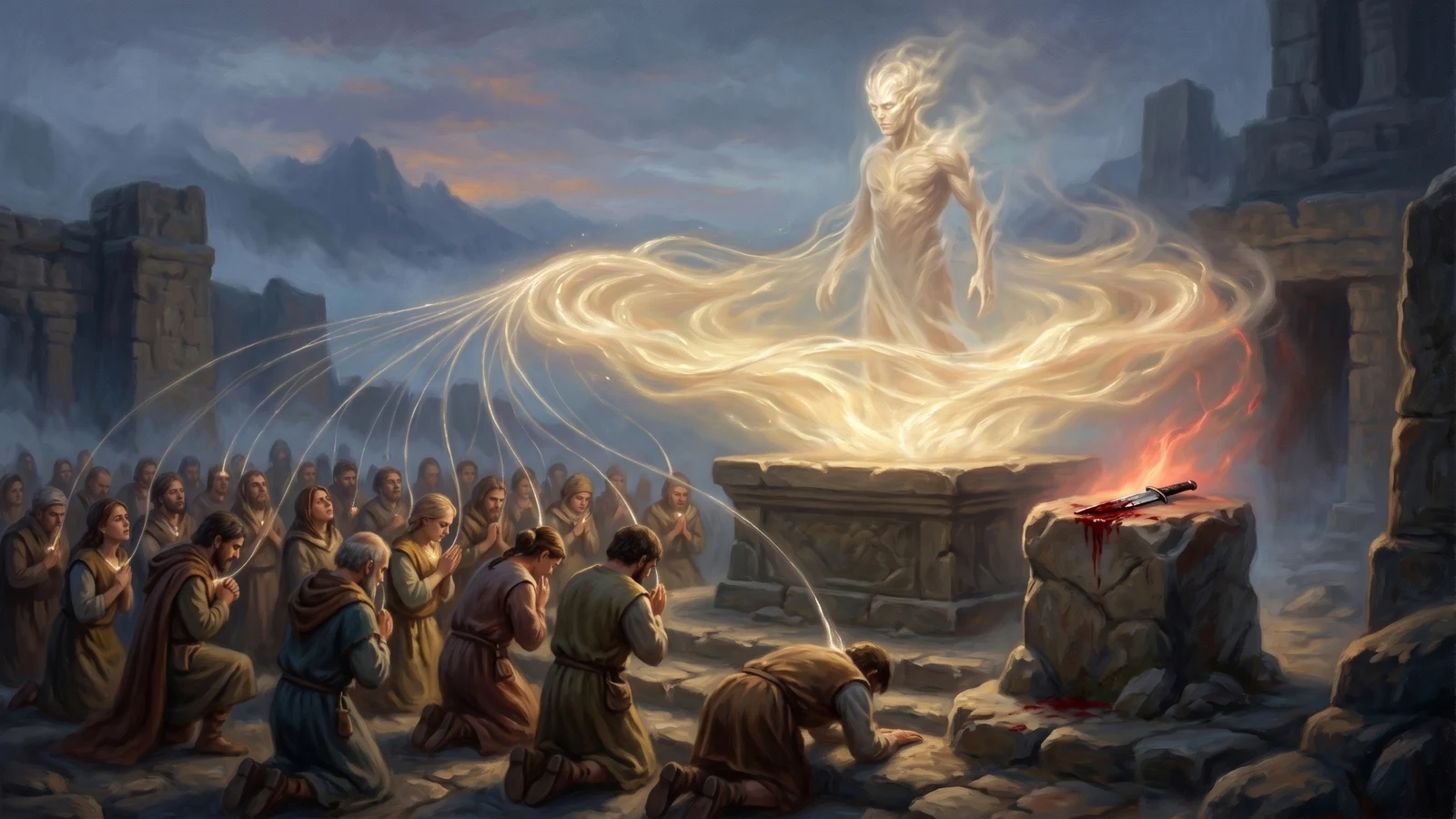
Start with the fact that decides everything else: a god of Alaria was once a person. Not descended from a god, not touched by one. A mortal who lived, died carrying the right kind of spirit, and rose. The gods here are called daemons, and the word carries no judgment of good or evil. It names a category of being, the way "dragon" or "titan" does. A daemon is a dead mortal who became something that prayer can feed and miracles can spend.
That is the whole of it, and it is stranger than it sounds. The titans who made the world, Azus and Melera, are not daemons and were never worshipped into being. They are older than worship. A daemon is the opposite kind of thing: a being that exists only because mortals remember it and pray to it, and that stops existing the moment they stop. Craggus was the god of all mankind for fifteen thousand years. He is gone now, and no one who reads this has ever heard him answer a prayer.
What worship buys
Worship is not flattery. It is fuel, and the books are kept in a currency the daemons can spend.
The mechanism is exact. Every prayer is a small tithe of the worshipper's own life, drawn off and pooled into the god's reserve. One prayer is almost nothing, a tenth of a breath of a person's vitality, paid at planting or at dawn or over a sickbed. Across a congregation it adds up, and across a civilization it becomes enormous. That reserve does two jobs. It has to stay above a floor, because a daemon whose reserve runs dry is forgotten, and forgotten means ended. And it is the account a god draws on to act. Every miracle is a withdrawal. Curing a plague, winning a battle, holding back a flood: each has a price in pooled life, and the god pays it out of what its worshippers have given.
A blessing costs the priest a prayer. The miracle behind it cost the god a year of someone's life, paid in advance by ten thousand strangers who will never know which of them funded it. — Velorin of Istora, On the Economy of the Divine
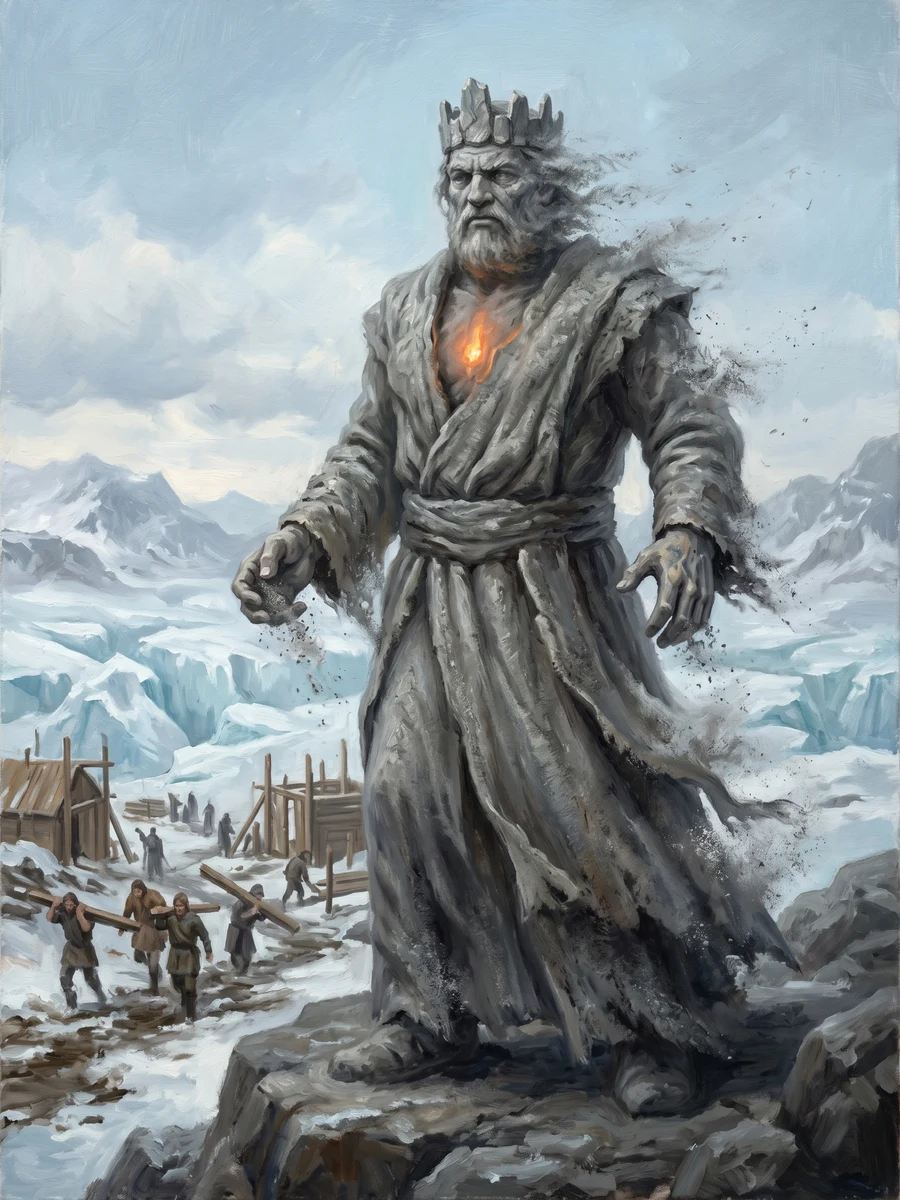
The small miracles are cheap, the order of a few hundred days of one worshipper's prayer. The large ones run high. Saving a city outright, or calling one soul back from death, costs the steady devotion of a thousand people for the better part of a year. And the truly vast acts, the kind that bend the world, are paid for only by the prayer of millions. When Craggus broke the Long Winter and pulled mankind out of the ice, he spent a reserve that had taken the massed terror of every surviving human culture to fill. No god has done anything on that scale since, because no god since has gathered a congregation that large.
There is a shortcut, and it is the ugliest fact in the system. A single life given in blood yields at once what a year of a faithful worshipper's prayers would yield slowly. A murder on an altar is a lump-sum deposit. This is why desperate cults kill instead of waiting, and why a god running low on prayer will sometimes find priests who have decided the math justifies the knife. The system does not forbid it. The system only counts.
How a mortal becomes a god
Most mortals who die do not become daemons, and most who could never get the chance. Three things have to be true at once, and they are independent. None of them buys you past the others.
The first is the kind of spirit you die with, which is a matter of cosmology more than of merit. The second is knowledge. A daemon-to-be must have mastered the titans' command-language, Deoric, in life, deeply enough to compose with it rather than merely recite it. This is rare almost past counting. The reconstruction of that language is the long, scholarly work of the Vyanoweir tradition, and only its deepest students have ever crossed the threshold. The third is worship. Even a qualified soul stays a footnote unless mortals pray to it, because without prayer the new reserve never clears the floor and the daemon ends as fast as it began.
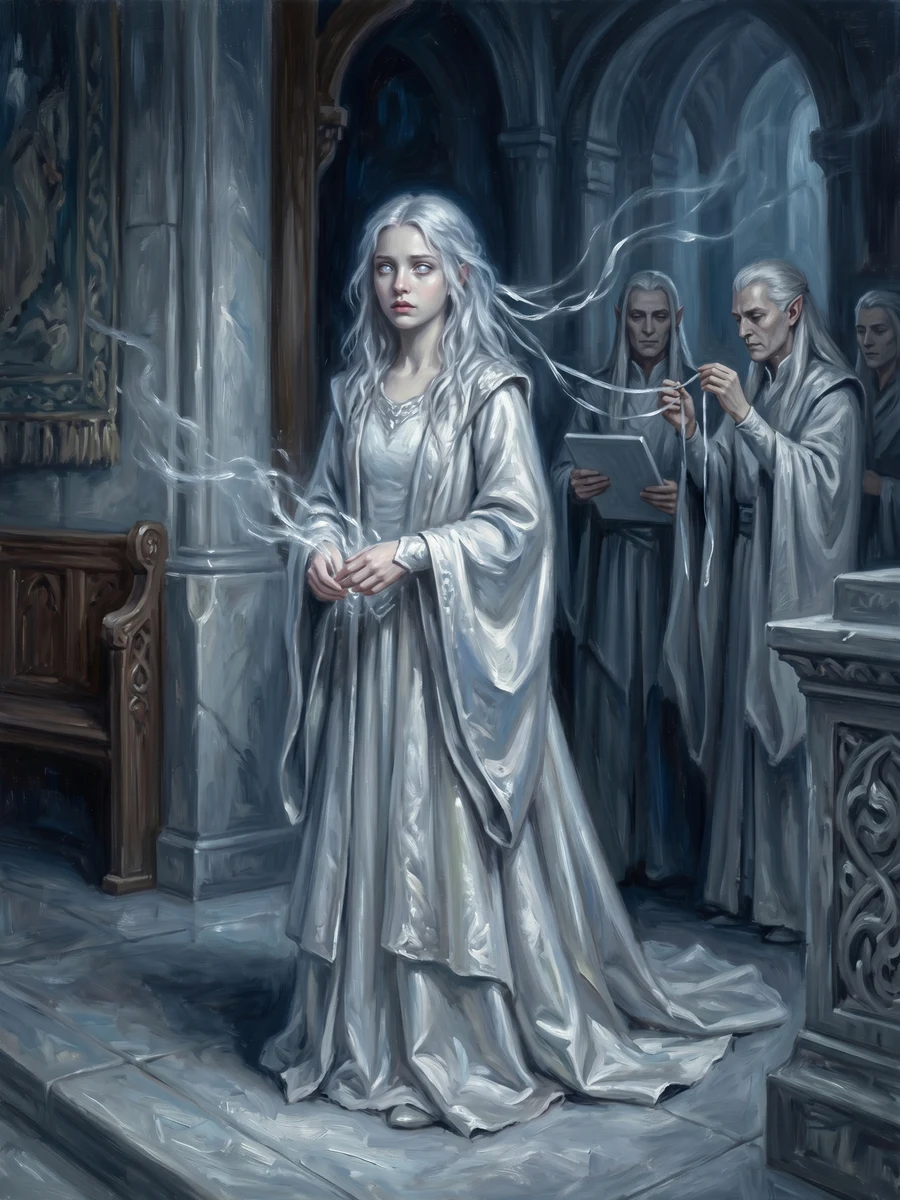
The result is that ascension is most often not earned at all. It is arranged. Tiira, the silver elves' young goddess, did not climb to divinity through faith. Her own government chose a clever girl, tutored her into a vessel, wiped the parts of her past it did not want her to keep, and installed her as a god the elves would be required to worship. A god can be manufactured by a state that understands the rules. The new daemon, in the first hours after rising, has almost nothing in reserve and cannot resist anything, and older powers know it. The moment of ascension is the moment a god is most easily seized.
The politics of prayer
Two daemons whose worshippers overlap are competitors, and the competition is zero-sum. A prayer given to one is a prayer not given to the other. So the gods of Alaria do not, as a rule, form one happy family. They form cartels.
A pantheon, looked at from the gods' side, is usually a non-compete agreement. Daemons whose domains do not overlap can share the secrets of their craft freely, because none of them is fishing in another's pond. A forge-god and a death-god lose nothing by teaching each other. The arrangement holds exactly as long as the domains stay separate, and it shatters the moment one god's worship expands into another's. The dwarves of the First Brotherhood keep a working example: Krondeum owns the finished blade and Krunites owns the first ore from a new vein, and a smith prays to each at the proper moment, and the two gods do not quarrel because their territories were drawn never to touch.
Krunites takes the first ore. Krondeum takes the named and finished thing. A smith who skips either rite is corrected, sometimes by an elder, sometimes by the work going wrong in his hands. — a saying of the First Brotherhood clan-halls
Where there is no treaty, there is appetite. A powerful daemon's strongest advantage is the knowledge it holds and no one else does, so the powerful hoard. The oldest gods are the most secretive, because their lead is built on grammar the living world has forgotten, and to teach it is to risk raising a rival to parity. Knowledge does leak anyway, slowly, through apostates and spies and worshippers who absorb more than their god meant to teach. But the default posture of an elder daemon is a closed hand. The most jealously kept thing in Alaria is not gold. It is the lost early grammar of Deoric, held in the memory of gods who studied it before the libraries burned and have every reason never to share it.
Gods can die, and stay dead
When a daemon's reserve empties below the floor, it does not fade into a diminished half-life or wait in some afterworld for belief to revive it. It ends. There is no coming back, and there is no record of any daemon that has.
The world has watched this happen at scale twice. The first was the God War, which was a bank run dressed as a holy war: the gods of the Golden Age spent themselves into ruin fighting over a shrinking pool of worshippers, and a follower of Dyos ended the whole contest by erupting a mountain and burying the world in a winter that lasted millennia. Every god of that age starved in the cold. The second was the Laughing Plague, which did not attack Craggus directly but dissolved the civilization whose prayers kept him alive, and so killed him by cutting off his income. A god is exactly as durable as its congregation.
Some cultures pray to gods that are gone. The rites continue. The names are still spoken at the year-turning, the temples still stand, the priests still teach. But nothing receives those prayers, and no miracle answers them; the life-tithe is paid and simply dissipates, lost to the substrate of the world. A dead god's cult is a cult with an empty seat at the head of the table, and the people who keep it usually know. They keep it because the calendar is what they have, and because remembering is the last thing a god ever asks of you before it stops being able to ask anything at all.
The planes these beings inhabit, and the structure of the reality their worshippers' souls pass into, are their own subject, treated under Cosmology and the Planes. The thing to carry out of this page is the bargain. A daemon is a dead mortal kept alive by being remembered, paid for in the lifeblood of the living, spending what it gathers on miracles and on the steady cost of not being forgotten. None of them is owed the next century. Each of them has to be paid for it.