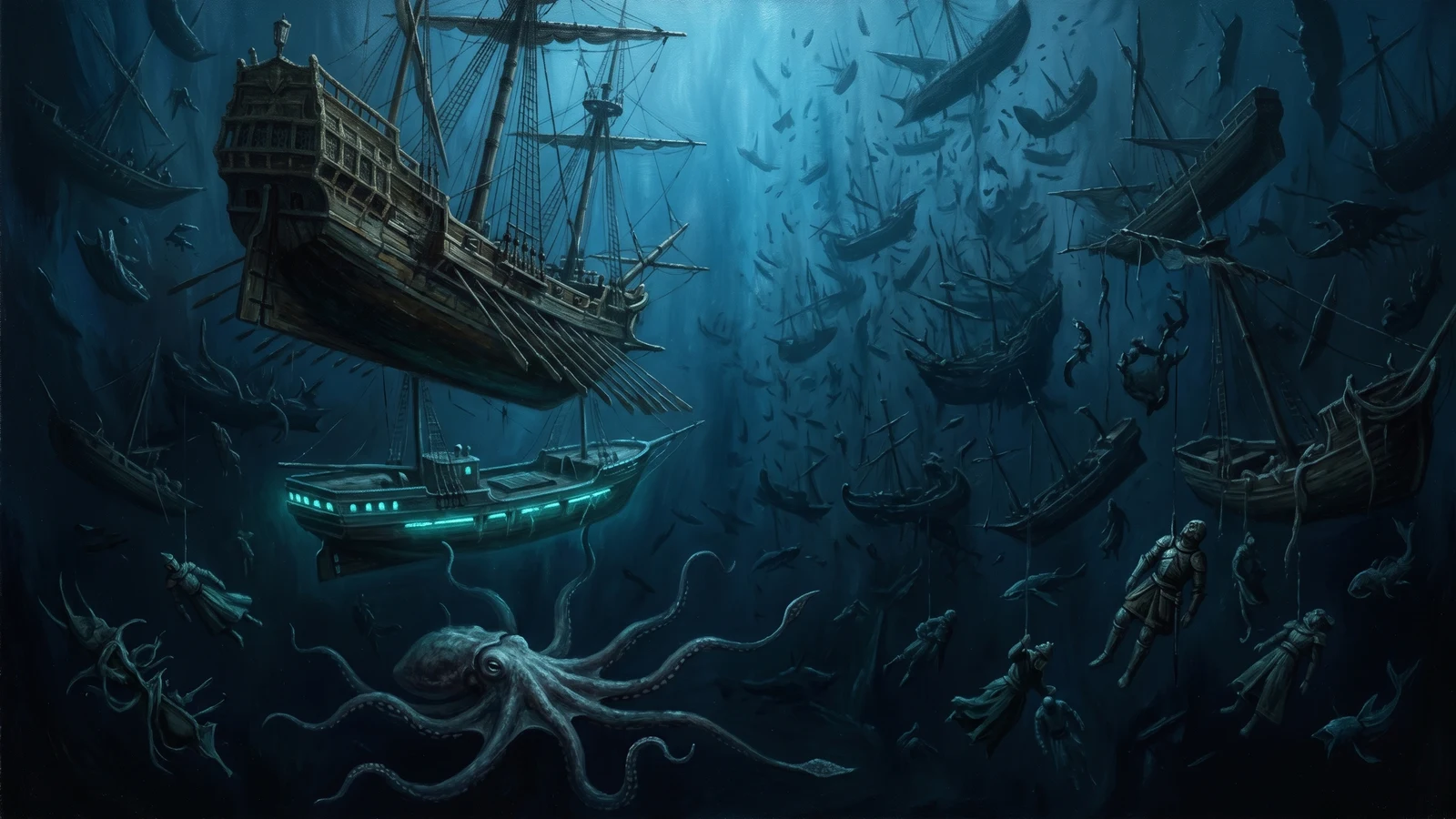
Slumber Deep is an abyssal trench approximately forty miles off the eastern coast of Phirexes, where the seafloor drops sharply into darkness. The trench plunges over three miles below sea level—far deeper than the surrounding ocean floor—and is the site of a Force and Water leyline intersection that produces one of the most unusual phenomena in Alarian waters.
Nothing moves in Slumber Deep.
The Stasis Effect
Where the Dynus (Force) and Pelus (Water) leylines cross, their energies reach a state of perfect opposition. Force presses inward with crushing intensity while Water resists outward with equal pressure. The result is equilibrium so complete that motion itself becomes impossible within the intersection's sphere of influence.
Objects that drift into the stasis zone stop. Not slowly—instantly. Currents terminate at the boundary. Fish that swim too deep hang suspended, gills frozen mid-flutter. Ships that sink toward the trench floor never reach it. They hang in the black water at whatever depth the stasis caught them, perfectly preserved, crews still at their posts.
The stasis is not death. Creatures caught in it do not age, do not decay, do not require food or air. But they cannot move, cannot speak, cannot close their eyes. Sailors trapped in the Deep have been conscious for centuries, watching the darkness, waiting for rescue that cannot reach them.
The zone of absolute stasis occupies roughly a quarter-mile sphere at the leyline intersection's heart. But the effect weakens gradually rather than ending cleanly. The outer regions—called the Drowse by those few who study such things—slow movement to a fraction of normal speed. A swimmer might take an hour to move their arm. Currents crawl. Light propagates sluggishly, creating visual distortions where fast-moving objects appear to stretch and smear.
The Suspended Graveyard
Over millennia, Slumber Deep has accumulated a vertical forest of the lost.
Ships hang at every depth, their positions marking the moment they crossed into stasis. A Chimeyan war galley lists forty degrees to port, its ballista still aimed at an enemy no longer present. A Kendor exploration vessel rests perfectly level, its bioluminescent running lights still glowing after three thousand years. Dozens of smaller craft—fishing boats, smuggler skiffs, vessels that simply drifted too far—cluster near the outer boundary where the Drowse begins.
Between and below the ships float the bodies. Not corpses—the stasis preserves them too completely for that. Sailors and passengers, some still reaching toward the surface, some curled in upon themselves, some with expressions of confusion that never had time to become fear. Sea creatures too: whales frozen mid-dive, schools of fish suspended in perfect formation, a kraken that ventured too deep and hangs now with tentacles splayed like a grotesque star.
The deepest objects are the oldest. Near the trench floor, the preserved remains of creatures that no longer exist anywhere else drift in eternal stillness—species that went extinct before humans walked Alaria, caught at the moment of their death and held there ever since.
The Crushing Approaches
The stasis zone is dangerous, but it is not the only threat. The outer reaches of Slumber Deep, beyond the Drowse, experience the raw pressure of the Force leyline without Water's counterbalancing resistance.
These regions—the Crushing Approaches—are zones of impossible pressure where the water itself becomes a weapon. Unprotected vessels implode. Bodies are compressed to a fraction of their original size. Sound becomes so intense that it causes physical damage. Some sections of the Approaches contain pressure differentials so extreme that moving from one area to another tears objects apart.
The pressure zones are not consistent. The Force leyline pulses, and the Approaches pulse with it—areas that were merely dangerous become instantly lethal, while lethally compressed zones briefly relax to survivability. Experienced navigators claim to sense a rhythm to the pulses, but no one has successfully charted a reliable safe passage.
Who Knows About Slumber Deep
Surface civilizations have fragmentary knowledge of the trench. Phirexes fishermen know to avoid the deep waters east of the swamp. Kendor records mention the Drowse as a forbidden zone, though even their underwater cities maintain no permanent presence nearby. Scholars who study leyline theory recognize that a Force/Water intersection should exist somewhere in the Sea of Seven Snakes, but most believe it lies much farther from shore.
The Chimeyan navy lost a squadron to Slumber Deep during the War of Jade Crowns and has classified all information about the trench. Their admiralty charts show the area as "unsurveyable—extreme currents" and recommend a wide detour. They do not mention the stasis, the fortress, or the lich.
Mirsalyenar prefers this arrangement. He does not seek surface contact, does not raid shipping, does not threaten coastal settlements. Whatever he is doing in Aphoryis, he does it quietly. Some scholars believe he is studying the leyline intersection itself, attempting to understand how two opposing forces can create perfect stillness. Others suspect he is trying to expand the stasis zone—to preserve something larger, or perhaps everything.
The truth may be simpler and more disturbing: he may simply be waiting. In a place where time has no meaning, patience costs nothing.